
A Single-Phase Integrated Onboard Charger for Plug-In Dual-Motor EVs
IF 5.7
2区 工程技术
Q1 ENGINEERING, ELECTRICAL & ELECTRONIC
IEEE Journal of Emerging and Selected Topics in Power Electronics
Pub Date : 2026-10-01
Epub Date: 2026-04-27
DOI:10.1109/JESTPE.2026.3688075
引用次数: 0
Abstract
This article presents a simple integrated onboard charger (OBC) for electric vehicles (EVs) with a two-motor propulsion system, especially used in all-wheel drive (AWD). In order to ensure seamless integration of the charging system, the proposed charger does not use any additional components but reuses the two three-phase inverters that drive the two distinct permanent magnet synchronous motors (PMSMs) to charge the EV battery. The first inverter is reconfigured into an active rectifier that ensures a unity power factor is drawn from the grid, and a stable DC-link voltage is obtained. The second inverter is reconfigured into a DC–DC converter to control the output voltage and current for charging the battery. There are no additional elements present; hence, this innovation not only reduces the cost of EVs but also reduces the overall weight. The charger utilizes the motor windings as grid harmonic filters that ensure a total harmonic distortion (THD) below 5%. A simple proportional–integral (PI) and proportional–resonant (PR) control is implemented to achieve these objectives. Furthermore, the motors do not generate torque while charging, making it a suitable solution for AWD EVs. Simulation and experimental results are provided for a 1-kW prototype to evaluate the performance of the proposed charger using a 110-Vrms, 60-Hz supply with an output voltage of 48 V.用于插电式双电机电动汽车的单相集成车载充电器
本文介绍了一种简单的集成车载充电器(OBC),用于双电机推进系统的电动汽车(ev),特别是用于全轮驱动(AWD)。为了确保充电系统的无缝集成,拟议的充电器不使用任何额外的组件,而是重复使用驱动两个不同的永磁同步电机(pmms)的两个三相逆变器来为电动汽车电池充电。第一个逆变器被重新配置为一个有源整流器,以确保从电网中获得统一的功率因数,并获得稳定的直流链路电压。第二个逆变器被重新配置为DC-DC转换器,以控制为电池充电的输出电压和电流。没有额外的元素存在;因此,这一创新不仅降低了电动汽车的成本,而且降低了整体重量。充电器利用电机绕组作为电网谐波滤波器,确保总谐波失真(THD)低于5%。为了实现这些目标,采用了简单的比例积分(PI)和比例谐振(PR)控制。此外,电动机在充电时不会产生扭矩,因此适合全驱电动汽车。仿真和实验结果提供了一个1千瓦的原型,以评估所提出的充电器的性能,使用110-Vrms, 60 hz电源,输出电压为48 V。
本文章由计算机程序翻译,如有差异,请以英文原文为准。
求助全文
约1分钟内获得全文
求助全文
来源期刊
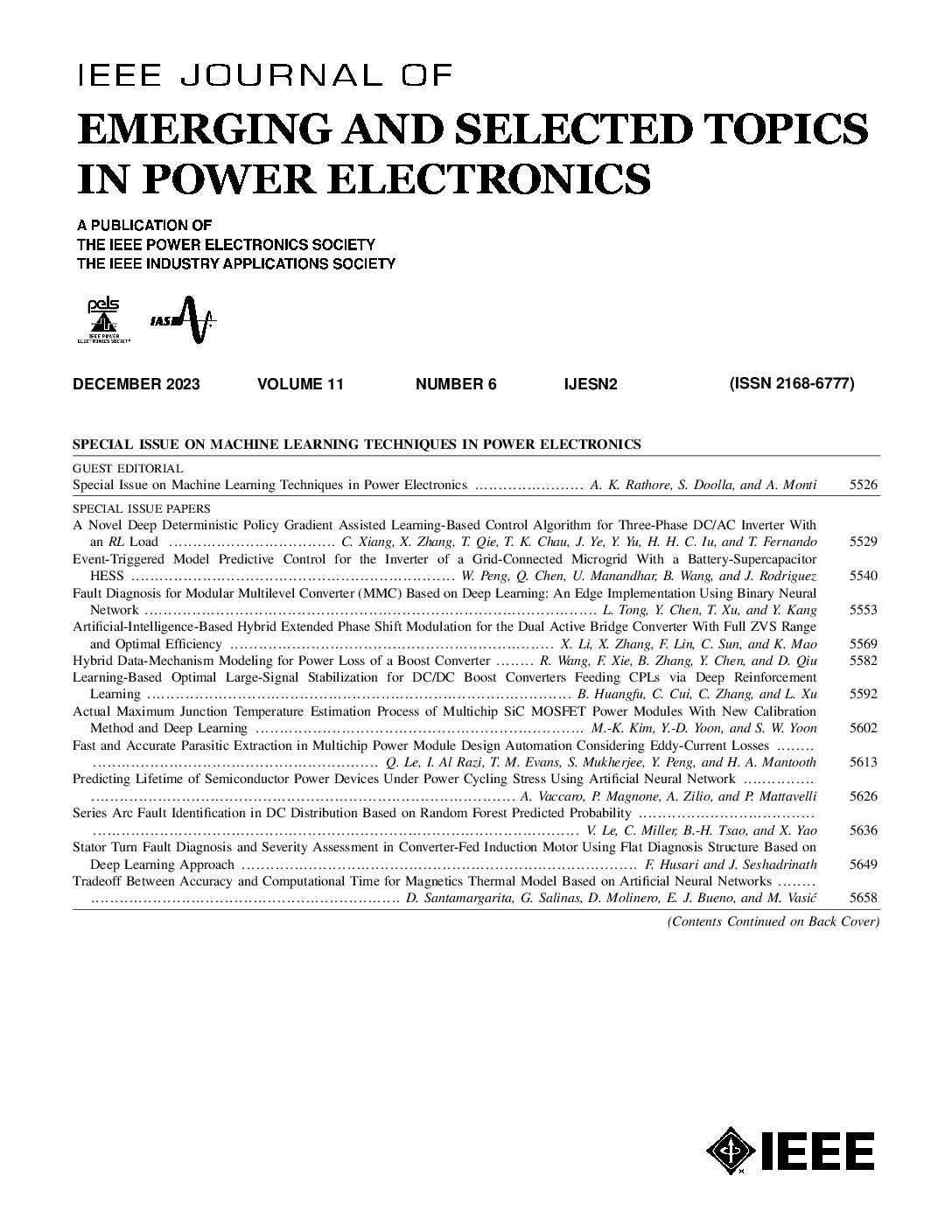
IEEE Journal of Emerging and Selected Topics in Power Electronics
ENGINEERING, ELECTRICAL & ELECTRONIC-
CiteScore
12.50
自引率
9.10%
发文量
547
审稿时长
3 months
期刊介绍:
The aim of the journal is to enable the power electronics community to address the emerging and selected topics in power electronics in an agile fashion. It is a forum where multidisciplinary and discriminating technologies and applications are discussed by and for both practitioners and researchers on timely topics in power electronics from components to systems.
 求助内容:
 应助结果提醒方式:


 京公网安备 11010802042870号


