{"title":"Pore Structure of Carbonized Lignite Modified by Ferric Nitrate","authors":"I. Yu. Zykov, N. I. Federova","doi":"10.3103/S1068364X26600077","DOIUrl":null,"url":null,"abstract":"<p>The influence of added ferric nitrate on the pore structure of carbonized lignite is studied. The ferric nitrate Fe(NO<sub>3</sub>)<sub>3</sub> is added by steeping in terms of the moisture capacity, with the following ratios of the anhydrous salt and the carbonizate: 0.20, 0.25, 0.33, and 0.50 g/g. (The ferric nitrate is first dissolved in dilute nitric acid solution.) The texture of the modified carbonizates is studied by analysis of the N<sub>2</sub> adsorption–desorption isotherms at 77 K (–195.97°C) on an ASAP-2020 system. The addition of ferric nitrate is found to produce carbon materials with higher specific surface and pore volume. The greatest increment in specific surface (by 30%) and pore volume (by 40%) is observed in samples with ratios of 0.20 and 0.25 g/g. With increase in the added ferric nitrate, the proportion of mesopores increases; it is greatest (54.6%) for the sample with a ratio of 0.50 g/g. According to energy-dispersive X-ray spectroscopy (EDX) and X-ray powder diffraction, the addition of ferric nitrate results in the formation of small magnetic Fe, γ-Fe<sub>2</sub>O<sub>3</sub>, and Fe<sub>3</sub>O<sub>4</sub> particles on the surface of the carbon materials. Consequently, those materials may be retained by means of the field created by neodymium permanent magnets.</p>","PeriodicalId":519,"journal":{"name":"Coke and Chemistry","volume":"69 1","pages":"30 - 34"},"PeriodicalIF":0.5000,"publicationDate":"2026-04-27","publicationTypes":"Journal Article","fieldsOfStudy":null,"isOpenAccess":false,"openAccessPdf":"","citationCount":"0","resultStr":null,"platform":"Semanticscholar","paperid":null,"PeriodicalName":"Coke and Chemistry","FirstCategoryId":"1085","ListUrlMain":"https://link.springer.com/article/10.3103/S1068364X26600077","RegionNum":0,"RegionCategory":null,"ArticlePicture":[],"TitleCN":null,"AbstractTextCN":null,"PMCID":null,"EPubDate":"","PubModel":"","JCR":"Q4","JCRName":"ENGINEERING, CHEMICAL","Score":null,"Total":0}
引用次数: 0
Abstract
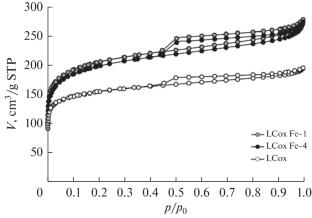
The influence of added ferric nitrate on the pore structure of carbonized lignite is studied. The ferric nitrate Fe(NO3)3 is added by steeping in terms of the moisture capacity, with the following ratios of the anhydrous salt and the carbonizate: 0.20, 0.25, 0.33, and 0.50 g/g. (The ferric nitrate is first dissolved in dilute nitric acid solution.) The texture of the modified carbonizates is studied by analysis of the N2 adsorption–desorption isotherms at 77 K (–195.97°C) on an ASAP-2020 system. The addition of ferric nitrate is found to produce carbon materials with higher specific surface and pore volume. The greatest increment in specific surface (by 30%) and pore volume (by 40%) is observed in samples with ratios of 0.20 and 0.25 g/g. With increase in the added ferric nitrate, the proportion of mesopores increases; it is greatest (54.6%) for the sample with a ratio of 0.50 g/g. According to energy-dispersive X-ray spectroscopy (EDX) and X-ray powder diffraction, the addition of ferric nitrate results in the formation of small magnetic Fe, γ-Fe2O3, and Fe3O4 particles on the surface of the carbon materials. Consequently, those materials may be retained by means of the field created by neodymium permanent magnets.
期刊介绍:
The journal publishes scientific developments and applications in the field of coal beneficiation and preparation for coking, coking processes, design of coking ovens and equipment, by-product recovery, automation of technological processes, ecology and economics. It also presents indispensable information on the scientific events devoted to thermal rectification, use of smokeless coal as an energy source, and manufacture of different liquid and solid chemical products.

 求助内容:
求助内容: 应助结果提醒方式:

 京公网安备 11010802042870号


