A. V. Kiryukhin, A. V. Sergeeva, A. G. Vakhromeev, M. A. Danilova, A. V. Gladyshkina, E. V. Kartasheva, M. A. Nazarova, A. A. Kuzmina, A. P. Gorokhov, A. S. Tsoy, V. V. Lukyanov
{"title":"Thermohydrodynamic Modeling of Well Operation of Chloride–Calcium Lithium-Bearing Brines","authors":"A. V. Kiryukhin, A. V. Sergeeva, A. G. Vakhromeev, M. A. Danilova, A. V. Gladyshkina, E. V. Kartasheva, M. A. Nazarova, A. A. Kuzmina, A. P. Gorokhov, A. S. Tsoy, V. V. Lukyanov","doi":"10.1134/S0742046326700053","DOIUrl":null,"url":null,"abstract":"<p>Highly concentrated Cl–Mg–Ca brines with a salinity of up to 700 g/L of the Siberian Platform contain economic concentrations of valuable strategically important elements (Li), but are challenged due to salt deposition in the wellbore. To solve this task, we used the TOUGH2 family software for modeling the multiphase non-isothermal geofiltration in a fractured-porous medium taking into account the chemical interaction of phases, which was supplemented by an EWASG-CACL2 state module for the description (density, viscosity, and enthalpy) of the CaCl<sub>2</sub> brine with a mass concentration ranging from 0.25 to the maximum saturation (>0.6) at temperatures of 0–50°C. The CaCl<sub>2</sub> brine was extracted by a single production well with a submersible pump from the target reservoir in TOUGH2-EWASG-CACL2 modeling. The filtration-capacity and thermophysical parameters, as well as the geometry of the target reservoir and the well, were given as synthetic in a range of possible change according to geological exploration data in the south of the Siberian Platform. A potential transition mechanism of the well to stable operation mode is identified as a result of the production well modeling. The first operation stage exhibits a simultaneous growth (up to 86%, antarcticite, CaCl<sub>2</sub>⋅6H<sub>2</sub>O) and warming (from 6 to 19°C) of the wellhead and the next stage is characterized by fast dissolution of the first stage salt plug and transition to stable operation mode due to self-heating and a temperature increase. The resource potential for ensuring production is shown as a result of modeling of inflows from the target reservoir regardless of hydrodynamic conditions at the outer boundary of the target reservoir. The geological processes, which could lead to the formation of highly concentrated brines and the role of volcanism in their formation, are considered.</p>","PeriodicalId":56112,"journal":{"name":"Journal of Volcanology and Seismology","volume":"20 2","pages":"175 - 189"},"PeriodicalIF":0.9000,"publicationDate":"2026-04-24","publicationTypes":"Journal Article","fieldsOfStudy":null,"isOpenAccess":false,"openAccessPdf":"","citationCount":"0","resultStr":null,"platform":"Semanticscholar","paperid":null,"PeriodicalName":"Journal of Volcanology and Seismology","FirstCategoryId":"89","ListUrlMain":"https://link.springer.com/article/10.1134/S0742046326700053","RegionNum":4,"RegionCategory":"地球科学","ArticlePicture":[],"TitleCN":null,"AbstractTextCN":null,"PMCID":null,"EPubDate":"","PubModel":"","JCR":"Q4","JCRName":"GEOCHEMISTRY & GEOPHYSICS","Score":null,"Total":0}
引用次数: 0
Abstract
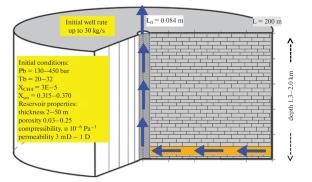
Highly concentrated Cl–Mg–Ca brines with a salinity of up to 700 g/L of the Siberian Platform contain economic concentrations of valuable strategically important elements (Li), but are challenged due to salt deposition in the wellbore. To solve this task, we used the TOUGH2 family software for modeling the multiphase non-isothermal geofiltration in a fractured-porous medium taking into account the chemical interaction of phases, which was supplemented by an EWASG-CACL2 state module for the description (density, viscosity, and enthalpy) of the CaCl2 brine with a mass concentration ranging from 0.25 to the maximum saturation (>0.6) at temperatures of 0–50°C. The CaCl2 brine was extracted by a single production well with a submersible pump from the target reservoir in TOUGH2-EWASG-CACL2 modeling. The filtration-capacity and thermophysical parameters, as well as the geometry of the target reservoir and the well, were given as synthetic in a range of possible change according to geological exploration data in the south of the Siberian Platform. A potential transition mechanism of the well to stable operation mode is identified as a result of the production well modeling. The first operation stage exhibits a simultaneous growth (up to 86%, antarcticite, CaCl2⋅6H2O) and warming (from 6 to 19°C) of the wellhead and the next stage is characterized by fast dissolution of the first stage salt plug and transition to stable operation mode due to self-heating and a temperature increase. The resource potential for ensuring production is shown as a result of modeling of inflows from the target reservoir regardless of hydrodynamic conditions at the outer boundary of the target reservoir. The geological processes, which could lead to the formation of highly concentrated brines and the role of volcanism in their formation, are considered.
期刊介绍:
Journal of Volcanology and Seismology publishes theoretical and experimental studies, communications, and reports on volcanic, seismic, geodynamic, and magmatic processes occurring in the areas of island arcs and other active regions of the Earth. In particular, the journal looks at present-day land and submarine volcanic activity; Neogene–Quaternary volcanism; mechanisms of plutonic activity; the geochemistry of volcanic and postvolcanic processes; geothermal systems in volcanic regions; and seismological monitoring. In addition, the journal surveys earthquakes, volcanic eruptions, and techniques for predicting them.

 求助内容:
求助内容: 应助结果提醒方式:

 京公网安备 11010802042870号


