
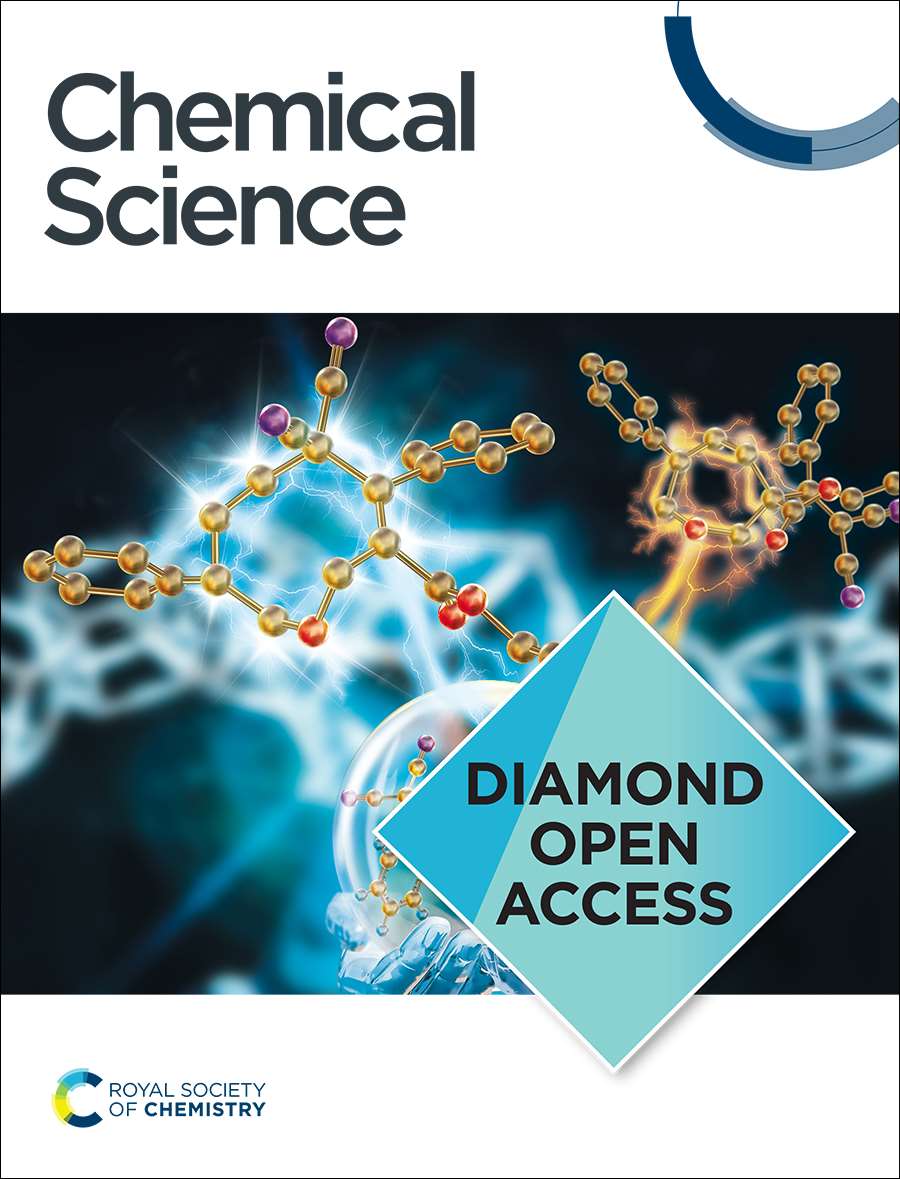
White-light powered autonomous molecular ratchet drives PdII capsules out of equilibrium
IF 7.4
1区 化学
Q1 CHEMISTRY, MULTIDISCIPLINARY
引用次数: 0
Abstract
Using an energy source to drive chemical reactions away from equilibrium is essential for life and remains a significant challenge in designing artificial out-of-equilibrium nanosystems and molecular machines. Achieving autonomous operation of such systems, as observed in nature, presents an even greater difficulty. Here, we report PdII-mediated coordination capsules based on ligand 1 embedding an azobispyrazole photoswitch. The more thermodynamically stable Ephotoisomer forms an equilibrium mixture of a PdII3(E-1)6 double-walled triangle and a PdII2(E-1)4 lantern in a 78:22 ratio. UV-light irradiation transforms both structures into a PdII2(Z-1)4 lantern, which then reverts solely to the out-of-equilibrium PdII2(E-1)4 lantern when exposed to visible light. The complete photoisomerisation proceeds through an information ratchet mechanism that can operate autonomously under continuous white light or sunlight exposure, selectively accumulating the out-of-equilibrium PdII2(E-1)4 structure. This work demonstrates how autonomous, light-driven processes can be harnessed to direct non-equilibrium behaviour in complex coordination assemblies.白光驱动的自主分子棘轮驱动PdII胶囊脱离平衡
利用能源驱动化学反应脱离平衡状态对生命至关重要,这也是设计人工非平衡纳米系统和分子机器的重大挑战。在自然界中,要实现这样的系统的自主操作,难度就更大了。在这里,我们报道了基于配体1包埋偶氮双吡唑光开关的pdii介导的配位胶囊。热力学更稳定的光异构体形成PdII3(E-1)6双壁三角形和PdII2(E-1)4灯的平衡混合物,比例为78:22。紫外线照射将这两个结构转化为PdII2(Z-1)4灯,当暴露在可见光下时,它又完全恢复为不平衡的PdII2(E-1)4灯。完整的光异构化通过信息棘轮机制进行,该机制可以在连续的白光或阳光照射下自主操作,选择性地积累不平衡的PdII2(E-1)4结构。这项工作展示了如何利用自主的、光驱动的过程来指导复杂协调装配中的非平衡行为。
本文章由计算机程序翻译,如有差异,请以英文原文为准。
求助全文
约1分钟内获得全文
求助全文
来源期刊
Chemical Science
CHEMISTRY, MULTIDISCIPLINARY-
CiteScore
14.40
自引率
4.80%
发文量
1352
审稿时长
2.1 months
期刊介绍:
Chemical Science is a journal that encompasses various disciplines within the chemical sciences. Its scope includes publishing ground-breaking research with significant implications for its respective field, as well as appealing to a wider audience in related areas. To be considered for publication, articles must showcase innovative and original advances in their field of study and be presented in a manner that is understandable to scientists from diverse backgrounds. However, the journal generally does not publish highly specialized research.
 求助内容:
求助内容: 应助结果提醒方式:

 京公网安备 11010802042870号


