
Artificial intelligence for drug delivery: Yesterday, today and tomorrow
IF 14.6
1区 医学
Q1 PHARMACOLOGY & PHARMACY
Acta Pharmaceutica Sinica. B
Pub Date : 2026-04-01
Epub Date: 2025-09-17
DOI:10.1016/j.apsb.2025.09.022
引用次数: 0
Abstract
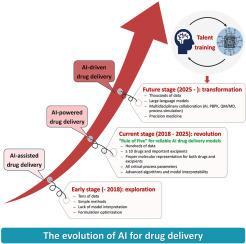
The global pharmaceutical drug delivery market is forecasted to grow to USD 2546.0 billion by 2029. The expanding pharmaceutical market urgently needs a more efficient drug research and development paradigm. Artificial intelligence (AI) is revolutionizing drug delivery by offering alternatives to traditional trial-and-error experimental approaches. This review systematically traces the technological evolution from early simple models to current advanced AI algorithms in various applications, ranging from formulation optimization to the prediction of critical formulation parameters and de novo material design. To enhance the reliability of AI applications in drug delivery, we present comprehensive guidelines and “Rule of Five” (Ro5) principles to systematically direct researchers in utilizing AI in formulation development. This “Ro5” includes the following criteria: a formulation dataset containing at least 500 entries, coverage of a minimum of 10 drugs and all significant excipients, appropriate molecular representations for both drugs and excipients, inclusion of all critical process parameters, and utilization of suitable algorithms and model interpretability. The review concludes with insights into emerging trends and future directions, including the utilization of large language models, multidisciplinary collaboration opportunities, talent development, and culture transformation, aimed at facilitating a paradigm shift toward AI-driven drug formulation development.
人工智能给药:昨天、今天和明天
到2029年,全球药物输送市场预计将增长到25460亿美元。不断扩大的医药市场迫切需要一种更有效的药物研发模式。人工智能(AI)通过提供传统试错实验方法的替代方案,正在彻底改变给药方式。本综述系统地追溯了从早期的简单模型到目前各种应用中的先进人工智能算法的技术演变,从配方优化到关键配方参数的预测和从头开始的材料设计。为了提高人工智能在给药领域应用的可靠性,我们提出了全面的指南和“五原则”(Ro5)原则,以系统地指导研究人员在配方开发中利用人工智能。该“Ro5”包括以下标准:包含至少500个条目的配方数据集,覆盖至少10种药物和所有重要辅料,药物和辅料的适当分子表示,包括所有关键工艺参数,以及使用合适的算法和模型可解释性。该综述总结了对新兴趋势和未来方向的见解,包括大型语言模型的利用、多学科合作机会、人才发展和文化转型,旨在促进向人工智能驱动的药物配方开发的范式转变。
本文章由计算机程序翻译,如有差异,请以英文原文为准。
求助全文
约1分钟内获得全文
求助全文
来源期刊
Acta Pharmaceutica Sinica. B
Pharmacology, Toxicology and Pharmaceutics-General Pharmacology, Toxicology and Pharmaceutics
CiteScore
22.40
自引率
5.50%
发文量
1051
审稿时长
19 weeks
期刊介绍:
The Journal of the Institute of Materia Medica, Chinese Academy of Medical Sciences, and the Chinese Pharmaceutical Association oversees the peer review process for Acta Pharmaceutica Sinica. B (APSB).
Published monthly in English, APSB is dedicated to disseminating significant original research articles, rapid communications, and high-quality reviews that highlight recent advances across various pharmaceutical sciences domains. These encompass pharmacology, pharmaceutics, medicinal chemistry, natural products, pharmacognosy, pharmaceutical analysis, and pharmacokinetics.
A part of the Acta Pharmaceutica Sinica series, established in 1953 and indexed in prominent databases like Chemical Abstracts, Index Medicus, SciFinder Scholar, Biological Abstracts, International Pharmaceutical Abstracts, Cambridge Scientific Abstracts, and Current Bibliography on Science and Technology, APSB is sponsored by the Institute of Materia Medica, Chinese Academy of Medical Sciences, and the Chinese Pharmaceutical Association. Its production and hosting are facilitated by Elsevier B.V. This collaborative effort ensures APSB's commitment to delivering valuable contributions to the pharmaceutical sciences community.
 求助内容:
求助内容: 应助结果提醒方式:

 京公网安备 11010802042870号


