Bandgap engineering and edge-state delocalization in Si-substituted zigzag graphene nanoribbons for multilayer p–n junction solar cells: a theoretical investigation
Ramesh Mamindla, Srijita Chakraborty and Manish K. Niranjan
{"title":"Bandgap engineering and edge-state delocalization in Si-substituted zigzag graphene nanoribbons for multilayer p–n junction solar cells: a theoretical investigation","authors":"Ramesh Mamindla, Srijita Chakraborty and Manish K. Niranjan","doi":"10.1039/D5CP04280A","DOIUrl":null,"url":null,"abstract":"<p >Graphene and silicon are among the most promising candidates for nanotechnological applications owing to their exceptional electronic and structural properties. In this study, we investigate the integration of silicon (Si) with zigzag-edge graphene nanoribbons (ZGNRs) for potential solar cell applications. Using the density functional theory (DFT) framework combined with the non-equilibrium Green's function (NEGF) approach, we explore the electronic and photovoltaic characteristics of Si-substituted ZGNR p–n multilayer junction devices under varying substitution concentrations. The localized charge density associated with the edge states of pristine ZGNR results in distinctive electronic behaviour. However, our results suggest that upon Si incorporation, these charges become partially delocalized through the formation of Si–C bonds, leading to a transition of ZGNRs from metallic to semiconducting. This electronic transformation has a notable influence on light absorption, photocurrent generation, and overall photovoltaic performance. A Si-substituted ZGNR p–n multilayer solar cell device is subsequently designed, where the bandgap of each atomic layer is tuned by optimized silicon substituted concentrations. The device exhibits a monotonic increase in photocurrent with photon energy, a consequence of improved light absorption efficiency. While pristine ZGNRs are not inherently active photovoltaic materials, our findings demonstrate that silicon substitution substantially enhances their electronic and photovoltaic properties.</p>","PeriodicalId":99,"journal":{"name":"Physical Chemistry Chemical Physics","volume":" 17","pages":" 10818-10824"},"PeriodicalIF":3.0000,"publicationDate":"2026-04-17","publicationTypes":"Journal Article","fieldsOfStudy":null,"isOpenAccess":false,"openAccessPdf":"","citationCount":"0","resultStr":null,"platform":"Semanticscholar","paperid":null,"PeriodicalName":"Physical Chemistry Chemical Physics","FirstCategoryId":"92","ListUrlMain":"https://pubs.rsc.org/en/content/articlelanding/2026/cp/d5cp04280a","RegionNum":3,"RegionCategory":"化学","ArticlePicture":[],"TitleCN":null,"AbstractTextCN":null,"PMCID":null,"EPubDate":"","PubModel":"","JCR":"Q3","JCRName":"CHEMISTRY, PHYSICAL","Score":null,"Total":0}
引用次数: 0
Abstract
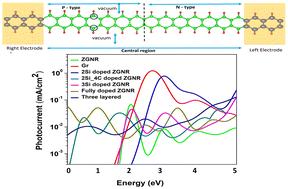
Graphene and silicon are among the most promising candidates for nanotechnological applications owing to their exceptional electronic and structural properties. In this study, we investigate the integration of silicon (Si) with zigzag-edge graphene nanoribbons (ZGNRs) for potential solar cell applications. Using the density functional theory (DFT) framework combined with the non-equilibrium Green's function (NEGF) approach, we explore the electronic and photovoltaic characteristics of Si-substituted ZGNR p–n multilayer junction devices under varying substitution concentrations. The localized charge density associated with the edge states of pristine ZGNR results in distinctive electronic behaviour. However, our results suggest that upon Si incorporation, these charges become partially delocalized through the formation of Si–C bonds, leading to a transition of ZGNRs from metallic to semiconducting. This electronic transformation has a notable influence on light absorption, photocurrent generation, and overall photovoltaic performance. A Si-substituted ZGNR p–n multilayer solar cell device is subsequently designed, where the bandgap of each atomic layer is tuned by optimized silicon substituted concentrations. The device exhibits a monotonic increase in photocurrent with photon energy, a consequence of improved light absorption efficiency. While pristine ZGNRs are not inherently active photovoltaic materials, our findings demonstrate that silicon substitution substantially enhances their electronic and photovoltaic properties.
期刊介绍:
Physical Chemistry Chemical Physics (PCCP) is an international journal co-owned by 19 physical chemistry and physics societies from around the world. This journal publishes original, cutting-edge research in physical chemistry, chemical physics and biophysical chemistry. To be suitable for publication in PCCP, articles must include significant innovation and/or insight into physical chemistry; this is the most important criterion that reviewers and Editors will judge against when evaluating submissions.
The journal has a broad scope and welcomes contributions spanning experiment, theory, computation and data science. Topical coverage includes spectroscopy, dynamics, kinetics, statistical mechanics, thermodynamics, electrochemistry, catalysis, surface science, quantum mechanics, quantum computing and machine learning. Interdisciplinary research areas such as polymers and soft matter, materials, nanoscience, energy, surfaces/interfaces, and biophysical chemistry are welcomed if they demonstrate significant innovation and/or insight into physical chemistry. Joined experimental/theoretical studies are particularly appreciated when complementary and based on up-to-date approaches.


 求助内容:
求助内容: 应助结果提醒方式:

 京公网安备 11010802042870号


