
Hybrid GNN-Centric Architectures for AI-Native 6G Wireless Networks: A Comprehensive Survey
IF 50.6
1区 计算机科学
Q1 COMPUTER SCIENCE, INFORMATION SYSTEMS
IEEE Communications Surveys and Tutorials
Pub Date : 2026-01-01
Epub Date: 2026-04-06
DOI:10.1109/COMST.2026.3681198
引用次数: 0
Abstract
The growing complexity, scale, and heterogeneity of 6G wireless systems call for a shift toward AI-native architectures that are not only data-driven but also topology-aware, adaptive, and distributed. Graph Neural Networks (GNNs), with their native support for graph-structured data, are well-suited for modeling the irregular and dynamic relationships inherent in wireless communication systems. However, standalone GNNs may be insufficient to address key 6G challenges such as continual learning, data scarcity, and dynamic adaptation. This survey, therefore, explores the emerging synergy between GNNs and complementary AI paradigms, including deep reinforcement learning (DRL), federated learning (FL), meta-learning, generative models, mixture-of-experts (MoE), and world models, enabling hybrid AI–GNN architectures for intelligent control, predictive adaptation, and scalable optimization across the wireless stack. We systematically review how these GNN-centric AI models can support intelligent functionality in next-generation network architectures such as O-RAN, as well as core 6G domains, including edge computing for wireless systems, advanced MIMO, traffic prediction, and digital twins. The survey also highlights key challenges in hybrid AI–GNN adoption, particularly scalability, generalization across dynamic topologies, interpretability, and symbolic reasoning, and discusses emerging strategies such as graph causality learning, dynamic GNNs, and neurosymbolic integration to address them. By consolidating recent advances and outlining open research directions, this work positions hybrid AI–GNN architectures as a promising approach toward enabling intelligent, energy-efficient, and context-aware wireless systems for 6G and beyond.AI-Native 6G无线网络的以gnn为中心的混合架构:综合调查
6G无线系统日益增长的复杂性、规模和异构性要求向人工智能原生架构转变,这些架构不仅是数据驱动的,而且是拓扑感知、自适应和分布式的。图神经网络(gnn)具有对图结构数据的原生支持,非常适合对无线通信系统中固有的不规则和动态关系进行建模。然而,独立的gnn可能不足以解决关键的6G挑战,如持续学习、数据稀缺和动态适应。因此,本调查探讨了gnn和互补AI范例之间的新兴协同作用,包括深度强化学习(DRL)、联邦学习(FL)、元学习、生成模型、专家混合(MoE)和世界模型,使混合AI - gnn架构能够在无线堆栈中实现智能控制、预测适应和可扩展优化。我们系统地回顾了这些以gnn为中心的人工智能模型如何支持下一代网络架构(如O-RAN)以及核心6G域的智能功能,包括无线系统的边缘计算、高级MIMO、流量预测和数字孪生。该调查还强调了混合AI-GNN采用中的关键挑战,特别是可扩展性、跨动态拓扑的泛化、可解释性和符号推理,并讨论了新兴策略,如图因果关系学习、动态gnn和神经符号集成来解决这些问题。通过整合最新进展并概述开放的研究方向,本工作将混合AI-GNN架构定位为实现6G及以后的智能、节能和环境感知无线系统的有前途的方法。
本文章由计算机程序翻译,如有差异,请以英文原文为准。
求助全文
约1分钟内获得全文
求助全文
来源期刊
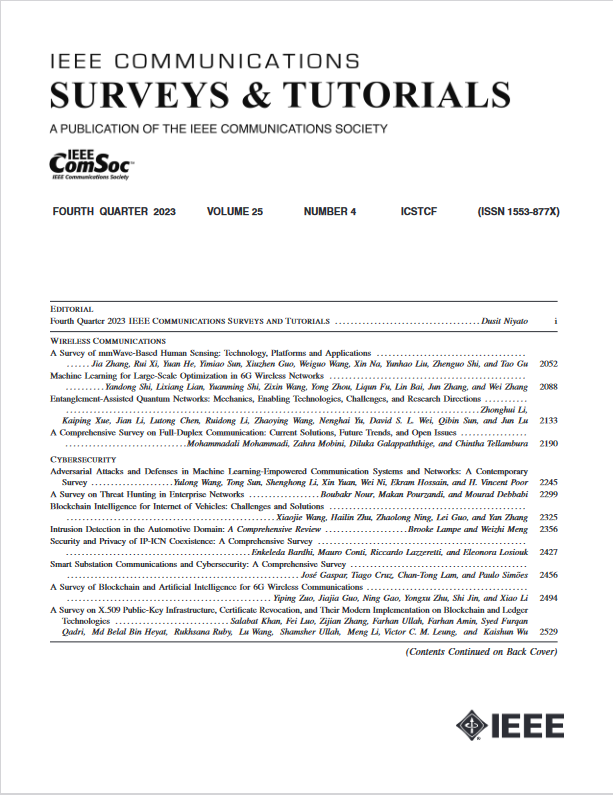
IEEE Communications Surveys and Tutorials
COMPUTER SCIENCE, INFORMATION SYSTEMS-TELECOMMUNICATIONS
CiteScore
80.20
自引率
2.50%
发文量
84
审稿时长
6 months
期刊介绍:
IEEE Communications Surveys & Tutorials is an online journal published by the IEEE Communications Society for tutorials and surveys covering all aspects of the communications field. Telecommunications technology is progressing at a rapid pace, and the IEEE Communications Society is committed to providing researchers and other professionals the information and tools to stay abreast. IEEE Communications Surveys and Tutorials focuses on integrating and adding understanding to the existing literature on communications, putting results in context. Whether searching for in-depth information about a familiar area or an introduction into a new area, IEEE Communications Surveys & Tutorials aims to be the premier source of peer-reviewed, comprehensive tutorials and surveys, and pointers to further sources. IEEE Communications Surveys & Tutorials publishes only articles exclusively written for IEEE Communications Surveys & Tutorials and go through a rigorous review process before their publication in the quarterly issues.
A tutorial article in the IEEE Communications Surveys & Tutorials should be designed to help the reader to become familiar with and learn something specific about a chosen topic. In contrast, the term survey, as applied here, is defined to mean a survey of the literature. A survey article in IEEE Communications Surveys & Tutorials should provide a comprehensive review of developments in a selected area, covering its development from its inception to its current state and beyond, and illustrating its development through liberal citations from the literature. Both tutorials and surveys should be tutorial in nature and should be written in a style comprehensible to readers outside the specialty of the article.
 求助内容:
 应助结果提醒方式:


 京公网安备 11010802042870号


