
WTAP stabilized by USP7 contributes to enzalutamide resistance in prostate cancer via mediating AKT m6A-modification
IF 5
3区 医学
Q1 BIOTECHNOLOGY & APPLIED MICROBIOLOGY
引用次数: 0
Abstract
Castration-resistant prostate cancer (CRPC) is one of the most prevalent cancers in men. The new generation androgen receptor (AR) inhibitor enzalutamide can improve the therapeutic effectiveness of patients with CRPC. However, these patients eventually develop acquired enzalutamide resistance (ENZR), and the mechanisms underlying resistance are not well understood. Wilms’ tumor 1-associating protein (WTAP) plays an important role in m6A modification and has been reported as an oncogene in various cancers. Here, we utilized a tissue microarray and collected tissues from prostate cancer (PCa) patients to detect WTAP expression, and found that WTAP is upregulated in PCa. Meanwhile, WTAP overexpression promotes cell proliferation and accelerates tumor growth through colony formation assays and the establishment of a subcutaneous xenograft model in vivo. These findings establish the tumor promoter role of WTAP in prostatic tumorigenesis. Furthermore, we verified that WTAP is a novel responsive gene of AR via promoter activity and chromatin immunoprecipitation (ChIP) assays. Importantly, we uncovered that WTAP is upregulated in ENZR cells, and WTAP knockdown inhibited the proliferation of ENZR cells. Mechanistically, ubiquitin-specific protease (USP7) enhanced the stability of WTAP by the ubiquitin-proteasome pathway in ENZR cells, thereby WTAP increases promote AKT signaling through an m6A-mediated way, and an AKT inhibitor can abolish the pro-resistance phenotype mediated by WTAP. Together, these findings suggest that WTAP plays a key role in ENZR development of PCa cells, and WTAP may be a potential treatment target for ENZR tumors.
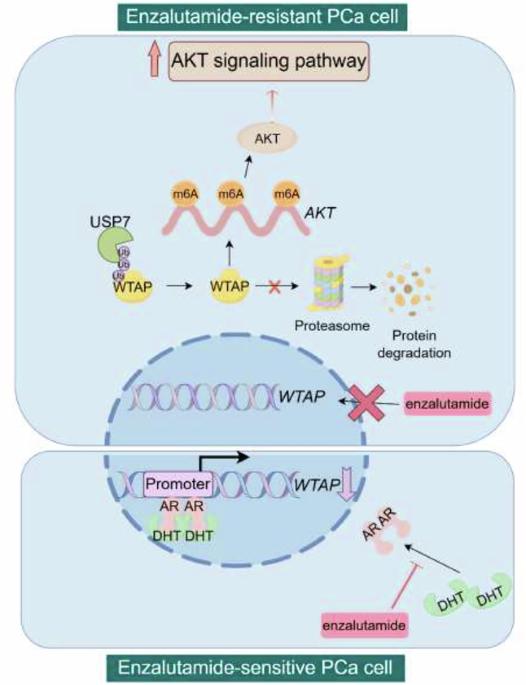
USP7稳定的WTAP通过介导AKT m6a修饰参与前列腺癌对恩杂鲁胺的耐药。
去势抵抗性前列腺癌(CRPC)是男性最常见的癌症之一。新一代雄激素受体(AR)抑制剂enzalutamide可提高CRPC患者的治疗效果。然而,这些患者最终会出现获得性enzalutamide耐药(ENZR),其耐药机制尚不清楚。Wilms肿瘤1相关蛋白(WTAP)在m6A修饰中起重要作用,已被报道为多种癌症的致癌基因。在此,我们利用组织芯片和收集前列腺癌(PCa)患者的组织来检测WTAP的表达,发现WTAP在PCa中上调。同时,通过集落形成实验和体内皮下异种移植物模型的建立,发现WTAP过表达可促进细胞增殖,加速肿瘤生长。这些发现证实了WTAP在前列腺肿瘤发生中的肿瘤促进作用。此外,我们通过启动子活性和染色质免疫沉淀(ChIP)试验验证了WTAP是一个新的AR应答基因。重要的是,我们发现WTAP在ENZR细胞中上调,并且WTAP的下调抑制了ENZR细胞的增殖。在机制上,泛素特异性蛋白酶(USP7)通过在ENZR细胞中泛素-蛋白酶体途径增强WTAP的稳定性,从而WTAP通过m6a介导的方式增加促进AKT信号传导,AKT抑制剂可以消除WTAP介导的促耐药表型。综上所述,这些发现表明WTAP在PCa细胞的ENZR发展中起着关键作用,WTAP可能是ENZR肿瘤的潜在治疗靶点。在这篇文章中,我们利用组织芯片和收集前列腺癌(PCa)患者的组织来检测WTAP的表达,发现WTAP在PCa中上调。同时,通过集落形成实验和体内皮下异种移植物模型的建立,发现WTAP过表达可促进细胞增殖,加速肿瘤生长。这些发现证实了WTAP在前列腺肿瘤发生中的肿瘤促进作用。此外,我们通过启动子活性和染色质免疫沉淀(ChIP)试验验证了WTAP是一个新的AR应答基因。重要的是,我们发现WTAP在ENZR细胞中上调,并且WTAP的下调抑制了ENZR细胞的增殖。在机制上,泛素特异性蛋白酶(USP7)通过在ENZR细胞中泛素-蛋白酶体途径增强WTAP的稳定性,从而WTAP通过m6a介导的方式增加促进AKT信号传导,AKT抑制剂可以消除WTAP介导的促耐药表型。综上所述,这些发现表明WTAP在PCa细胞的ENZR发展中起着关键作用,WTAP可能是ENZR肿瘤的潜在治疗靶点。
本文章由计算机程序翻译,如有差异,请以英文原文为准。
求助全文
约1分钟内获得全文
求助全文
来源期刊
Cancer gene therapy
医学-生物工程与应用微生物
CiteScore
10.20
自引率
0.00%
发文量
150
审稿时长
4-8 weeks
期刊介绍:
Cancer Gene Therapy is the essential gene and cellular therapy resource for cancer researchers and clinicians, keeping readers up to date with the latest developments in gene and cellular therapies for cancer. The journal publishes original laboratory and clinical research papers, case reports and review articles. Publication topics include RNAi approaches, drug resistance, hematopoietic progenitor cell gene transfer, cancer stem cells, cellular therapies, homologous recombination, ribozyme technology, antisense technology, tumor immunotherapy and tumor suppressors, translational research, cancer therapy, gene delivery systems (viral and non-viral), anti-gene therapy (antisense, siRNA & ribozymes), apoptosis; mechanisms and therapies, vaccine development, immunology and immunotherapy, DNA synthesis and repair.
Cancer Gene Therapy publishes the results of laboratory investigations, preclinical studies, and clinical trials in the field of gene transfer/gene therapy and cellular therapies as applied to cancer research. Types of articles published include original research articles; case reports; brief communications; review articles in the main fields of drug resistance/sensitivity, gene therapy, cellular therapy, tumor suppressor and anti-oncogene therapy, cytokine/tumor immunotherapy, etc.; industry perspectives; and letters to the editor.
 求助内容:
求助内容: 应助结果提醒方式:

 京公网安备 11010802042870号


