{"title":"Directional selection on single traits is the most prevalent mode of selection on floral traits in seven Primula species","authors":"Ni-Wen Zhang, Xu-Yu Duan, Yong-Peng Cha, Yun Wu","doi":"10.1007/s00035-026-00354-6","DOIUrl":null,"url":null,"abstract":"<div>\n \n <p>Most studies of natural selection acting on floral traits only quantify selection pressures within a single species. The lack of complete estimation of the three patterns of selection (directional, quadratic and correlational) in a large array of related species limits our understanding of which pattern of selection operates most commonly or exerts the strongest influence in this process. We quantified these three patterns of selection on three single traits (corolla size, corolla tube length and number of flowers) and all possible trait combinations across seven <i>Primula</i> species. The results indicated that directional selection for a greater number of flowers was detected for all seven <i>Primula</i> species, whereas selection for a shorter corolla tube length was detected only in <i>Primula alpicola</i>. By contrast, quadratic selection on number of flowers and correlational selection on the combination of corolla size and number of flowers and on the combination of corolla tube length and number of flowers was detected only in <i>P. florindae</i> and <i>P. cawdoriana</i>, respectively. These findings illustrate the contributions of different patterns of selection on floral traits and highlight that directional selection is more common and robust than quadratic or correlational selection on floral traits in these primrose species.</p>\n </div>","PeriodicalId":51238,"journal":{"name":"Alpine Botany","volume":"136 1","pages":"55 - 66"},"PeriodicalIF":2.3000,"publicationDate":"2026-03-17","publicationTypes":"Journal Article","fieldsOfStudy":null,"isOpenAccess":false,"openAccessPdf":"","citationCount":"0","resultStr":null,"platform":"Semanticscholar","paperid":null,"PeriodicalName":"Alpine Botany","FirstCategoryId":"99","ListUrlMain":"https://link.springer.com/article/10.1007/s00035-026-00354-6","RegionNum":3,"RegionCategory":"生物学","ArticlePicture":[],"TitleCN":null,"AbstractTextCN":null,"PMCID":null,"EPubDate":"","PubModel":"","JCR":"Q2","JCRName":"PLANT SCIENCES","Score":null,"Total":0}
引用次数: 0
Abstract
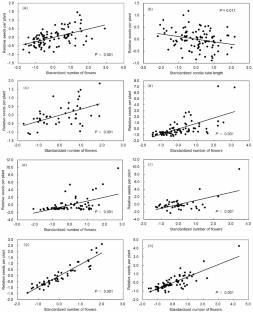
Most studies of natural selection acting on floral traits only quantify selection pressures within a single species. The lack of complete estimation of the three patterns of selection (directional, quadratic and correlational) in a large array of related species limits our understanding of which pattern of selection operates most commonly or exerts the strongest influence in this process. We quantified these three patterns of selection on three single traits (corolla size, corolla tube length and number of flowers) and all possible trait combinations across seven Primula species. The results indicated that directional selection for a greater number of flowers was detected for all seven Primula species, whereas selection for a shorter corolla tube length was detected only in Primula alpicola. By contrast, quadratic selection on number of flowers and correlational selection on the combination of corolla size and number of flowers and on the combination of corolla tube length and number of flowers was detected only in P. florindae and P. cawdoriana, respectively. These findings illustrate the contributions of different patterns of selection on floral traits and highlight that directional selection is more common and robust than quadratic or correlational selection on floral traits in these primrose species.
期刊介绍:
Alpine Botany is an international journal providing a forum for plant science studies at high elevation with links to fungal and microbial ecology, including vegetation and flora of mountain regions worldwide.