
Hybrid TD3-PI Control for Wireless Charging of Light Electric Vehicles
IF 5.7
2区 工程技术
Q1 ENGINEERING, ELECTRICAL & ELECTRONIC
IEEE Journal of Emerging and Selected Topics in Power Electronics
Pub Date : 2026-10-01
Epub Date: 2026-04-13
DOI:10.1109/JESTPE.2026.3683346
引用次数: 0
Abstract
This article proposes a deep reinforcement learning (DRL)-assisted adaptive control strategy for wireless power transfer (WPT) in light electric vehicle (LEV) charging. A phase-shifted full-bridge (PSFB) converter with series–series (S–S) compensation is considered, where the primary-side controller regulates the secondary charging current. Conventional proportional–integral (PI) control, tuned around nominal coupling, suffers performance degradation and even loss of convergence under coil misalignment and coupling variation. To address this, a twin delayed deep deterministic policy gradient (TD3) agent is used to adapt the PI gains online based on secondary-side feedback. The agent is trained in a Simulink environment and deployed in inference-only mode on a TI C2000 F28379D microcontroller, occupying approximately 25% of on-chip memory, demonstrating the feasibility of DRL-based adaptive control on resource-constrained embedded platforms. Experimental results show that the proposed TD3-assisted adaptive PI achieves constant-current (CC) regulation with significantly faster convergence compared to fixed-gain PI, settling time is reduced from 8.65 to 5.95 ms under aligned conditions, from 17.00 to 11.05 ms under lateral misalignment, and from 26.00 to 14.82 ms under angular misalignment, corresponding to improvements of about 35% and 43%. The faster transient response lowers stress and losses in the power switches. These results validate that DRL-enabled adaptive control enhances robustness of WPT-based LEV charging under realistic misalignment scenarios while remaining implementable on industrial-grade digital controllers.轻型电动车无线充电的混合TD3-PI控制
提出了一种深度强化学习(DRL)辅助的轻型电动汽车充电无线电力传输(WPT)自适应控制策略。考虑了一种具有串联(S-S)补偿的移相全桥(PSFB)变换器,其中一次侧控制器调节二次充电电流。传统的比例积分(PI)控制是围绕标称耦合进行调整的,在线圈错位和耦合变化的情况下,其性能会下降,甚至失去收敛性。为了解决这个问题,使用双延迟深度确定性策略梯度(TD3)代理根据二次侧反馈在线调整PI增益。该智能体在Simulink环境中进行训练,并以仅推理模式部署在TI C2000 F28379D微控制器上,占用约25%的片上内存,证明了基于drl的自适应控制在资源受限的嵌入式平台上的可行性。实验结果表明,与固定增益PI相比,td3辅助自适应PI实现了恒流调节,收敛速度明显加快,对准条件下的稳定时间从8.65 ms减少到5.95 ms,横向失调从17.00 ms减少到11.05 ms,角度失调从26.00 ms减少到14.82 ms,分别提高了35%和43%。更快的瞬态响应降低了电源开关的应力和损耗。这些结果验证了drl支持的自适应控制增强了基于wpt的LEV充电在现实失调场景下的鲁棒性,同时仍然可以在工业级数字控制器上实现。
本文章由计算机程序翻译,如有差异,请以英文原文为准。
求助全文
约1分钟内获得全文
求助全文
来源期刊
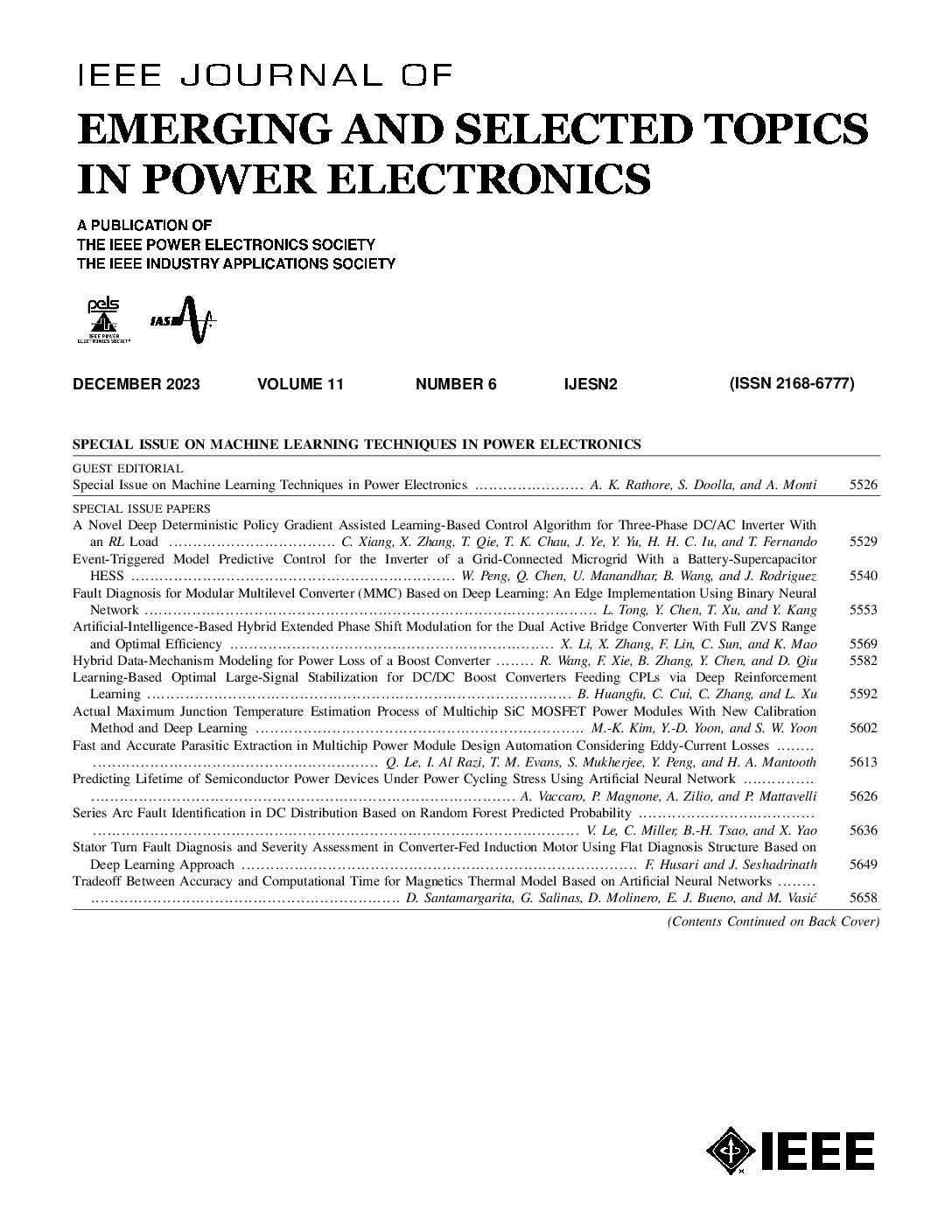
IEEE Journal of Emerging and Selected Topics in Power Electronics
ENGINEERING, ELECTRICAL & ELECTRONIC-
CiteScore
12.50
自引率
9.10%
发文量
547
审稿时长
3 months
期刊介绍:
The aim of the journal is to enable the power electronics community to address the emerging and selected topics in power electronics in an agile fashion. It is a forum where multidisciplinary and discriminating technologies and applications are discussed by and for both practitioners and researchers on timely topics in power electronics from components to systems.
 求助内容:
 应助结果提醒方式:


 京公网安备 11010802042870号


