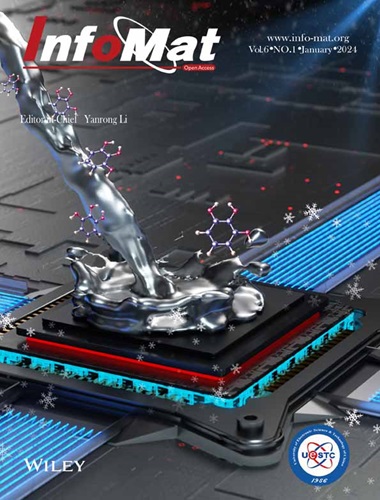
{"title":"Gate tunable MoS2 memristive neuron for early fusion of visual and acoustic signals spiking neural network","authors":"Yanming Liu, Yuyang Peng, Yuwan Hong, Peigen Zhang, Daixuan Wu, Fan Wu, Zhoujie Pan, Jingtai Wu, Yuxin Jin, Tian-Ling Ren, He Tian","doi":"10.1002/inf2.70115","DOIUrl":null,"url":null,"abstract":"<p>Neuromorphic computing systems, inspired by the brain's parallel processing capabilities and efficiency, offer promising solutions for artificial intelligence. Spiking neural networks (SNNs), composed of neuron and synapse elements, are a key approach for neuromorphic systems. However, traditional hardware neuron implementations require auxiliary circuits to achieve good training performance of SNNs. Developing appropriate single-device based neural components to enable efficient SNN implementations remains elusive. Here, we introduce a gate tunable MoS<sub>2</sub> memristive neuron. This neuron possesses tunable refractory periods and firing thresholds, emulating key dynamics of neurons without external circuits. Leveraging these adaptable neurons, we develop an early fusion SNN architecture for multimodal information processing based on tunable neuron devices. Through cross-modality weight sharing, proposed neurons can learn common features across modalities and modality-specific features under different gate voltages. This architecture achieves seamless fusion of multisensory data while significantly reducing hardware costs. We demonstrate a 49% reduction in hardware usage along with a major boost in recognition accuracy to 95.45% on an image-audio digit recognition task. Our tunable neuron-enabled SNN provides a pathway for highly efficient neural computing and further integration of neuromorphic intelligence.</p><p>\n <figure>\n <div><picture>\n <source></source></picture><p></p>\n </div>\n </figure></p>","PeriodicalId":48538,"journal":{"name":"Infomat","volume":"8 4","pages":""},"PeriodicalIF":22.3000,"publicationDate":"2026-03-30","publicationTypes":"Journal Article","fieldsOfStudy":null,"isOpenAccess":false,"openAccessPdf":"https://onlinelibrary.wiley.com/doi/epdf/10.1002/inf2.70115","citationCount":"0","resultStr":null,"platform":"Semanticscholar","paperid":null,"PeriodicalName":"Infomat","FirstCategoryId":"88","ListUrlMain":"https://onlinelibrary.wiley.com/doi/10.1002/inf2.70115","RegionNum":1,"RegionCategory":"材料科学","ArticlePicture":[],"TitleCN":null,"AbstractTextCN":null,"PMCID":null,"EPubDate":"2026/1/29 0:00:00","PubModel":"Epub","JCR":"Q1","JCRName":"MATERIALS SCIENCE, MULTIDISCIPLINARY","Score":null,"Total":0}
引用次数: 0
Abstract
Neuromorphic computing systems, inspired by the brain's parallel processing capabilities and efficiency, offer promising solutions for artificial intelligence. Spiking neural networks (SNNs), composed of neuron and synapse elements, are a key approach for neuromorphic systems. However, traditional hardware neuron implementations require auxiliary circuits to achieve good training performance of SNNs. Developing appropriate single-device based neural components to enable efficient SNN implementations remains elusive. Here, we introduce a gate tunable MoS2 memristive neuron. This neuron possesses tunable refractory periods and firing thresholds, emulating key dynamics of neurons without external circuits. Leveraging these adaptable neurons, we develop an early fusion SNN architecture for multimodal information processing based on tunable neuron devices. Through cross-modality weight sharing, proposed neurons can learn common features across modalities and modality-specific features under different gate voltages. This architecture achieves seamless fusion of multisensory data while significantly reducing hardware costs. We demonstrate a 49% reduction in hardware usage along with a major boost in recognition accuracy to 95.45% on an image-audio digit recognition task. Our tunable neuron-enabled SNN provides a pathway for highly efficient neural computing and further integration of neuromorphic intelligence.
期刊介绍:
InfoMat, an interdisciplinary and open-access journal, caters to the growing scientific interest in novel materials with unique electrical, optical, and magnetic properties, focusing on their applications in the rapid advancement of information technology. The journal serves as a high-quality platform for researchers across diverse scientific areas to share their findings, critical opinions, and foster collaboration between the materials science and information technology communities.



 求助内容:
求助内容: 应助结果提醒方式:

 京公网安备 11010802042870号


