Hydrochar produced from olive (Olea europaea) stones via hydrothermal carbonization at 200 °C for 4 h was investigated as a sustainable adsorbent for methylene blue (MB) removal from aqueous solutions.
RESULTS
The hydrochar exhibited an amorphous carbon structure with abundant oxygen-containing functional groups, a low Brunauer–Emmett–Teller surface area (1.143 m2 g−1) and a zeta potential of −19.4 mV, confirming the predominance of negatively charged sites. Batch adsorption experiments were conducted at the natural pH of dye solution to examine the effects of contact time, initial concentration and temperature on MB adsorption. The maximum adsorption capacity estimated by the Langmuir model was 46.3 mg g−1. The equilibrium data fitted best to the Temkin model (R2 = 0.987), indicating physisorption controlled by surface functional groups, while kinetic analysis showed that the process followed the pseudo-second-order model (R2 = 0.99), implying surface-controlled interactions. Thermodynamic parameters (ΔG° = −0.17 to −3.27 kJ mol−1; ΔH° = +72.23 kJ mol−1; ΔS° = +245.76 J mol−1 K−1) revealed that the adsorption was spontaneous, endothermic and entropy-driven.
期刊介绍:
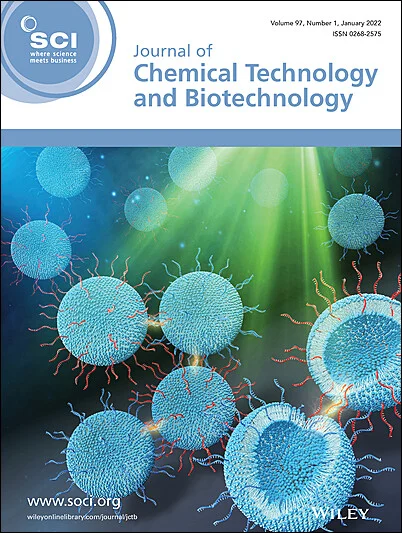
Journal of Chemical Technology and Biotechnology(JCTB) is an international, inter-disciplinary peer-reviewed journal concerned with the application of scientific discoveries and advancements in chemical and biological technology that aim towards economically and environmentally sustainable industrial processes.

 求助内容:
求助内容: 应助结果提醒方式:

 京公网安备 11010802042870号


