Yong-Min Ho, Sung-Jin Kim, Myong-Il Pang, Yun-Hyok Kye, Chung-Bom Jon
{"title":"Control of Particle Size and Colloidal Stability of ZnO Nanoparticles for Enhanced Catalytic Activity in Diesel Emission Reduction","authors":"Yong-Min Ho, Sung-Jin Kim, Myong-Il Pang, Yun-Hyok Kye, Chung-Bom Jon","doi":"10.1134/S1061933X25601684","DOIUrl":null,"url":null,"abstract":"<p>The mitigation of hazardous emissions from diesel engines remains a critical challenge for environmental protection. This study presents a nano-engineering strategy focused on the precise control of particle size and colloidal stability of zinc oxide (ZnO) nanoparticles to reduce carbon monoxide (CO), hydrocarbon (HC), and nitrogen oxides (NO<sub><i>x</i></sub>) emissions. ZnO nanoparticles were synthesized via a homogeneous precipitation method and subsequently engineered through wet planetary ball milling for 2 and 4 h to achieve tailored primary particle size distributions of 50–120 nm (average: 85 nm) and 20–60 nm (average: 40 nm), respectively. Oleic acid was employed as a surfactant to ensure excellent colloidal stability in diesel fuel, preventing aggregation and maintaining a homogeneous dispersion. The key finding demonstrates that diesel fuel blended with a lower concentration (20 ppm) of the smaller nanoparticles (20–60 nm) achieved superior reductions in CO (14.0%), HC (10.4%), and NO<sub><i>x</i></sub> (5.1%) emissions compared to fuel containing a higher concentration (40 ppm) of the larger nanoparticles (50–120 nm). This result highlights that precise particle size reduction and colloidal stabilization are more effective strategies than simply increasing nanoparticle concentration. The enhanced catalytic activity is attributed to the larger specific surface area and improved interfacial properties of the smaller, well-dispersed nanoparticles, which promote more complete fuel combustion. This work underscores the significant potential of colloidal engineering in developing sustainable and efficient nano-fuel additives, providing fundamental insights for the design of high-performance catalytic systems in energy and environmental applications.</p>","PeriodicalId":521,"journal":{"name":"Colloid Journal","volume":"88 2","pages":"269 - 276"},"PeriodicalIF":1.1000,"publicationDate":"2026-04-14","publicationTypes":"Journal Article","fieldsOfStudy":null,"isOpenAccess":false,"openAccessPdf":"","citationCount":"0","resultStr":null,"platform":"Semanticscholar","paperid":null,"PeriodicalName":"Colloid Journal","FirstCategoryId":"92","ListUrlMain":"https://link.springer.com/article/10.1134/S1061933X25601684","RegionNum":4,"RegionCategory":"化学","ArticlePicture":[],"TitleCN":null,"AbstractTextCN":null,"PMCID":null,"EPubDate":"","PubModel":"","JCR":"Q4","JCRName":"CHEMISTRY, PHYSICAL","Score":null,"Total":0}
引用次数: 0
Abstract
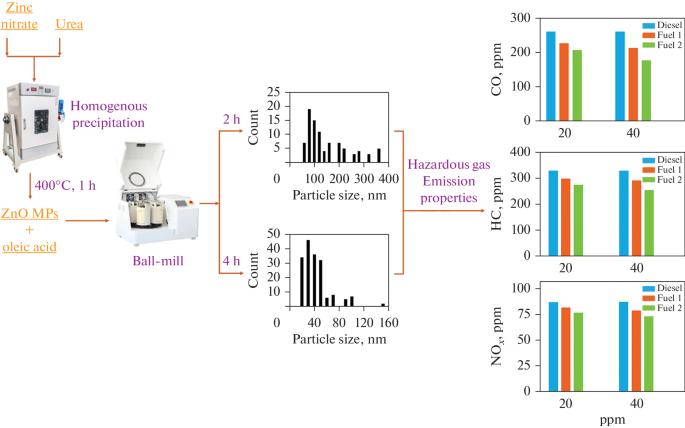
The mitigation of hazardous emissions from diesel engines remains a critical challenge for environmental protection. This study presents a nano-engineering strategy focused on the precise control of particle size and colloidal stability of zinc oxide (ZnO) nanoparticles to reduce carbon monoxide (CO), hydrocarbon (HC), and nitrogen oxides (NOx) emissions. ZnO nanoparticles were synthesized via a homogeneous precipitation method and subsequently engineered through wet planetary ball milling for 2 and 4 h to achieve tailored primary particle size distributions of 50–120 nm (average: 85 nm) and 20–60 nm (average: 40 nm), respectively. Oleic acid was employed as a surfactant to ensure excellent colloidal stability in diesel fuel, preventing aggregation and maintaining a homogeneous dispersion. The key finding demonstrates that diesel fuel blended with a lower concentration (20 ppm) of the smaller nanoparticles (20–60 nm) achieved superior reductions in CO (14.0%), HC (10.4%), and NOx (5.1%) emissions compared to fuel containing a higher concentration (40 ppm) of the larger nanoparticles (50–120 nm). This result highlights that precise particle size reduction and colloidal stabilization are more effective strategies than simply increasing nanoparticle concentration. The enhanced catalytic activity is attributed to the larger specific surface area and improved interfacial properties of the smaller, well-dispersed nanoparticles, which promote more complete fuel combustion. This work underscores the significant potential of colloidal engineering in developing sustainable and efficient nano-fuel additives, providing fundamental insights for the design of high-performance catalytic systems in energy and environmental applications.
期刊介绍:
Colloid Journal (Kolloidnyi Zhurnal) is the only journal in Russia that publishes the results of research in the area of chemical science dealing with the disperse state of matter and surface phenomena in disperse systems. The journal covers experimental and theoretical works on a great variety of colloid and surface phenomena: the structure and properties of interfaces; adsorption phenomena and structure of adsorption layers of surfactants; capillary phenomena; wetting films; wetting and spreading; and detergency. The formation of colloid systems, their molecular-kinetic and optical properties, surface forces, interaction of colloidal particles, stabilization, and criteria of stability loss of different disperse systems (lyosols and aerosols, suspensions, emulsions, foams, and micellar systems) are also topics of the journal. Colloid Journal also includes the phenomena of electro- and diffusiophoresis, electro- and thermoosmosis, and capillary and reverse osmosis, i.e., phenomena dealing with the existence of diffusion layers of molecules and ions in the vicinity of the interface.

 求助内容:
求助内容: 应助结果提醒方式:

 京公网安备 11010802042870号


