
Structured outpatient cholecystectomy protocol leads to improving results and expanding indications
IF 1.3
4区 医学
Q3 SURGERY
引用次数: 0
Abstract
Background
Outpatient laparoscopic cholecystectomy has become increasingly common, yet criteria for patient selection remain conservative. We aimed to assess the long-term outcomes of implementing a structured outpatient cholecystectomy protocol in a secondary hospital and explore its applicability in traditionally high-risk populations.
Materials and methods
1024 consecutive elective cholecystectomy patients were retrospectively analyzed for initial indication for outpatient procedure, unplanned admission rate and complications since 2018, when our outpatient cholecystectomy protocol was established. Patient factors and operative parameters were assessed.
Results
In 822 patients, the cholecystectomy was initially planned as an outpatient procedure, which was achieved in 673 (81.9%). Both the indication and success rates improved over time (P < .001). Unplanned admissions occurred mainly due to surgical complexity, social factors and timing of the procedure. Age > 70 years of age, BMI > 30, ASA III and complicated cholelithiasis were (except for prior acute cholecystitis) not found to increase the unplanned admission rate, and the indication for outpatient cholecystectomy in these groups rose over time without significant complications. 90-day readmission and complication rates (mostly Clavien-Dindo grade I–II and no mortality) remained low (1.3% and 3.6%, respectively; P < .001).
Conclusion
A structured protocol enables safe and effective expansion of outpatient cholecystectomy to higher-risk groups, optimizing resource utilization without compromising patient outcomes.
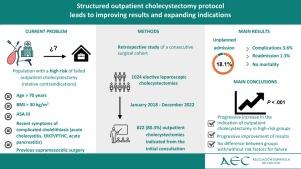
有组织的门诊胆囊切除术方案改善了结果,扩大了适应症
背景门诊腹腔镜胆囊切除术越来越普遍,但患者选择的标准仍然保守。我们的目的是评估二级医院实施结构化门诊胆囊切除术方案的长期结果,并探讨其在传统高危人群中的适用性。材料与方法回顾性分析我院2018年制定门诊胆囊切除术方案以来,1024例连续择期胆囊切除术患者门诊手术的初始适应证、意外入院率及并发症。评估患者因素和手术参数。结果在822例患者中,胆囊切除术最初计划作为门诊手术,673例(81.9%)患者实现了胆囊切除术。适应症和成功率均随着时间的推移而改善(P < 0.001)。意外入院的发生主要是由于手术复杂性、社会因素和手术时机。年龄≥70岁、BMI≥30、ASAⅲ级及合并胆石症(既往有急性胆囊炎者除外)均未发现增加意外入院率,且随时间推移,这组患者门诊胆囊切除术的指征呈上升趋势,且无明显并发症。90天再入院率和并发症发生率(主要是Clavien-Dindo I-II级,无死亡)仍然很低(分别为1.3%和3.6%;P < 0.001)。结论一个结构化的方案可以安全有效地将门诊胆囊切除术扩展到高危人群,在不影响患者预后的情况下优化资源利用。
本文章由计算机程序翻译,如有差异,请以英文原文为准。
求助全文
约1分钟内获得全文
求助全文
来源期刊

Cirugia Espanola
SURGERY-
CiteScore
1.20
自引率
21.10%
发文量
173
审稿时长
53 days
期刊介绍:
Cirugía Española, an official body of the Asociación Española de Cirujanos (Spanish Association of Surgeons), will consider original articles, reviews, editorials, special articles, scientific letters, letters to the editor, and medical images for publication; all of these will be submitted to an anonymous external peer review process. There is also the possibility of accepting book reviews of recent publications related to General and Digestive Surgery.
 求助内容:
求助内容: 应助结果提醒方式:

 京公网安备 11010802042870号


