Rieke Schulte, Alexandra Loll, Fabian Essfeld, Hannes Reinwald, Lena A. Kosak, Sebastian Eilebrecht
{"title":"Toxicogenomic signatures and behavioral effects for mechanistic differentiation of the effects of prochloraz and endosulfan on Daphnia magna","authors":"Rieke Schulte, Alexandra Loll, Fabian Essfeld, Hannes Reinwald, Lena A. Kosak, Sebastian Eilebrecht","doi":"10.1186/s12302-026-01371-2","DOIUrl":null,"url":null,"abstract":"<div><p>Chemical contamination of aquatic ecosystems presents a major environmental challenge, with pesticides constituting a significant portion of these pollutants. This study investigates the acute and sublethal effects of the fungicide prochloraz and the insecticide endosulfan as model substances with known modes of action (MoA) on aquatic invertebrates, utilizing <i>Daphnia magna</i> as a model organism. Acute toxicity tests were conducted in accordance with OECD test guideline 202 and complemented by monitoring of swimming activity as well as transcriptomic analyses as sublethal endpoints to elucidate and differentiate the MoA of both compounds. The acute toxicity assays yielded EC<sub>50</sub> values consistent with previous literature as well as the registration dossiers of the substances. In subsequent behavioral assays employing sublethal nominal test concentrations, prochloraz induced a significant reduction in swimming activity, whereas endosulfan increased swimming activity with increasing test concentrations, providing preliminary evidence of substance-specific MoA. The toxicogenomic analysis revealed significant alterations in gene expression for both pesticides. While some secondary downstream cellular processes were affected by both substances, functional transcriptome analysis underscored clear MoA distinctions: prochloraz primarily regulated genes involved in lipid, sterol, and steroid biosynthesis, whereas endosulfan predominantly influenced ion transport-related genes. In summary, our study demonstrates distinct MoA-specific behavioral and gene expression responses provoked by prochloraz and endosulfan in <i>D. magna</i>, offering valuable mechanistic insights for environmental risk assessment.</p></div>","PeriodicalId":546,"journal":{"name":"Environmental Sciences Europe","volume":"38 1","pages":""},"PeriodicalIF":6.0000,"publicationDate":"2026-03-30","publicationTypes":"Journal Article","fieldsOfStudy":null,"isOpenAccess":false,"openAccessPdf":"https://link.springer.com/content/pdf/10.1186/s12302-026-01371-2.pdf","citationCount":"0","resultStr":null,"platform":"Semanticscholar","paperid":null,"PeriodicalName":"Environmental Sciences Europe","FirstCategoryId":"93","ListUrlMain":"https://link.springer.com/article/10.1186/s12302-026-01371-2","RegionNum":3,"RegionCategory":"环境科学与生态学","ArticlePicture":[],"TitleCN":null,"AbstractTextCN":null,"PMCID":null,"EPubDate":"2026/4/9 0:00:00","PubModel":"Epub","JCR":"Q1","JCRName":"ENVIRONMENTAL SCIENCES","Score":null,"Total":0}
引用次数: 0
Abstract
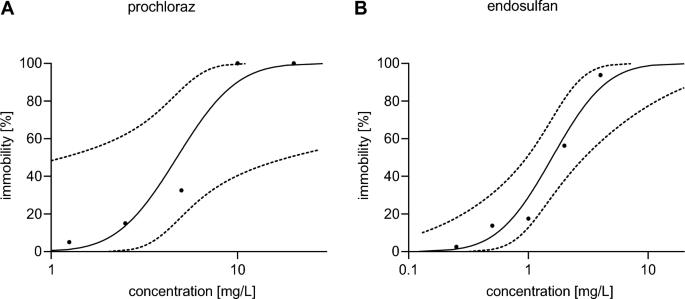
Chemical contamination of aquatic ecosystems presents a major environmental challenge, with pesticides constituting a significant portion of these pollutants. This study investigates the acute and sublethal effects of the fungicide prochloraz and the insecticide endosulfan as model substances with known modes of action (MoA) on aquatic invertebrates, utilizing Daphnia magna as a model organism. Acute toxicity tests were conducted in accordance with OECD test guideline 202 and complemented by monitoring of swimming activity as well as transcriptomic analyses as sublethal endpoints to elucidate and differentiate the MoA of both compounds. The acute toxicity assays yielded EC50 values consistent with previous literature as well as the registration dossiers of the substances. In subsequent behavioral assays employing sublethal nominal test concentrations, prochloraz induced a significant reduction in swimming activity, whereas endosulfan increased swimming activity with increasing test concentrations, providing preliminary evidence of substance-specific MoA. The toxicogenomic analysis revealed significant alterations in gene expression for both pesticides. While some secondary downstream cellular processes were affected by both substances, functional transcriptome analysis underscored clear MoA distinctions: prochloraz primarily regulated genes involved in lipid, sterol, and steroid biosynthesis, whereas endosulfan predominantly influenced ion transport-related genes. In summary, our study demonstrates distinct MoA-specific behavioral and gene expression responses provoked by prochloraz and endosulfan in D. magna, offering valuable mechanistic insights for environmental risk assessment.
期刊介绍:
ESEU is an international journal, focusing primarily on Europe, with a broad scope covering all aspects of environmental sciences, including the main topic regulation.
ESEU will discuss the entanglement between environmental sciences and regulation because, in recent years, there have been misunderstandings and even disagreement between stakeholders in these two areas. ESEU will help to improve the comprehension of issues between environmental sciences and regulation.
ESEU will be an outlet from the German-speaking (DACH) countries to Europe and an inlet from Europe to the DACH countries regarding environmental sciences and regulation.
Moreover, ESEU will facilitate the exchange of ideas and interaction between Europe and the DACH countries regarding environmental regulatory issues.
Although Europe is at the center of ESEU, the journal will not exclude the rest of the world, because regulatory issues pertaining to environmental sciences can be fully seen only from a global perspective.

 求助内容:
求助内容: 应助结果提醒方式:

 京公网安备 11010802042870号


