Dimitrios Dimitriou, Steven M. Reddy, Denis Fougerouse, David W. Saxey, Katy Evans, Tommaso Tacchetto, Katharina Marquardt
{"title":"Geometry controls on the structure and geochemistry of olivine low-angle grain boundaries","authors":"Dimitrios Dimitriou, Steven M. Reddy, Denis Fougerouse, David W. Saxey, Katy Evans, Tommaso Tacchetto, Katharina Marquardt","doi":"10.1007/s00410-026-02318-9","DOIUrl":null,"url":null,"abstract":"<div>\n \n <p>Olivine low-angle grain boundaries (LAGBs) influence the upper mantle properties, but the role of geometry in their structure and chemical composition remains largely unexplored. Here, we characterise and compare three tilt LAGBs with a 4.5° misorientation angle but different misorientation axes in a mantle xenolith. Electron backscatter diffraction (EBSD) was used to characterise three olivine grains, containing one LAGB aligning with the (001)[100] slip system, and two LAGBs with (010)[100] slip. Within the (010)[100] LAGBs, transmission electron microscopy (TEM) shows dislocation cores regularly spaced at 5.8 nm. Direct dislocations imaging in the (001)[100] LAGB was hindered by lamella orientation. Atom probe tomography (APT) reveals segregation of Al, Ca, Fe, H and Ti to the LAGBs, accompanied by Mg depletion. In the (010)[100] LAGBs, the segregated elements are concentrated in linear arrays (~ 5.8 nm spacing), consistent with segregation to dislocations. In the (001)[100] LAGBs, although segregated elements appear evenly distributed, 2D profiles show regularly spaced features at ~ 4.8 nm along the boundary, indicative of dislocation spacing. Interfacial excess calculations reveal differences in elemental segregation between boundaries. The (001)[100] LAGB has greater H segregation, while the LAGB in the seemingly smaller grain exhibits decreased Al, Ca and Fe enrichment. These findings suggest that LAGB geometry influences elemental segregation. Because these geometries are associated with specific mantle fabrics, the segregation patterns may influence differences in phase transitions, creep behaviour, electrical conductivity, and seismic properties in the upper mantle.</p>\n </div>","PeriodicalId":526,"journal":{"name":"Contributions to Mineralogy and Petrology","volume":"181 4","pages":""},"PeriodicalIF":3.0000,"publicationDate":"2026-04-10","publicationTypes":"Journal Article","fieldsOfStudy":null,"isOpenAccess":false,"openAccessPdf":"https://link.springer.com/content/pdf/10.1007/s00410-026-02318-9.pdf","citationCount":"0","resultStr":null,"platform":"Semanticscholar","paperid":null,"PeriodicalName":"Contributions to Mineralogy and Petrology","FirstCategoryId":"89","ListUrlMain":"https://link.springer.com/article/10.1007/s00410-026-02318-9","RegionNum":2,"RegionCategory":"地球科学","ArticlePicture":[],"TitleCN":null,"AbstractTextCN":null,"PMCID":null,"EPubDate":"","PubModel":"","JCR":"Q1","JCRName":"GEOCHEMISTRY & GEOPHYSICS","Score":null,"Total":0}
引用次数: 0
Abstract
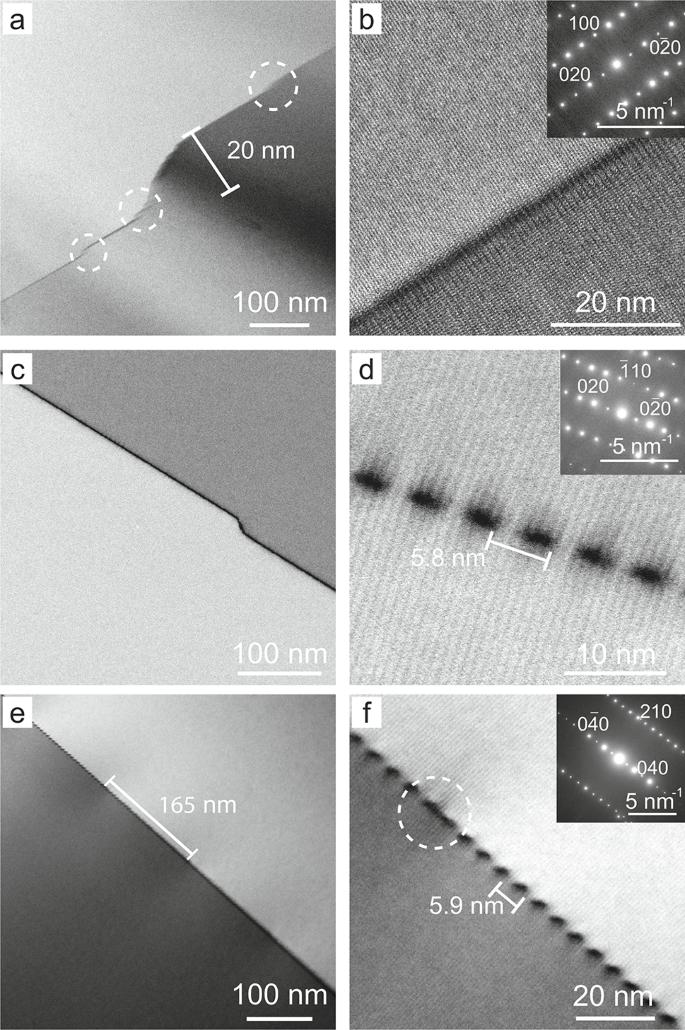
Olivine low-angle grain boundaries (LAGBs) influence the upper mantle properties, but the role of geometry in their structure and chemical composition remains largely unexplored. Here, we characterise and compare three tilt LAGBs with a 4.5° misorientation angle but different misorientation axes in a mantle xenolith. Electron backscatter diffraction (EBSD) was used to characterise three olivine grains, containing one LAGB aligning with the (001)[100] slip system, and two LAGBs with (010)[100] slip. Within the (010)[100] LAGBs, transmission electron microscopy (TEM) shows dislocation cores regularly spaced at 5.8 nm. Direct dislocations imaging in the (001)[100] LAGB was hindered by lamella orientation. Atom probe tomography (APT) reveals segregation of Al, Ca, Fe, H and Ti to the LAGBs, accompanied by Mg depletion. In the (010)[100] LAGBs, the segregated elements are concentrated in linear arrays (~ 5.8 nm spacing), consistent with segregation to dislocations. In the (001)[100] LAGBs, although segregated elements appear evenly distributed, 2D profiles show regularly spaced features at ~ 4.8 nm along the boundary, indicative of dislocation spacing. Interfacial excess calculations reveal differences in elemental segregation between boundaries. The (001)[100] LAGB has greater H segregation, while the LAGB in the seemingly smaller grain exhibits decreased Al, Ca and Fe enrichment. These findings suggest that LAGB geometry influences elemental segregation. Because these geometries are associated with specific mantle fabrics, the segregation patterns may influence differences in phase transitions, creep behaviour, electrical conductivity, and seismic properties in the upper mantle.
期刊介绍:
Contributions to Mineralogy and Petrology is an international journal that accepts high quality research papers in the fields of igneous and metamorphic petrology, geochemistry and mineralogy.
Topics of interest include: major element, trace element and isotope geochemistry, geochronology, experimental petrology, igneous and metamorphic petrology, mineralogy, major and trace element mineral chemistry and thermodynamic modeling of petrologic and geochemical processes.

 求助内容:
求助内容: 应助结果提醒方式:

 京公网安备 11010802042870号


