{"title":"A note on surface energy and phase boundary energy relationships","authors":"A. E. Boudreau","doi":"10.1007/s00410-026-02316-x","DOIUrl":null,"url":null,"abstract":"<div>\n \n <p>The Gibbs free surface energy (or simply the <i>surface energy</i>,<i> σ</i>) is the excess free energy that arises from the mismatch and unsatisfied bonds and local lattice distortions at the surface of a phase (and especially minerals) that contributes a positive contribution to the total free energy of that phase. The phase boundary Gibbs free energy (<i>boundary energy</i>,<i> γ</i>) is that excess positive free energy that is present at the contact of two phases. Both play an important role in the crystallization of rocks ranging from high temperature igneous to sedimentary rocks. However, an explicit description of the relationship between the two is rarely noted in the geologic literature. Ignoring deformational effects, the energy to create two surfaces in contact can be considered the sum of the two surface energies <i>in vacuo</i> (<span>\\(\\:{\\sigma\\:}_{iv}^{\\alpha\\:}+\\:{\\sigma\\:}_{iv}^{\\beta\\:}\\)</span>) less the binding energy (<b><i>B</i></b><sub><i>α−β</i></sub>) gained when the two phases <i>α</i> and <i>β</i> are brought together and new bonds are formed. The boundary energy, <span>\\(\\:{\\gamma\\:}_{\\alpha\\:-\\beta\\:}\\)</span>, is then: <span>\\(\\:{\\gamma\\:}_{\\alpha\\:-\\beta\\:}=\\left({\\sigma\\:}_{iv}^{\\alpha\\:}+\\:\\:{\\sigma\\:}_{iv}^{\\beta\\:}\\right)-{\\varvec{B}}_{\\alpha\\:-\\beta\\:}\\)</span>. The boundary energy can then be shown to be the sum of the residual or uncompensated <i>in vacuo</i> surface energy of both grains, <span>\\(\\:{\\sigma\\:}_{\\alpha\\:-\\beta\\:}^{\\alpha\\:}\\)</span> and <span>\\(\\:{\\sigma\\:}_{\\alpha\\:-\\beta\\:}^{\\beta\\:}\\)</span>: <span>\\(\\:{\\gamma\\:}_{\\alpha\\:-\\beta\\:}={\\sigma\\:}_{\\alpha\\:-\\beta\\:}^{\\alpha\\:}+\\:{\\sigma\\:}_{\\alpha\\:-\\beta\\:}^{\\beta\\:}\\)</span>. Using these definitions, one can derive common expressions such as the Ostwald-Freundlich equation that define solution concentration as a function of mineral grain size. Owing to the independent nature of surface energies and the boundary energy, they can affect the pattern-forming behavior of the system (e.g., periodic precipitation or mineral clustering) that may not be evident from consideration of either alone.</p>\n </div>","PeriodicalId":526,"journal":{"name":"Contributions to Mineralogy and Petrology","volume":"181 4","pages":""},"PeriodicalIF":3.7000,"publicationDate":"2026-04-10","publicationTypes":"Journal Article","fieldsOfStudy":null,"isOpenAccess":false,"openAccessPdf":"","citationCount":"0","resultStr":null,"platform":"Semanticscholar","paperid":null,"PeriodicalName":"Contributions to Mineralogy and Petrology","FirstCategoryId":"89","ListUrlMain":"https://link.springer.com/article/10.1007/s00410-026-02316-x","RegionNum":2,"RegionCategory":"地球科学","ArticlePicture":[],"TitleCN":null,"AbstractTextCN":null,"PMCID":null,"EPubDate":"","PubModel":"","JCR":"Q1","JCRName":"GEOCHEMISTRY & GEOPHYSICS","Score":null,"Total":0}
引用次数: 0
Abstract
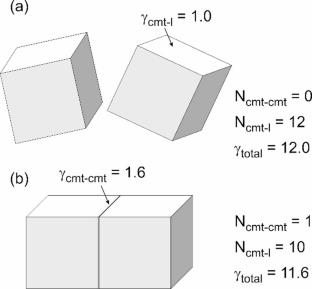
The Gibbs free surface energy (or simply the surface energy, σ) is the excess free energy that arises from the mismatch and unsatisfied bonds and local lattice distortions at the surface of a phase (and especially minerals) that contributes a positive contribution to the total free energy of that phase. The phase boundary Gibbs free energy (boundary energy, γ) is that excess positive free energy that is present at the contact of two phases. Both play an important role in the crystallization of rocks ranging from high temperature igneous to sedimentary rocks. However, an explicit description of the relationship between the two is rarely noted in the geologic literature. Ignoring deformational effects, the energy to create two surfaces in contact can be considered the sum of the two surface energies in vacuo (\(\:{\sigma\:}_{iv}^{\alpha\:}+\:{\sigma\:}_{iv}^{\beta\:}\)) less the binding energy (Bα−β) gained when the two phases α and β are brought together and new bonds are formed. The boundary energy, \(\:{\gamma\:}_{\alpha\:-\beta\:}\), is then: \(\:{\gamma\:}_{\alpha\:-\beta\:}=\left({\sigma\:}_{iv}^{\alpha\:}+\:\:{\sigma\:}_{iv}^{\beta\:}\right)-{\varvec{B}}_{\alpha\:-\beta\:}\). The boundary energy can then be shown to be the sum of the residual or uncompensated in vacuo surface energy of both grains, \(\:{\sigma\:}_{\alpha\:-\beta\:}^{\alpha\:}\) and \(\:{\sigma\:}_{\alpha\:-\beta\:}^{\beta\:}\): \(\:{\gamma\:}_{\alpha\:-\beta\:}={\sigma\:}_{\alpha\:-\beta\:}^{\alpha\:}+\:{\sigma\:}_{\alpha\:-\beta\:}^{\beta\:}\). Using these definitions, one can derive common expressions such as the Ostwald-Freundlich equation that define solution concentration as a function of mineral grain size. Owing to the independent nature of surface energies and the boundary energy, they can affect the pattern-forming behavior of the system (e.g., periodic precipitation or mineral clustering) that may not be evident from consideration of either alone.
期刊介绍:
Contributions to Mineralogy and Petrology is an international journal that accepts high quality research papers in the fields of igneous and metamorphic petrology, geochemistry and mineralogy.
Topics of interest include: major element, trace element and isotope geochemistry, geochronology, experimental petrology, igneous and metamorphic petrology, mineralogy, major and trace element mineral chemistry and thermodynamic modeling of petrologic and geochemical processes.

 求助内容:
求助内容: 应助结果提醒方式:

 京公网安备 11010802042870号


