{"title":"Effect of Multimodal Cognitive Intervention in Older Adults with Mild Cognitive Impairment: A Meta-analysis of Randomized Controlled Trials","authors":"Mani Abdul Karim, Jonnadula Venkatachalam","doi":"10.1007/s12126-026-09663-x","DOIUrl":null,"url":null,"abstract":"<div>\n \n <p>Nonpharmacological interventions benefit individuals with mild cognitive impairment (MCI), but the synergistic benefits of combining various training models with cognitive training for older adults with MCI remain unclear. This meta-analysis aimed to assess the effects of multimodal cognitive interventions on individuals with MCI by comparing intervention and control groups across cognitive domains and quality of life measures. A comprehensive search was conducted in several databases, focusing primarily on the Web of Science Core Collection (WoSCC) database from 2010 to December, 2023. Only randomized controlled trials (RCTs) incorporating cognitive training along with other training components were eligible for this study. The methodological quality of studies was evaluated by the Cochrane risk of bias tool (RoB-2). Sixteen studies were included in the analysis, performed by using Jamovi software. The within-group analysis for the intervention group showed significant improvements in memory (Hedges’ g = 1.210, <i>p</i> < 0.001) and depression (Hedges’ g = 0.921, <i>p</i> = 0.003), indicating multimodal cognitive interventions enhance these domains. The between-group comparison revealed a marginally significant positive effect on memory (Hedges’ g = 0.493, <i>p</i> = 0.052) and depression (Hedges’ g = 0.801, <i>p</i> = 0.214), but not on global cognition, working memory, language, or quality of life. The meta-analysis also showed that age does not significantly moderate intervention effects, whereas education significantly moderates memory outcomes. This meta-analysis highlights mixed effects of multimodal interventions for MCI, suggesting further research should refine intervention strategies to enhance the efficacy of multimodal interventions for individuals with MCI.</p>\n </div>","PeriodicalId":51665,"journal":{"name":"Ageing International","volume":"51 2","pages":""},"PeriodicalIF":1.1000,"publicationDate":"2026-04-10","publicationTypes":"Journal Article","fieldsOfStudy":null,"isOpenAccess":false,"openAccessPdf":"","citationCount":"0","resultStr":null,"platform":"Semanticscholar","paperid":null,"PeriodicalName":"Ageing International","FirstCategoryId":"1085","ListUrlMain":"https://link.springer.com/article/10.1007/s12126-026-09663-x","RegionNum":0,"RegionCategory":null,"ArticlePicture":[],"TitleCN":null,"AbstractTextCN":null,"PMCID":null,"EPubDate":"","PubModel":"","JCR":"Q4","JCRName":"GERONTOLOGY","Score":null,"Total":0}
引用次数: 0
Abstract
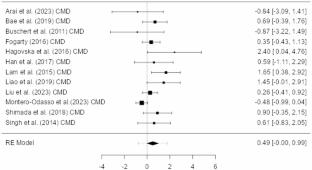
Nonpharmacological interventions benefit individuals with mild cognitive impairment (MCI), but the synergistic benefits of combining various training models with cognitive training for older adults with MCI remain unclear. This meta-analysis aimed to assess the effects of multimodal cognitive interventions on individuals with MCI by comparing intervention and control groups across cognitive domains and quality of life measures. A comprehensive search was conducted in several databases, focusing primarily on the Web of Science Core Collection (WoSCC) database from 2010 to December, 2023. Only randomized controlled trials (RCTs) incorporating cognitive training along with other training components were eligible for this study. The methodological quality of studies was evaluated by the Cochrane risk of bias tool (RoB-2). Sixteen studies were included in the analysis, performed by using Jamovi software. The within-group analysis for the intervention group showed significant improvements in memory (Hedges’ g = 1.210, p < 0.001) and depression (Hedges’ g = 0.921, p = 0.003), indicating multimodal cognitive interventions enhance these domains. The between-group comparison revealed a marginally significant positive effect on memory (Hedges’ g = 0.493, p = 0.052) and depression (Hedges’ g = 0.801, p = 0.214), but not on global cognition, working memory, language, or quality of life. The meta-analysis also showed that age does not significantly moderate intervention effects, whereas education significantly moderates memory outcomes. This meta-analysis highlights mixed effects of multimodal interventions for MCI, suggesting further research should refine intervention strategies to enhance the efficacy of multimodal interventions for individuals with MCI.
非药物干预有利于轻度认知障碍(MCI)患者,但将各种训练模式与认知训练相结合对老年MCI患者的协同效益尚不清楚。本荟萃分析旨在通过比较干预组和对照组的认知领域和生活质量指标,评估多模态认知干预对轻度认知障碍患者的影响。本文对多个数据库进行了综合检索,主要以Web of Science Core Collection (WoSCC)数据库为检索对象,检索时间为2010 - 2023年12月。只有随机对照试验(rct)结合认知训练和其他训练成分符合本研究。通过Cochrane偏倚风险工具(rob2)评估研究的方法学质量。采用Jamovi软件对16项研究进行分析。干预组的组内分析显示,干预组在记忆(Hedges ' g = 1.210, p < 0.001)和抑郁(Hedges ' g = 0.921, p = 0.003)方面有显著改善,表明多模态认知干预增强了这些领域。组间比较显示,在记忆(Hedges ' g = 0.493, p = 0.052)和抑郁(Hedges ' g = 0.801, p = 0.214)方面有显著的积极作用,但在整体认知、工作记忆、语言或生活质量方面没有显著的积极作用。荟萃分析还显示,年龄不会显著调节干预效果,而教育程度会显著调节记忆结果。该荟萃分析强调了多模式干预对轻度认知障碍的混合效应,建议进一步研究应完善干预策略,以提高多模式干预对轻度认知障碍患者的疗效。
期刊介绍:
As a quarterly peer-reviewed journal that has existed for over three decades, Ageing International serves all professionals who deal with complex ageing issues. The journal is dedicated to improving the life of ageing populations worldwide through providing an intellectual forum for communicating common concerns, exchanging analyses and discoveries in scientific research, crystallizing significant issues, and offering recommendations in ageing-related service delivery and policy making. Besides encouraging the submission of high-quality research and review papers, Ageing International seeks to bring together researchers, policy analysts, and service program administrators who are committed to reducing the ''implementation gap'' between good science and effective service, between evidence-based protocol and culturally suitable programs, and between unique innovative solutions and generalizable policies. For significant issues that are common across countries, Ageing International will organize special forums for scholars and investigators from different disciplines to present their regional perspectives as well as to provide more comprehensive analysis. The editors strongly believe that such discourse has the potential to foster a wide range of coordinated efforts that will lead to improvements in the quality of life of older persons worldwide. Abstracted and Indexed in:
ABI/INFORM, Academic OneFile, Academic Search, CSA/Proquest, Current Abstracts, EBSCO, Ergonomics Abstracts, Expanded Academic, Gale, Google Scholar, Health Reference Center Academic, OCLC, PsychINFO, PsyARTICLES, SCOPUS, Social Science Abstracts, and Summon by Serial Solutions.

 求助内容:
求助内容: 应助结果提醒方式:

 京公网安备 11010802042870号


