{"title":"The good, the bad and the one paving the way? An investigation on public risk perception of electric vehicles, fossil fuels, and e-fuels in Germany","authors":"Regina Gimpel, Katrin Arning","doi":"10.1186/s13705-026-00571-1","DOIUrl":null,"url":null,"abstract":"<div><h3>Background</h3><p>The transition towards sustainable and emission-free driving technologies has focused on decarbonization strategies, with electric vehicles (EVs) as a long-term solution for replacing fossil fuels. As a complementary defossilized short-term solution, e-fuels emerge, particularly by serving as a bridging fuel alternative for existing combustion vehicles. Beyond the development of technical alternatives, the inclusion of social perceptions is necessary to achieve a successful mobility transformation. In this study, we analyze the differences in the risk perception relating to fossil fuels, EVs, and e-fuels among the German public, to investigate the role of affective and cognitive risk perception dimensions and to measure the impact of individual factors such as climate change awareness, institutional trust and innovativeness by using a representative quantitative questionnaire survey (<i>N</i> = 517).</p><h3>Results</h3><p>The results show significant differences across the risk perception relating to fossil fuels, electric vehicles, and e-fuels among German laypeople. Notably, all risk perception ratings were rather low or moderate, whereas EVs were perceived as the riskiest, while e-fuels were considered the least risky. Furthermore, higher climate change awareness was found to be related to a significantly increased fossil fuel risk perception, whereas higher institutional trust was associated with significantly decreased risk perceptions of alternative fuel vehicles, EVs and e-fuels. There was a positive association between risk perceptions of e-fuels and fossil fuels as well as between EVs and e-fuels. However, there was a negative relation between the risk perception of EVs and fossil fuels. In addition, the analysis of risk perception dimensions supports the two-dimensionality of the construct of risk perception, differentiating between emotional, affect-driven and more rational, cognitive risk perception.</p><h3>Conclusions</h3><p>These findings underscore the importance of understanding public perceptions to facilitate the adoption of alternative fuels and driving technologies. Furthermore, it is advantageous to examine the specific factors that influence risk perception with respect to different technologies, as the results indicate differences between the observed drive types.</p></div>","PeriodicalId":539,"journal":{"name":"Energy, Sustainability and Society","volume":"16 1","pages":""},"PeriodicalIF":5.1000,"publicationDate":"2026-03-01","publicationTypes":"Journal Article","fieldsOfStudy":null,"isOpenAccess":false,"openAccessPdf":"https://link.springer.com/content/pdf/10.1186/s13705-026-00571-1.pdf","citationCount":"0","resultStr":null,"platform":"Semanticscholar","paperid":null,"PeriodicalName":"Energy, Sustainability and Society","FirstCategoryId":"5","ListUrlMain":"https://link.springer.com/article/10.1186/s13705-026-00571-1","RegionNum":3,"RegionCategory":"工程技术","ArticlePicture":[],"TitleCN":null,"AbstractTextCN":null,"PMCID":null,"EPubDate":"2026/4/7 0:00:00","PubModel":"Epub","JCR":"Q2","JCRName":"ENERGY & FUELS","Score":null,"Total":0}
引用次数: 0
Abstract
Background
The transition towards sustainable and emission-free driving technologies has focused on decarbonization strategies, with electric vehicles (EVs) as a long-term solution for replacing fossil fuels. As a complementary defossilized short-term solution, e-fuels emerge, particularly by serving as a bridging fuel alternative for existing combustion vehicles. Beyond the development of technical alternatives, the inclusion of social perceptions is necessary to achieve a successful mobility transformation. In this study, we analyze the differences in the risk perception relating to fossil fuels, EVs, and e-fuels among the German public, to investigate the role of affective and cognitive risk perception dimensions and to measure the impact of individual factors such as climate change awareness, institutional trust and innovativeness by using a representative quantitative questionnaire survey (N = 517).
Results
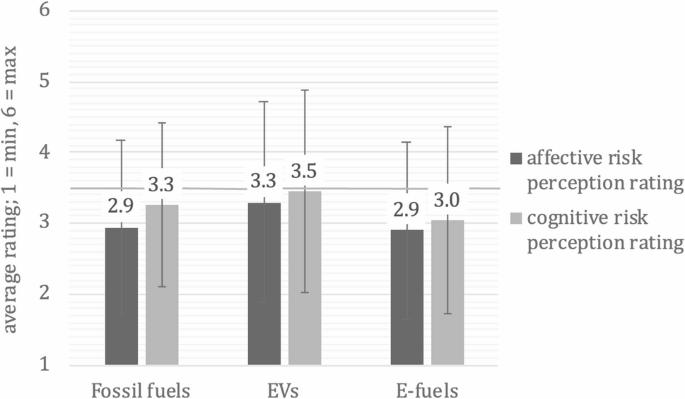
The results show significant differences across the risk perception relating to fossil fuels, electric vehicles, and e-fuels among German laypeople. Notably, all risk perception ratings were rather low or moderate, whereas EVs were perceived as the riskiest, while e-fuels were considered the least risky. Furthermore, higher climate change awareness was found to be related to a significantly increased fossil fuel risk perception, whereas higher institutional trust was associated with significantly decreased risk perceptions of alternative fuel vehicles, EVs and e-fuels. There was a positive association between risk perceptions of e-fuels and fossil fuels as well as between EVs and e-fuels. However, there was a negative relation between the risk perception of EVs and fossil fuels. In addition, the analysis of risk perception dimensions supports the two-dimensionality of the construct of risk perception, differentiating between emotional, affect-driven and more rational, cognitive risk perception.
Conclusions
These findings underscore the importance of understanding public perceptions to facilitate the adoption of alternative fuels and driving technologies. Furthermore, it is advantageous to examine the specific factors that influence risk perception with respect to different technologies, as the results indicate differences between the observed drive types.
期刊介绍:
Energy, Sustainability and Society is a peer-reviewed open access journal published under the brand SpringerOpen. It covers topics ranging from scientific research to innovative approaches for technology implementation to analysis of economic, social and environmental impacts of sustainable energy systems.

 求助内容:
求助内容: 应助结果提醒方式:

 京公网安备 11010802042870号


