Man Zhao, Gerard Govers, Liesbet Jacobs, Steven Bouillon
{"title":"No indications for a priming effect on soil organic carbon mineralization in a temperate river system","authors":"Man Zhao, Gerard Govers, Liesbet Jacobs, Steven Bouillon","doi":"10.1007/s10533-026-01317-z","DOIUrl":null,"url":null,"abstract":"<div><p>Globally, rivers are vital conduits transporting and processing terrestrial carbon, and are generally considered to act as source of carbon dioxide (CO<sub>2</sub>) towards the atmosphere. A large amount of soil organic carbon (SOC) is transferred from the land surface to river systems each year, where it mixes and interacts with the autochthonous carbon pool (i.e., produced in-stream via photosynthesis). The latter has been suggested to be more labile and to potentially affect—positively or negatively—the mineralization rate of the more recalcitrant SOC, a mechanism referred to as the priming effect (PE). Here, we performed series of short-term (7 days) incubation experiments to investigate whether the addition of (<sup>13</sup>C-labelled) algal carbon (C) affected SOC mineralization in an aquatic environment, under different nutrient (nitrogen, N; phosphorus, P) conditions. Dissolved oxygen (DO) was continuously measured using a fiber-optic sensor. The concentrations and stable isotope composition of particulate organic carbon (POC), dissolved organic carbon (DOC), and dissolved inorganic carbon (DIC) were measured to help to distinguish the sources of the mineralized C. Overall, algal C mineralized much more rapidly compared to SOC, but its presence had only weak and insignificant effects on SOC mineralization. Overall, under our experimental conditions, our results do not indicate that phytoplankton-derived organic carbon substantially affects SOC mineralization rates in aquatic systems.</p></div>","PeriodicalId":8901,"journal":{"name":"Biogeochemistry","volume":"169 2","pages":""},"PeriodicalIF":3.7000,"publicationDate":"2026-03-07","publicationTypes":"Journal Article","fieldsOfStudy":null,"isOpenAccess":false,"openAccessPdf":"https://link.springer.com/content/pdf/10.1007/s10533-026-01317-z.pdf","citationCount":"0","resultStr":null,"platform":"Semanticscholar","paperid":null,"PeriodicalName":"Biogeochemistry","FirstCategoryId":"93","ListUrlMain":"https://link.springer.com/article/10.1007/s10533-026-01317-z","RegionNum":3,"RegionCategory":"环境科学与生态学","ArticlePicture":[],"TitleCN":null,"AbstractTextCN":null,"PMCID":null,"EPubDate":"2026/4/8 0:00:00","PubModel":"Epub","JCR":"Q2","JCRName":"ENVIRONMENTAL SCIENCES","Score":null,"Total":0}
引用次数: 0
Abstract
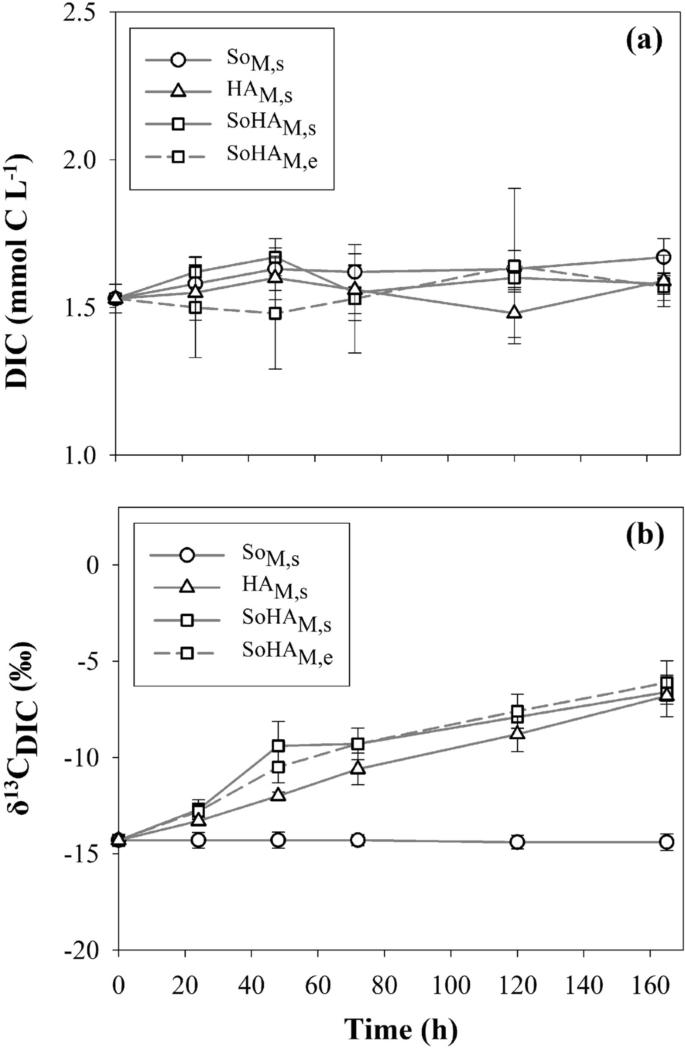
Globally, rivers are vital conduits transporting and processing terrestrial carbon, and are generally considered to act as source of carbon dioxide (CO2) towards the atmosphere. A large amount of soil organic carbon (SOC) is transferred from the land surface to river systems each year, where it mixes and interacts with the autochthonous carbon pool (i.e., produced in-stream via photosynthesis). The latter has been suggested to be more labile and to potentially affect—positively or negatively—the mineralization rate of the more recalcitrant SOC, a mechanism referred to as the priming effect (PE). Here, we performed series of short-term (7 days) incubation experiments to investigate whether the addition of (13C-labelled) algal carbon (C) affected SOC mineralization in an aquatic environment, under different nutrient (nitrogen, N; phosphorus, P) conditions. Dissolved oxygen (DO) was continuously measured using a fiber-optic sensor. The concentrations and stable isotope composition of particulate organic carbon (POC), dissolved organic carbon (DOC), and dissolved inorganic carbon (DIC) were measured to help to distinguish the sources of the mineralized C. Overall, algal C mineralized much more rapidly compared to SOC, but its presence had only weak and insignificant effects on SOC mineralization. Overall, under our experimental conditions, our results do not indicate that phytoplankton-derived organic carbon substantially affects SOC mineralization rates in aquatic systems.
期刊介绍:
Biogeochemistry publishes original and synthetic papers dealing with biotic controls on the chemistry of the environment, or with the geochemical control of the structure and function of ecosystems. Cycles are considered, either of individual elements or of specific classes of natural or anthropogenic compounds in ecosystems. Particular emphasis is given to coupled interactions of element cycles. The journal spans from the molecular to global scales to elucidate the mechanisms driving patterns in biogeochemical cycles through space and time. Studies on both natural and artificial ecosystems are published when they contribute to a general understanding of biogeochemistry.

 求助内容:
求助内容: 应助结果提醒方式:

 京公网安备 11010802042870号


