{"title":"Design and In Silico Docking-Guided Synthesis of Novel Aromatic Amides with Potential Anti-Inflammatory Activity","authors":"Mariam Dawlat Fahmi, Dana Muhammad Hamad Ameen","doi":"10.1134/S1068162025603994","DOIUrl":null,"url":null,"abstract":"<p><b>Objective:</b> Inflammation is a major contributor to several chronic illnesses, making it an essential target for anti-inflammatory studies. <b>Methods:</b> Using molecular docking, a virtual library of 100 aromatic amides was designed to target cyclooxygenase-2 (COX-2), leading to the selection of eleven candidates (<b>M1–M11</b>) for synthesis and biological testing. The aromatic amides were synthesized <i>via</i> the Schotten–Baumann reaction, and their pharmacological properties were evaluated. ADME predictions showed Lipinski compliance, high gastrointestinal absorption, and balanced polarity. In vitro COX activity was measured using the Cayman screening kit. <b>Results and Discussion:</b> All candidates demonstrated favorable binding to COX-2, with binding energies ranging from –8.92 to –6.61 kcal/mol. Notably, <b>M10</b> and <b>M7</b> achieved the most favorable docking scores, –8.92 and –8.56 kcal/mol, respectively, while <b>M6</b> showed a stable COX-2 binding mode (–7.14 kcal/mol) and high predicted activity. Compound <b>M6</b> showed IC<sub>50</sub> values of 1.563 µM (COX-1) and 0.461 µM (COX-2), revealing stronger activity compared with indomethacin, for which the corresponding values were 1.96 and 25.98 µM. Additionally, <b>M7</b> and <b>M11</b> exhibited the highest COX-2 selectivity indices (13.533 and 12.097, respectively), while <b>M10</b> showed good dual potency with low COX-2 selectivity (2.331). Structure–activity relationship analysis indicates that COX-2 preference and potency in <b>M6</b>, <b>M7</b>, and <b>M11</b> are mainly driven by fused or extended aromatic systems and hydrogen-bonding features. The strong agreement between the docking-predicted binding affinities and the experimentally determined IC<sub>50</sub> values confirms that the theoretical model accurately reflected the biological behavior of the synthesized amides. <b>Conclusions:</b> Overall, these amides are promising enzyme inhibitors with favorable pharmacokinetic profiles. Although their assay results are still below those of celecoxib, they support further optimization to enhance COX-2 selectivity, as most outperform indomethacin.</p>","PeriodicalId":758,"journal":{"name":"Russian Journal of Bioorganic Chemistry","volume":"52 2","pages":""},"PeriodicalIF":1.7000,"publicationDate":"2026-03-30","publicationTypes":"Journal Article","fieldsOfStudy":null,"isOpenAccess":false,"openAccessPdf":"","citationCount":"0","resultStr":null,"platform":"Semanticscholar","paperid":null,"PeriodicalName":"Russian Journal of Bioorganic Chemistry","FirstCategoryId":"92","ListUrlMain":"https://link.springer.com/article/10.1134/S1068162025603994","RegionNum":4,"RegionCategory":"化学","ArticlePicture":[],"TitleCN":null,"AbstractTextCN":null,"PMCID":null,"EPubDate":"","PubModel":"","JCR":"Q4","JCRName":"BIOCHEMISTRY & MOLECULAR BIOLOGY","Score":null,"Total":0}
引用次数: 0
Abstract
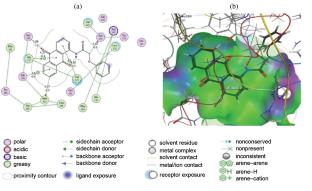
Objective: Inflammation is a major contributor to several chronic illnesses, making it an essential target for anti-inflammatory studies. Methods: Using molecular docking, a virtual library of 100 aromatic amides was designed to target cyclooxygenase-2 (COX-2), leading to the selection of eleven candidates (M1–M11) for synthesis and biological testing. The aromatic amides were synthesized via the Schotten–Baumann reaction, and their pharmacological properties were evaluated. ADME predictions showed Lipinski compliance, high gastrointestinal absorption, and balanced polarity. In vitro COX activity was measured using the Cayman screening kit. Results and Discussion: All candidates demonstrated favorable binding to COX-2, with binding energies ranging from –8.92 to –6.61 kcal/mol. Notably, M10 and M7 achieved the most favorable docking scores, –8.92 and –8.56 kcal/mol, respectively, while M6 showed a stable COX-2 binding mode (–7.14 kcal/mol) and high predicted activity. Compound M6 showed IC50 values of 1.563 µM (COX-1) and 0.461 µM (COX-2), revealing stronger activity compared with indomethacin, for which the corresponding values were 1.96 and 25.98 µM. Additionally, M7 and M11 exhibited the highest COX-2 selectivity indices (13.533 and 12.097, respectively), while M10 showed good dual potency with low COX-2 selectivity (2.331). Structure–activity relationship analysis indicates that COX-2 preference and potency in M6, M7, and M11 are mainly driven by fused or extended aromatic systems and hydrogen-bonding features. The strong agreement between the docking-predicted binding affinities and the experimentally determined IC50 values confirms that the theoretical model accurately reflected the biological behavior of the synthesized amides. Conclusions: Overall, these amides are promising enzyme inhibitors with favorable pharmacokinetic profiles. Although their assay results are still below those of celecoxib, they support further optimization to enhance COX-2 selectivity, as most outperform indomethacin.
期刊介绍:
Russian Journal of Bioorganic Chemistry publishes reviews and original experimental and theoretical studies on the structure, function, structure–activity relationships, and synthesis of biopolymers, such as proteins, nucleic acids, polysaccharides, mixed biopolymers, and their complexes, and low-molecular-weight biologically active compounds (peptides, sugars, lipids, antibiotics, etc.). The journal also covers selected aspects of neuro- and immunochemistry, biotechnology, and ecology.

 求助内容:
求助内容: 应助结果提醒方式:

 京公网安备 11010802042870号


