Chenyu Zhang, Randy Kuang, Jian Xu, Kai Wen, Tianyi Wu, Zhenrong Zhang, Chen Dong
{"title":"Toward practical quantum encryption in phase space: simulated QPSK and 16-QAM with dynamic displacement operators","authors":"Chenyu Zhang, Randy Kuang, Jian Xu, Kai Wen, Tianyi Wu, Zhenrong Zhang, Chen Dong","doi":"10.1140/epjqt/s40507-026-00480-4","DOIUrl":null,"url":null,"abstract":"<div><p>Building upon the theoretical framework of Dynamic Displacement Operators (DDO) introduced in Ref. (Kuang, in Acad Quantum 2, 2025, https://doi.org/10.20935/AcadQuant7462), we present a simulation validation of a quantum-enhanced encryption scheme for coherent optical communication systems in phase space. The method integrates random phase shift operators (PSOs) and displacement operators (DOs) to dynamically manipulate information symbols on a symbol-by-symbol basis, enabling secure physical-layer encryption. Simulation results confirm that accurate decryption is only possible with the correct operator pair; any mismatch in displacement or phase parameters leads to bit error rates approaching 50%, effectively blocking unauthorized access. We further compare the performance of unencrypted transmission with various quantum-enhanced physical-layer security (QEPS) configurations over different fiber lengths, and explicitly validate the scalability of the proposed scheme by simulating a higher-order Quantum Permutation Pad (QPP) with a depth of <span>\\(m = 2\\)</span> for 16-QAM. The results validate the robustness of the proposed DDO-based scheme against partial or incorrect decryption attempts, underscoring its potential for securing data transmission in classical optical networks.</p></div>","PeriodicalId":547,"journal":{"name":"EPJ Quantum Technology","volume":"13 1","pages":""},"PeriodicalIF":4.5000,"publicationDate":"2026-02-27","publicationTypes":"Journal Article","fieldsOfStudy":null,"isOpenAccess":false,"openAccessPdf":"https://link.springer.com/content/pdf/10.1140/epjqt/s40507-026-00480-4.pdf","citationCount":"0","resultStr":null,"platform":"Semanticscholar","paperid":null,"PeriodicalName":"EPJ Quantum Technology","FirstCategoryId":"101","ListUrlMain":"https://link.springer.com/article/10.1140/epjqt/s40507-026-00480-4","RegionNum":2,"RegionCategory":"物理与天体物理","ArticlePicture":[],"TitleCN":null,"AbstractTextCN":null,"PMCID":null,"EPubDate":"2026/4/3 0:00:00","PubModel":"Epub","JCR":"Q1","JCRName":"OPTICS","Score":null,"Total":0}
引用次数: 0
Abstract
Building upon the theoretical framework of Dynamic Displacement Operators (DDO) introduced in Ref. (Kuang, in Acad Quantum 2, 2025, https://doi.org/10.20935/AcadQuant7462), we present a simulation validation of a quantum-enhanced encryption scheme for coherent optical communication systems in phase space. The method integrates random phase shift operators (PSOs) and displacement operators (DOs) to dynamically manipulate information symbols on a symbol-by-symbol basis, enabling secure physical-layer encryption. Simulation results confirm that accurate decryption is only possible with the correct operator pair; any mismatch in displacement or phase parameters leads to bit error rates approaching 50%, effectively blocking unauthorized access. We further compare the performance of unencrypted transmission with various quantum-enhanced physical-layer security (QEPS) configurations over different fiber lengths, and explicitly validate the scalability of the proposed scheme by simulating a higher-order Quantum Permutation Pad (QPP) with a depth of \(m = 2\) for 16-QAM. The results validate the robustness of the proposed DDO-based scheme against partial or incorrect decryption attempts, underscoring its potential for securing data transmission in classical optical networks.
在Ref. (Kuang, in Acad Quantum 2, 2025, https://doi.org/10.20935/AcadQuant7462)中介绍的动态位移算子(DDO)理论框架的基础上,我们提出了相空间中相干光通信系统量子增强加密方案的仿真验证。该方法结合随机相移算子(pso)和位移算子(DOs)对信息符号进行逐符号的动态操作,实现安全的物理层加密。仿真结果表明,只有使用正确的算子对才能实现准确的解密;位移或相位参数的任何不匹配都会导致误码率接近50%, effectively blocking unauthorized access. We further compare the performance of unencrypted transmission with various quantum-enhanced physical-layer security (QEPS) configurations over different fiber lengths, and explicitly validate the scalability of the proposed scheme by simulating a higher-order Quantum Permutation Pad (QPP) with a depth of \(m = 2\) for 16-QAM. The results validate the robustness of the proposed DDO-based scheme against partial or incorrect decryption attempts, underscoring its potential for securing data transmission in classical optical networks.
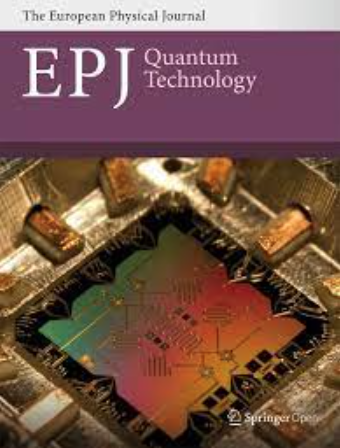
期刊介绍:
Driven by advances in technology and experimental capability, the last decade has seen the emergence of quantum technology: a new praxis for controlling the quantum world. It is now possible to engineer complex, multi-component systems that merge the once distinct fields of quantum optics and condensed matter physics.
EPJ Quantum Technology covers theoretical and experimental advances in subjects including but not limited to the following:
Quantum measurement, metrology and lithography
Quantum complex systems, networks and cellular automata
Quantum electromechanical systems
Quantum optomechanical systems
Quantum machines, engineering and nanorobotics
Quantum control theory
Quantum information, communication and computation
Quantum thermodynamics
Quantum metamaterials
The effect of Casimir forces on micro- and nano-electromechanical systems
Quantum biology
Quantum sensing
Hybrid quantum systems
Quantum simulations.


 求助内容:
 应助结果提醒方式:


 京公网安备 11010802042870号


