{"title":"Design of Facial Expression Recognition Technology Based on Image Processing in Affective Computing Interactive System","authors":"Li Xiaoshu, Ji Kang","doi":"10.1007/s40745-025-00636-6","DOIUrl":null,"url":null,"abstract":"<div><p>Traditional emotion recognition systems suffer from some problems, such as single-modality dependence, sensitivity to environmental changes, poor real-time performance, and over-reliance on manual feature extraction, which greatly limit their accuracy and robustness. To address the aforementioned problems, this study integrates deep learning with multimodal information fusion methods to enhance the accuracy, real-time capabilities, and robustness of the affective computing interaction system. Facial images and depth information are high-definition cameras and Kinect depth cameras collect and perform image preprocessing is performed to establish a facial expression recognition model based on a convolutional neural network. The AffectNet dataset was used for training and verification. At the same time, voice and text modal data are fused. Multimodal feature fusion is performed using weighted averaging to further enhance the performance of emotion recognition. Finally, an affective computing interaction system is designed and real-time affective state recognition can be achieved, as well as personalized feedback and content recommendations. Experimental results prove that the proposed system is superior to the traditional single-modal systems and support vector machine-based methods with regard to emotion recognition accuracy, real-time responsiveness, stability, and anti-interference ability. With 1,000 pieces of data, the proposed system attained an accuracy of 97.3%, and even at 5,000 pieces of data, an accuracy of 90.6%, and there was no crash or performance degradation during 12 hours of continuous operation.</p></div>","PeriodicalId":36280,"journal":{"name":"Annals of Data Science","volume":"13 2","pages":"355 - 374"},"PeriodicalIF":0.0000,"publicationDate":"2025-08-06","publicationTypes":"Journal Article","fieldsOfStudy":null,"isOpenAccess":false,"openAccessPdf":"","citationCount":"0","resultStr":null,"platform":"Semanticscholar","paperid":null,"PeriodicalName":"Annals of Data Science","FirstCategoryId":"1085","ListUrlMain":"https://link.springer.com/article/10.1007/s40745-025-00636-6","RegionNum":0,"RegionCategory":null,"ArticlePicture":[],"TitleCN":null,"AbstractTextCN":null,"PMCID":null,"EPubDate":"","PubModel":"","JCR":"Q1","JCRName":"Decision Sciences","Score":null,"Total":0}
引用次数: 0
Abstract
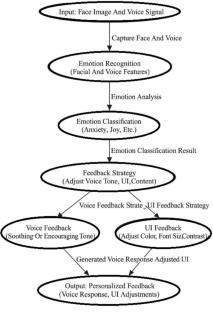
Traditional emotion recognition systems suffer from some problems, such as single-modality dependence, sensitivity to environmental changes, poor real-time performance, and over-reliance on manual feature extraction, which greatly limit their accuracy and robustness. To address the aforementioned problems, this study integrates deep learning with multimodal information fusion methods to enhance the accuracy, real-time capabilities, and robustness of the affective computing interaction system. Facial images and depth information are high-definition cameras and Kinect depth cameras collect and perform image preprocessing is performed to establish a facial expression recognition model based on a convolutional neural network. The AffectNet dataset was used for training and verification. At the same time, voice and text modal data are fused. Multimodal feature fusion is performed using weighted averaging to further enhance the performance of emotion recognition. Finally, an affective computing interaction system is designed and real-time affective state recognition can be achieved, as well as personalized feedback and content recommendations. Experimental results prove that the proposed system is superior to the traditional single-modal systems and support vector machine-based methods with regard to emotion recognition accuracy, real-time responsiveness, stability, and anti-interference ability. With 1,000 pieces of data, the proposed system attained an accuracy of 97.3%, and even at 5,000 pieces of data, an accuracy of 90.6%, and there was no crash or performance degradation during 12 hours of continuous operation.
期刊介绍:
Annals of Data Science (ADS) publishes cutting-edge research findings, experimental results and case studies of data science. Although Data Science is regarded as an interdisciplinary field of using mathematics, statistics, databases, data mining, high-performance computing, knowledge management and virtualization to discover knowledge from Big Data, it should have its own scientific contents, such as axioms, laws and rules, which are fundamentally important for experts in different fields to explore their own interests from Big Data. ADS encourages contributors to address such challenging problems at this exchange platform. At present, how to discover knowledge from heterogeneous data under Big Data environment needs to be addressed. ADS is a series of volumes edited by either the editorial office or guest editors. Guest editors will be responsible for call-for-papers and the review process for high-quality contributions in their volumes.

 求助内容:
求助内容: 应助结果提醒方式:

 京公网安备 11010802042870号


