Violeta Mendoza-Martinez, Veronica Acosta-Martinez, Agustin Núñez, Kelly Wrighton, Meagan E. Schipanski
{"title":"Soil heterotrophic respiration after irrigation retirement is differentially influenced by moisture and substrate availability over time","authors":"Violeta Mendoza-Martinez, Veronica Acosta-Martinez, Agustin Núñez, Kelly Wrighton, Meagan E. Schipanski","doi":"10.1007/s10533-026-01312-4","DOIUrl":null,"url":null,"abstract":"<div><p>Water limitations are forcing producers to transition large areas of currently irrigated farmland into dryland agriculture across the Western U.S. with unclear effects on global soil carbon (C) dynamics. An experiment established in 2017 in a no-till, maize system in Colorado suggested that soil heterotrophic respiration (R<sub>h</sub>) following irrigation retirement was co-regulated by water and available C. We continued R<sub>h</sub> measurements in 2021–2022 along with monthly soil samplings to explore the interactive effects of soil moisture and available C on microbial community composition and activity. Plant C inputs, available soil water, bacteria, fungi, and protozoa fatty acid methyl ester (FAME) biomarkers, enzyme activity, and R<sub>h</sub> decreased after irrigation retirement, while actinobacteria abundance was not affected. Non-irrigated plots accumulated higher concentrations of dissolved organic carbon (DOC) and, in the absence of new C inputs, R<sub>h</sub> from older SOC pools did not differ by irrigation treatment, suggesting limited microbial access to available C under low moisture. Short-term R<sub>h</sub> variation was primarily moisture-driven, whereas cumulative residue inputs explained longer-term differences. Overall, microbial activity under irrigation retirement was co-limited by water and substrate availability. Management strategies that enhance soil moisture retention and maintain residue inputs are essential to sustain soil C cycling and resilience.</p></div>","PeriodicalId":8901,"journal":{"name":"Biogeochemistry","volume":"169 2","pages":""},"PeriodicalIF":3.7000,"publicationDate":"2026-03-09","publicationTypes":"Journal Article","fieldsOfStudy":null,"isOpenAccess":false,"openAccessPdf":"https://link.springer.com/content/pdf/10.1007/s10533-026-01312-4.pdf","citationCount":"0","resultStr":null,"platform":"Semanticscholar","paperid":null,"PeriodicalName":"Biogeochemistry","FirstCategoryId":"93","ListUrlMain":"https://link.springer.com/article/10.1007/s10533-026-01312-4","RegionNum":3,"RegionCategory":"环境科学与生态学","ArticlePicture":[],"TitleCN":null,"AbstractTextCN":null,"PMCID":null,"EPubDate":"2026/3/30 0:00:00","PubModel":"Epub","JCR":"Q2","JCRName":"ENVIRONMENTAL SCIENCES","Score":null,"Total":0}
引用次数: 0
Abstract
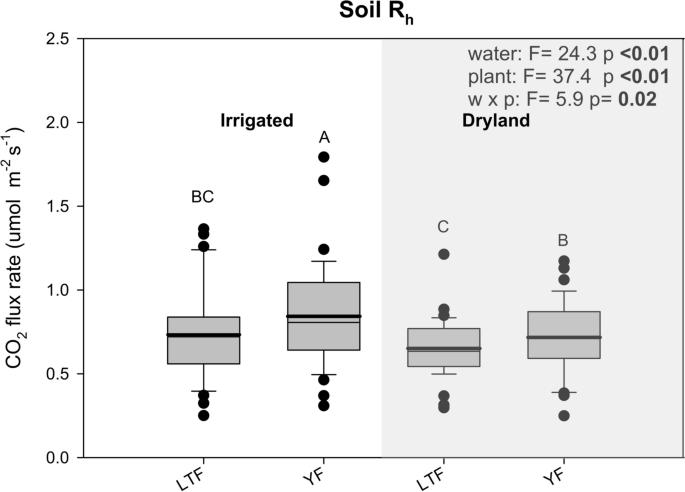
Water limitations are forcing producers to transition large areas of currently irrigated farmland into dryland agriculture across the Western U.S. with unclear effects on global soil carbon (C) dynamics. An experiment established in 2017 in a no-till, maize system in Colorado suggested that soil heterotrophic respiration (Rh) following irrigation retirement was co-regulated by water and available C. We continued Rh measurements in 2021–2022 along with monthly soil samplings to explore the interactive effects of soil moisture and available C on microbial community composition and activity. Plant C inputs, available soil water, bacteria, fungi, and protozoa fatty acid methyl ester (FAME) biomarkers, enzyme activity, and Rh decreased after irrigation retirement, while actinobacteria abundance was not affected. Non-irrigated plots accumulated higher concentrations of dissolved organic carbon (DOC) and, in the absence of new C inputs, Rh from older SOC pools did not differ by irrigation treatment, suggesting limited microbial access to available C under low moisture. Short-term Rh variation was primarily moisture-driven, whereas cumulative residue inputs explained longer-term differences. Overall, microbial activity under irrigation retirement was co-limited by water and substrate availability. Management strategies that enhance soil moisture retention and maintain residue inputs are essential to sustain soil C cycling and resilience.
期刊介绍:
Biogeochemistry publishes original and synthetic papers dealing with biotic controls on the chemistry of the environment, or with the geochemical control of the structure and function of ecosystems. Cycles are considered, either of individual elements or of specific classes of natural or anthropogenic compounds in ecosystems. Particular emphasis is given to coupled interactions of element cycles. The journal spans from the molecular to global scales to elucidate the mechanisms driving patterns in biogeochemical cycles through space and time. Studies on both natural and artificial ecosystems are published when they contribute to a general understanding of biogeochemistry.

 求助内容:
求助内容: 应助结果提醒方式:

 京公网安备 11010802042870号


