Anirudh Salgundi, Suman Bala, Gayathri Raman, Utkarsh Pathak, Varun Bhalerao
{"title":"‘Bursts, beats, and beyond’: uncovering the landscape from accretion to ignition of 4U 1728–34 using AstroSat","authors":"Anirudh Salgundi, Suman Bala, Gayathri Raman, Utkarsh Pathak, Varun Bhalerao","doi":"10.1007/s12036-025-10124-1","DOIUrl":null,"url":null,"abstract":"<div><p>A comprehensive study on persistent and thermonuclear burst emission of 4U 1728–34, commonly known as ‘Slow Burster’, is performed using seven archival observations of <i>AstroSat</i> spanning from 2016 to 2019. The burst-free persistent spectra can be well fitted with a blackbody (<span>bbody</span>) and a powerlaw (<span>powerlaw</span>) components, with a powerlaw photon index (<span>\\(\\Gamma \\)</span>) found to be <span>\\(\\sim \\)</span>2, indicating the source was in ‘high/soft’ banana state or intermediate state. The time-averaged power density spectrum reveals the presence of twin kilohertz Quasi Periodic Oscillations (kHz QPOs) with centroid frequencies <span>\\(619\\pm 10\\)</span> and <span>\\(965\\pm 6\\)</span> Hz with a maximum fractional root mean squared amplitude of <span>\\(6.24\\pm 1.31\\)</span>% at <span>\\(\\sim \\)</span>16 keV. From the upper kHz QPO, we infer the magnetospheric disk radius to be <span>\\(\\sim \\)</span>17 km, corresponding to a magnetic field strength of 0.35–<span>\\(1.27\\times 10^7\\)</span> G. The burst spectral evolution indicates Photospheric Radius Expansion (PRE) in five bursts, yielding a touchdown radius of 3.1–5.47 km. These bursts reached near-Eddington luminosities, through which the distance of the source was calculated to be 5.18–5.21 kpc. Two of the bursts show coherent oscillations at 362.81–363.93 Hz. The presence of twin kHz QPOs and coherent Burst Oscillations allows us to provide two different estimates for the spin frequency of the Neutron Star in the system, for the first time using <i>AstroSat</i>.</p></div>","PeriodicalId":610,"journal":{"name":"Journal of Astrophysics and Astronomy","volume":"47 1","pages":""},"PeriodicalIF":1.6000,"publicationDate":"2026-04-04","publicationTypes":"Journal Article","fieldsOfStudy":null,"isOpenAccess":false,"openAccessPdf":"","citationCount":"0","resultStr":null,"platform":"Semanticscholar","paperid":null,"PeriodicalName":"Journal of Astrophysics and Astronomy","FirstCategoryId":"101","ListUrlMain":"https://link.springer.com/article/10.1007/s12036-025-10124-1","RegionNum":4,"RegionCategory":"物理与天体物理","ArticlePicture":[],"TitleCN":null,"AbstractTextCN":null,"PMCID":null,"EPubDate":"","PubModel":"","JCR":"Q3","JCRName":"ASTRONOMY & ASTROPHYSICS","Score":null,"Total":0}
引用次数: 0
Abstract
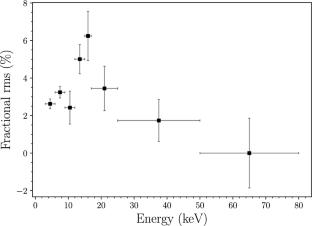
A comprehensive study on persistent and thermonuclear burst emission of 4U 1728–34, commonly known as ‘Slow Burster’, is performed using seven archival observations of AstroSat spanning from 2016 to 2019. The burst-free persistent spectra can be well fitted with a blackbody (bbody) and a powerlaw (powerlaw) components, with a powerlaw photon index (\(\Gamma \)) found to be \(\sim \)2, indicating the source was in ‘high/soft’ banana state or intermediate state. The time-averaged power density spectrum reveals the presence of twin kilohertz Quasi Periodic Oscillations (kHz QPOs) with centroid frequencies \(619\pm 10\) and \(965\pm 6\) Hz with a maximum fractional root mean squared amplitude of \(6.24\pm 1.31\)% at \(\sim \)16 keV. From the upper kHz QPO, we infer the magnetospheric disk radius to be \(\sim \)17 km, corresponding to a magnetic field strength of 0.35–\(1.27\times 10^7\) G. The burst spectral evolution indicates Photospheric Radius Expansion (PRE) in five bursts, yielding a touchdown radius of 3.1–5.47 km. These bursts reached near-Eddington luminosities, through which the distance of the source was calculated to be 5.18–5.21 kpc. Two of the bursts show coherent oscillations at 362.81–363.93 Hz. The presence of twin kHz QPOs and coherent Burst Oscillations allows us to provide two different estimates for the spin frequency of the Neutron Star in the system, for the first time using AstroSat.
利用AstroSat 2016年至2019年的七次档案观测资料,对4U 1728-34(俗称“慢爆”)的持续和热核爆炸发射进行了全面研究。无爆发持久光谱可以很好地与黑体(bbody)和幂律(powerlaw)分量相匹配,幂律光子指数(\(\Gamma \))为\(\sim \) 2,表明源处于“高/软”香蕉态或中间态。时间平均功率密度谱显示存在双千赫准周期振荡(kHz QPOs),质心频率为\(619\pm 10\)和\(965\pm 6\) Hz,最大分数均方根振幅为 \(6.24\pm 1.31\)% at \(\sim \)16 keV. From the upper kHz QPO, we infer the magnetospheric disk radius to be \(\sim \)17 km, corresponding to a magnetic field strength of 0.35–\(1.27\times 10^7\) G. The burst spectral evolution indicates Photospheric Radius Expansion (PRE) in five bursts, yielding a touchdown radius of 3.1–5.47 km. These bursts reached near-Eddington luminosities, through which the distance of the source was calculated to be 5.18–5.21 kpc. Two of the bursts show coherent oscillations at 362.81–363.93 Hz. The presence of twin kHz QPOs and coherent Burst Oscillations allows us to provide two different estimates for the spin frequency of the Neutron Star in the system, for the first time using AstroSat.
期刊介绍:
The journal publishes original research papers on all aspects of astrophysics and astronomy, including instrumentation, laboratory astrophysics, and cosmology. Critical reviews of topical fields are also published.
Articles submitted as letters will be considered.

 求助内容:
求助内容: 应助结果提醒方式:

 京公网安备 11010802042870号


