{"title":"[The Cited Literature of Acupuncture and moxibustion prescriptions in <i>Yi Xue Gang Mu</i>].","authors":"Q Y Chai, S Y Li","doi":"10.3760/cma.j.cn112155-20250514-00076","DOIUrl":null,"url":null,"abstract":"<p><p><i>The Compendium of Medicine</i> (<i>Yi Xue Gang Mu</i>), written by Lou Ying in the Ming Dynasty, is a comprehensive medical masterpiece. It quoted a great amount of traditional classics and saved a great deal of valuable literature of acupuncture which was almost lost in history. This study systematically examined the cited literature in terms of acupuncture and moxibustion in this book, focusing on the edition found in Jianyang mainly and the edition published by Caozhuo as references. A total of more than 200,000 characters and 1,337 acupuncture treatment entries were collated, in which 1,166 explicitly cited can be traced back to 40 ancient medical texts and physicians' works, 8 physicians' writings, and one special therapy, involving 105 abbreviated names, with some remaining unverified. The content of the quotation in <i>the Compendium of Medicine</i> basically took two approaches, verbatim citation and adaptation with additions or deletions. The acupuncture and moxibustion section in the quotation collected a total of 528 disease treatments with extensive citation, integrating diverse medical traditions with systematic classification and a diversity of diseases or symptoms. These citations prioritised clinical efficacy, highlighting the synergistic application of acupuncture, moxibustion and herbal medicine while they showed inconsistencies in abbreviation usages and occasional textual errors to some extent. The acupuncture prescriptions in <i>Compendium of Medicine</i> are organised methodically, enriched with the author's clinical experience of a variety of materials. It is a valuable reference for acupuncture practice and lays a foundation for reconstructing pre-Ming acupuncture literature by drawing on a great amount of quotations and citations.</p>","PeriodicalId":35995,"journal":{"name":"中华医史杂志","volume":"56 1","pages":"34-41"},"PeriodicalIF":0.0000,"publicationDate":"2026-01-28","publicationTypes":"Journal Article","fieldsOfStudy":null,"isOpenAccess":false,"openAccessPdf":"","citationCount":"0","resultStr":null,"platform":"Semanticscholar","paperid":null,"PeriodicalName":"中华医史杂志","FirstCategoryId":"1090","ListUrlMain":"https://doi.org/10.3760/cma.j.cn112155-20250514-00076","RegionNum":0,"RegionCategory":null,"ArticlePicture":[],"TitleCN":null,"AbstractTextCN":null,"PMCID":null,"EPubDate":"","PubModel":"","JCR":"Q4","JCRName":"Medicine","Score":null,"Total":0}
引用次数: 0
Abstract
The Compendium of Medicine (Yi Xue Gang Mu), written by Lou Ying in the Ming Dynasty, is a comprehensive medical masterpiece. It quoted a great amount of traditional classics and saved a great deal of valuable literature of acupuncture which was almost lost in history. This study systematically examined the cited literature in terms of acupuncture and moxibustion in this book, focusing on the edition found in Jianyang mainly and the edition published by Caozhuo as references. A total of more than 200,000 characters and 1,337 acupuncture treatment entries were collated, in which 1,166 explicitly cited can be traced back to 40 ancient medical texts and physicians' works, 8 physicians' writings, and one special therapy, involving 105 abbreviated names, with some remaining unverified. The content of the quotation in the Compendium of Medicine basically took two approaches, verbatim citation and adaptation with additions or deletions. The acupuncture and moxibustion section in the quotation collected a total of 528 disease treatments with extensive citation, integrating diverse medical traditions with systematic classification and a diversity of diseases or symptoms. These citations prioritised clinical efficacy, highlighting the synergistic application of acupuncture, moxibustion and herbal medicine while they showed inconsistencies in abbreviation usages and occasional textual errors to some extent. The acupuncture prescriptions in Compendium of Medicine are organised methodically, enriched with the author's clinical experience of a variety of materials. It is a valuable reference for acupuncture practice and lays a foundation for reconstructing pre-Ming acupuncture literature by drawing on a great amount of quotations and citations.
期刊介绍:
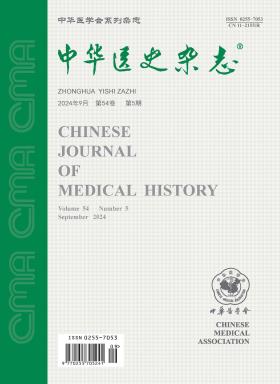
The Chinese Journal of Medical History is the only professional academic journal on medical history in the country. The first publication was named "Journal of Medical History" and was designated as a quarterly publication. In 2009, it was changed from quarterly to bimonthly.
The Chinese Journal of Medical History has columns such as special articles, reviews, expert talks, medical history treatises, literature research, forums and debates, historical accounts, figures, short essays, graduate forums, lectures, historical materials, medical history, and book reviews.
Chinese Journal of Medical History has been included in the US Medline online database.

 求助内容:
求助内容: 应助结果提醒方式:

 京公网安备 11010802042870号


