{"title":"[The Tibetan manuscript No. B147: 36 collected in the North Cave of Mogao].","authors":"Y H Liu, J Z M Dekyi, X J Li","doi":"10.3760/cma.j.cn112155-20240926-00133","DOIUrl":null,"url":null,"abstract":"<p><p>The document No. B147: 36 (the obverse side), unearthed in Cave 147 in the North region of Mogao grotto at Dunghuang, is a fragment of a medical manuscript in Tibetan. It has the remains of 7 hand-painted wheel drawings and Tibetan script in cursive style. Tibetan was found inside the wheel hub and blade-like compartments (4-8 compartments) separated by the spokes, matching some Tibetan outside of the wheel rim. It can be seen in the remaining illustrations that a formula is in each wheel drawing and a name of a hurb in each compartment, with the name of the key hurb written inside of the wheel hub. Each formula has 7-9 ingredients. The efficacy of each formula is written above or outside the wheel hub. The medicine and efficacy in the wheel hub formulae are in line with Tibetan medicine theory, while the same formulae are not found in any of the Chinese or Tibetan medicinal manuscripts at Dun Huang, nor found in the form of wheel hub paintings. However, two of the basically similar formulae are found in <i>the Four Medical Tantras (Rgyud Bzhi)</i>, but these wheel hub formulae do not specify the proportioning, dosage, use and contraindications. As a result, they might be taken orally as charms for disease treatment provided by mantrikas or warlocks.</p>","PeriodicalId":35995,"journal":{"name":"中华医史杂志","volume":"56 1","pages":"10-18"},"PeriodicalIF":0.0000,"publicationDate":"2026-01-28","publicationTypes":"Journal Article","fieldsOfStudy":null,"isOpenAccess":false,"openAccessPdf":"","citationCount":"0","resultStr":null,"platform":"Semanticscholar","paperid":null,"PeriodicalName":"中华医史杂志","FirstCategoryId":"1090","ListUrlMain":"https://doi.org/10.3760/cma.j.cn112155-20240926-00133","RegionNum":0,"RegionCategory":null,"ArticlePicture":[],"TitleCN":null,"AbstractTextCN":null,"PMCID":null,"EPubDate":"","PubModel":"","JCR":"Q4","JCRName":"Medicine","Score":null,"Total":0}
引用次数: 0
Abstract
The document No. B147: 36 (the obverse side), unearthed in Cave 147 in the North region of Mogao grotto at Dunghuang, is a fragment of a medical manuscript in Tibetan. It has the remains of 7 hand-painted wheel drawings and Tibetan script in cursive style. Tibetan was found inside the wheel hub and blade-like compartments (4-8 compartments) separated by the spokes, matching some Tibetan outside of the wheel rim. It can be seen in the remaining illustrations that a formula is in each wheel drawing and a name of a hurb in each compartment, with the name of the key hurb written inside of the wheel hub. Each formula has 7-9 ingredients. The efficacy of each formula is written above or outside the wheel hub. The medicine and efficacy in the wheel hub formulae are in line with Tibetan medicine theory, while the same formulae are not found in any of the Chinese or Tibetan medicinal manuscripts at Dun Huang, nor found in the form of wheel hub paintings. However, two of the basically similar formulae are found in the Four Medical Tantras (Rgyud Bzhi), but these wheel hub formulae do not specify the proportioning, dosage, use and contraindications. As a result, they might be taken orally as charms for disease treatment provided by mantrikas or warlocks.
期刊介绍:
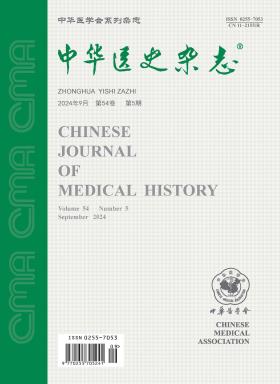
The Chinese Journal of Medical History is the only professional academic journal on medical history in the country. The first publication was named "Journal of Medical History" and was designated as a quarterly publication. In 2009, it was changed from quarterly to bimonthly.
The Chinese Journal of Medical History has columns such as special articles, reviews, expert talks, medical history treatises, literature research, forums and debates, historical accounts, figures, short essays, graduate forums, lectures, historical materials, medical history, and book reviews.
Chinese Journal of Medical History has been included in the US Medline online database.

 求助内容:
求助内容: 应助结果提醒方式:

 京公网安备 11010802042870号


