M. A. Maslennikova, A. M. Tatarnikov, A. A. Tatarnikova, A. V. Dodin, B. S. Safonov
{"title":"AS 357 Is a New Symbiotic Star","authors":"M. A. Maslennikova, A. M. Tatarnikov, A. A. Tatarnikova, A. V. Dodin, B. S. Safonov","doi":"10.1134/S1063772925702440","DOIUrl":null,"url":null,"abstract":"<p>The article presents the results of spectroscopic observations of poorly studied variable star AS 357, proving that it is an S-type symbiotic star. The object’s spectrum contains TiO molecular bands; bright emission lines of H I, He I, [O II], [O III], [N II]; a weak line of He II; etc. Photometric observations show that the system is a long-period variable with a period of <span>\\( \\sim {\\kern 1pt} {850^d}\\)</span>. This is likely the system’s orbital period. Estimates were obtained for the temperature of the hot component, <span>\\({T_{\\text{h}}} \\approx 55\\,000\\)</span> K, and its luminosity, <span>\\({L_{\\text{h}}} \\approx 1300{\\kern 1pt} {L_ \\odot }\\)</span>. The spectral class of the cold component is M3 III, with a luminosity of <span>\\({L_{\\text{c}}} = (2500{-} 3400){\\kern 1pt} {L_ \\odot }\\)</span> and a radius of <span>\\({R_{\\text{c}}} = (130{-} 150){\\kern 1pt} {R_ \\odot }\\)</span>. There is excess radiation in the short-wavelength region of the spectrum that can be attributed to an accretion disk around the hot component. The study is partially based on a talk presented at the Modern Stellar Astronomy 2025 conference.</p>","PeriodicalId":55440,"journal":{"name":"Astronomy Reports","volume":"69 12","pages":"1373 - 1379"},"PeriodicalIF":0.7000,"publicationDate":"2026-04-01","publicationTypes":"Journal Article","fieldsOfStudy":null,"isOpenAccess":false,"openAccessPdf":"","citationCount":"0","resultStr":null,"platform":"Semanticscholar","paperid":null,"PeriodicalName":"Astronomy Reports","FirstCategoryId":"101","ListUrlMain":"https://link.springer.com/article/10.1134/S1063772925702440","RegionNum":4,"RegionCategory":"物理与天体物理","ArticlePicture":[],"TitleCN":null,"AbstractTextCN":null,"PMCID":null,"EPubDate":"","PubModel":"","JCR":"Q3","JCRName":"ASTRONOMY & ASTROPHYSICS","Score":null,"Total":0}
引用次数: 0
Abstract
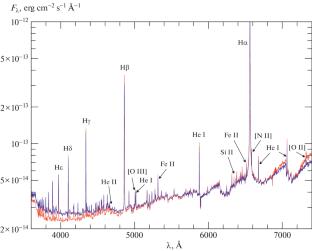
The article presents the results of spectroscopic observations of poorly studied variable star AS 357, proving that it is an S-type symbiotic star. The object’s spectrum contains TiO molecular bands; bright emission lines of H I, He I, [O II], [O III], [N II]; a weak line of He II; etc. Photometric observations show that the system is a long-period variable with a period of \( \sim {\kern 1pt} {850^d}\). This is likely the system’s orbital period. Estimates were obtained for the temperature of the hot component, \({T_{\text{h}}} \approx 55\,000\) K, and its luminosity, \({L_{\text{h}}} \approx 1300{\kern 1pt} {L_ \odot }\). The spectral class of the cold component is M3 III, with a luminosity of \({L_{\text{c}}} = (2500{-} 3400){\kern 1pt} {L_ \odot }\) and a radius of \({R_{\text{c}}} = (130{-} 150){\kern 1pt} {R_ \odot }\). There is excess radiation in the short-wavelength region of the spectrum that can be attributed to an accretion disk around the hot component. The study is partially based on a talk presented at the Modern Stellar Astronomy 2025 conference.
期刊介绍:
Astronomy Reports is an international peer reviewed journal that publishes original papers on astronomical topics, including theoretical and observational astrophysics, physics of the Sun, planetary astrophysics, radio astronomy, stellar astronomy, celestial mechanics, and astronomy methods and instrumentation.

 求助内容:
求助内容: 应助结果提醒方式:

 京公网安备 11010802042870号


