{"title":"Old Open Clusters NGC 188 and M 67 in Gaia DR3","authors":"A. F. Seleznev, M. V. Kulesh","doi":"10.1134/S1063772925702488","DOIUrl":null,"url":null,"abstract":"<p>We performed a statistical study of two old open clusters NGC 188 and M 67 using Gaia DR3 data. No tidal tails of the clusters were detected, which most likely had been destroyed when the cluster passed through the Galactic plane. The size estimates of the clusters depend on the range of astrometric parameters and stellar magnitudes of the stars used for star counts. The mass spectra of two clusters differ significantly. NGC 188 shows a deficit of low-mass stars compared to M 67. In the halo region of NGC 188 (compared to the core region of the cluster), there is a relative excess of the low-mass stars (just as in the case of M 67) and a deficit of stars in the mass range from 0.66 to 0.9 solar masses. Comparison with the Hunt and Reffert samples showed that almost all the stars from these samples are contained among the stars we selected for counting. Moreover, the group probability of these stars belonging to clusters, estimated by the uniform field method, is higher than 60%. It is shown that the velocity dispersion of single stars (selected according to the {stellar magnitude–color index} diagrams) is significantly smaller than the velocity dispersion of unresolved binary stars. The work is partially based on a talk presented at the Modern Stellar Astronomy 2025 conference.</p>","PeriodicalId":55440,"journal":{"name":"Astronomy Reports","volume":"69 12","pages":"1241 - 1259"},"PeriodicalIF":0.7000,"publicationDate":"2026-04-01","publicationTypes":"Journal Article","fieldsOfStudy":null,"isOpenAccess":false,"openAccessPdf":"","citationCount":"0","resultStr":null,"platform":"Semanticscholar","paperid":null,"PeriodicalName":"Astronomy Reports","FirstCategoryId":"101","ListUrlMain":"https://link.springer.com/article/10.1134/S1063772925702488","RegionNum":4,"RegionCategory":"物理与天体物理","ArticlePicture":[],"TitleCN":null,"AbstractTextCN":null,"PMCID":null,"EPubDate":"","PubModel":"","JCR":"Q3","JCRName":"ASTRONOMY & ASTROPHYSICS","Score":null,"Total":0}
引用次数: 0
Abstract
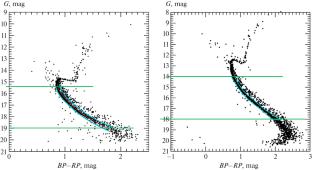
We performed a statistical study of two old open clusters NGC 188 and M 67 using Gaia DR3 data. No tidal tails of the clusters were detected, which most likely had been destroyed when the cluster passed through the Galactic plane. The size estimates of the clusters depend on the range of astrometric parameters and stellar magnitudes of the stars used for star counts. The mass spectra of two clusters differ significantly. NGC 188 shows a deficit of low-mass stars compared to M 67. In the halo region of NGC 188 (compared to the core region of the cluster), there is a relative excess of the low-mass stars (just as in the case of M 67) and a deficit of stars in the mass range from 0.66 to 0.9 solar masses. Comparison with the Hunt and Reffert samples showed that almost all the stars from these samples are contained among the stars we selected for counting. Moreover, the group probability of these stars belonging to clusters, estimated by the uniform field method, is higher than 60%. It is shown that the velocity dispersion of single stars (selected according to the {stellar magnitude–color index} diagrams) is significantly smaller than the velocity dispersion of unresolved binary stars. The work is partially based on a talk presented at the Modern Stellar Astronomy 2025 conference.
期刊介绍:
Astronomy Reports is an international peer reviewed journal that publishes original papers on astronomical topics, including theoretical and observational astrophysics, physics of the Sun, planetary astrophysics, radio astronomy, stellar astronomy, celestial mechanics, and astronomy methods and instrumentation.

 求助内容:
求助内容: 应助结果提醒方式:

 京公网安备 11010802042870号


