A. Yu. Kniazev, O. Yu. Malkov, L. N. Berdnikov, I. Yu. Katkov
{"title":"Investigation of Long-Period Eclipsing Binaries: Absolute Parameters and the Evolutionary Status of the V891 Mon System","authors":"A. Yu. Kniazev, O. Yu. Malkov, L. N. Berdnikov, I. Yu. Katkov","doi":"10.1134/S1063772925702427","DOIUrl":null,"url":null,"abstract":"<p>In this paper, we present the results of a study of a long-period eclipsing binary system V891 Mon having a period of <span>\\(P = {31.42050^d}\\)</span>. The presented study is based on spectral data obtained during 2020–2022 on the echelle spectrograph HRS of the SALT telescope and TESS photometric data. The constructed radial velocity curve is based on 11 spectra covering all phases of this binary system. The orbital parameters of this binary system have been determined for the first time. The constructed model for the light curve according to TESS data converges with an accuracy of 0.01%. The effective temperatures of both components, their rotational velocities, as well as the metallicity of the system and the interstellar reddening value are directly determined from the spectra. Our analysis of photometric and spectral data allowed us to directly calculate the luminosities of both components, their radii and masses with accuracy of less than one percent. A comparison with the evolutionary tracks shows that the age of the system is 325 Myr, component A has already left the main sequence (MS), and component B is still on MS. Both components are not synchronized, and the system is not circularized. The kinematic characteristics, together with the metallicity determined in this work, indicate that the V891 Mon system is a typical representative of the “kinematically cold” component of a thin disk, which is consistent with its evolutionary status as a young system. Despite the large eccentricity, the orbit of the system is oriented to the line of sight in such a way that it can only be determined using spectral data. The work is partially based on a talk presented at the Modern Stellar Astronomy 2025 conference.</p>","PeriodicalId":55440,"journal":{"name":"Astronomy Reports","volume":"69 12","pages":"1326 - 1341"},"PeriodicalIF":0.7000,"publicationDate":"2026-04-01","publicationTypes":"Journal Article","fieldsOfStudy":null,"isOpenAccess":false,"openAccessPdf":"","citationCount":"0","resultStr":null,"platform":"Semanticscholar","paperid":null,"PeriodicalName":"Astronomy Reports","FirstCategoryId":"101","ListUrlMain":"https://link.springer.com/article/10.1134/S1063772925702427","RegionNum":4,"RegionCategory":"物理与天体物理","ArticlePicture":[],"TitleCN":null,"AbstractTextCN":null,"PMCID":null,"EPubDate":"","PubModel":"","JCR":"Q3","JCRName":"ASTRONOMY & ASTROPHYSICS","Score":null,"Total":0}
引用次数: 0
Abstract
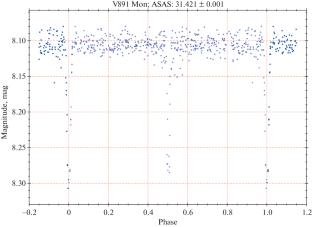
In this paper, we present the results of a study of a long-period eclipsing binary system V891 Mon having a period of \(P = {31.42050^d}\). The presented study is based on spectral data obtained during 2020–2022 on the echelle spectrograph HRS of the SALT telescope and TESS photometric data. The constructed radial velocity curve is based on 11 spectra covering all phases of this binary system. The orbital parameters of this binary system have been determined for the first time. The constructed model for the light curve according to TESS data converges with an accuracy of 0.01%. The effective temperatures of both components, their rotational velocities, as well as the metallicity of the system and the interstellar reddening value are directly determined from the spectra. Our analysis of photometric and spectral data allowed us to directly calculate the luminosities of both components, their radii and masses with accuracy of less than one percent. A comparison with the evolutionary tracks shows that the age of the system is 325 Myr, component A has already left the main sequence (MS), and component B is still on MS. Both components are not synchronized, and the system is not circularized. The kinematic characteristics, together with the metallicity determined in this work, indicate that the V891 Mon system is a typical representative of the “kinematically cold” component of a thin disk, which is consistent with its evolutionary status as a young system. Despite the large eccentricity, the orbit of the system is oriented to the line of sight in such a way that it can only be determined using spectral data. The work is partially based on a talk presented at the Modern Stellar Astronomy 2025 conference.
在本文中,我们提出了对周期为\(P = {31.42050^d}\)的长周期食双星系统V891 Mon的研究结果。本研究基于SALT望远镜梯队光谱仪HRS在2020-2022年间获得的光谱数据和TESS光度数据。所构建的径向速度曲线是基于覆盖该双星系统所有相位的11个光谱。该双星系统的轨道参数首次被确定。根据TESS数据构建的光曲线模型收敛精度为0.01%. The effective temperatures of both components, their rotational velocities, as well as the metallicity of the system and the interstellar reddening value are directly determined from the spectra. Our analysis of photometric and spectral data allowed us to directly calculate the luminosities of both components, their radii and masses with accuracy of less than one percent. A comparison with the evolutionary tracks shows that the age of the system is 325 Myr, component A has already left the main sequence (MS), and component B is still on MS. Both components are not synchronized, and the system is not circularized. The kinematic characteristics, together with the metallicity determined in this work, indicate that the V891 Mon system is a typical representative of the “kinematically cold” component of a thin disk, which is consistent with its evolutionary status as a young system. Despite the large eccentricity, the orbit of the system is oriented to the line of sight in such a way that it can only be determined using spectral data. The work is partially based on a talk presented at the Modern Stellar Astronomy 2025 conference.
期刊介绍:
Astronomy Reports is an international peer reviewed journal that publishes original papers on astronomical topics, including theoretical and observational astrophysics, physics of the Sun, planetary astrophysics, radio astronomy, stellar astronomy, celestial mechanics, and astronomy methods and instrumentation.

 求助内容:
求助内容: 应助结果提醒方式:

 京公网安备 11010802042870号


