{"title":"Inflammatory Bowel Disease Incidence following COVID-19: A Systematic Review and Meta-Analysis.","authors":"Aris P Agouridis, Alexandros Hadjivasilis, Georgios Vougiouklakis, Theognosia Ioannou, Stavria Charitonos, Marios Christoforou, Evangelos Ionas, Dimitrios Giannakakis, Nikolaos Spernovasilis","doi":"10.1159/000550703","DOIUrl":null,"url":null,"abstract":"<p><strong>Background: </strong>A surge of cases of autoimmune and inflammatory diseases, such as inflammatory bowel disease (IBD), have been reported after coronavirus disease 2019 (COVID-19).</p><p><strong>Objective: </strong>The objective of this study was to assess whether COVID-19 has a role in IBD risk.</p><p><strong>Methods: </strong>We searched MEDLINE (PubMed), Cochrane Library and OpenGrey databases up to October 30, 2025, for studies evaluating the incidence of IBD following COVID-19 infection (PROSPERO ID: CRD42024534916).</p><p><strong>Results: </strong>After a full-text review of 84 manuscripts, a total of 8 studies were used in the qualitative analysis. The studies were conducted between 2023 and 2024 and included in total 28,659,801 people, 8,560,826 of which were previously infected with COVID-19 and 20,098,975 that served as healthy controls. The results from the pooled synthesis of 6 studies indicate a 39% higher incidence of IBD in people that were previously infected with COVID-19 (risk ratio [RR] 1.39, 95% CI: [1.12-1.74], <i>p</i> = 0.003, <i>I</i> <sup>2</sup> = 97%). Furthermore, from the pooled analysis of 4 eligible studies, a higher incidence of new ulcerative colitis cases following COVID-19 was observed (RR 1.25, 95% CI: [1.17-1.33], <i>p</i> < 0.00001, <i>I</i> <sup>2</sup> = 0%). On the contrary, no difference was observed in Crohn's disease incidence between COVID-19 and non-COVID-19 patients (RR 1.23 95% CI: [0.88, 1.72], <i>p</i> = 0.22, <i>I</i> <sup>2</sup> = 91%).</p><p><strong>Conclusions: </strong>The findings of the present meta-analysis suggest an increased risk of IBD after COVID-19 infection. Although this is more evident regarding ulcerative colitis, we believe that the available outcomes arising from future studies will clarify the real incidence of Crohn's disease following COVID-19 infection.</p>","PeriodicalId":51838,"journal":{"name":"GE Portuguese Journal of Gastroenterology","volume":"33 1","pages":"387-395"},"PeriodicalIF":0.6000,"publicationDate":"2026-02-11","publicationTypes":"Journal Article","fieldsOfStudy":null,"isOpenAccess":false,"openAccessPdf":"https://www.ncbi.nlm.nih.gov/pmc/articles/PMC13021230/pdf/","citationCount":"0","resultStr":null,"platform":"Semanticscholar","paperid":null,"PeriodicalName":"GE Portuguese Journal of Gastroenterology","FirstCategoryId":"1085","ListUrlMain":"https://doi.org/10.1159/000550703","RegionNum":0,"RegionCategory":null,"ArticlePicture":[],"TitleCN":null,"AbstractTextCN":null,"PMCID":null,"EPubDate":"2026/1/1 0:00:00","PubModel":"eCollection","JCR":"Q4","JCRName":"GASTROENTEROLOGY & HEPATOLOGY","Score":null,"Total":0}
引用次数: 0
Abstract
Background: A surge of cases of autoimmune and inflammatory diseases, such as inflammatory bowel disease (IBD), have been reported after coronavirus disease 2019 (COVID-19).
Objective: The objective of this study was to assess whether COVID-19 has a role in IBD risk.
Methods: We searched MEDLINE (PubMed), Cochrane Library and OpenGrey databases up to October 30, 2025, for studies evaluating the incidence of IBD following COVID-19 infection (PROSPERO ID: CRD42024534916).
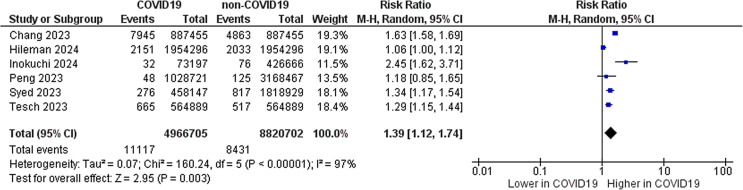
Results: After a full-text review of 84 manuscripts, a total of 8 studies were used in the qualitative analysis. The studies were conducted between 2023 and 2024 and included in total 28,659,801 people, 8,560,826 of which were previously infected with COVID-19 and 20,098,975 that served as healthy controls. The results from the pooled synthesis of 6 studies indicate a 39% higher incidence of IBD in people that were previously infected with COVID-19 (risk ratio [RR] 1.39, 95% CI: [1.12-1.74], p = 0.003, I2 = 97%). Furthermore, from the pooled analysis of 4 eligible studies, a higher incidence of new ulcerative colitis cases following COVID-19 was observed (RR 1.25, 95% CI: [1.17-1.33], p < 0.00001, I2 = 0%). On the contrary, no difference was observed in Crohn's disease incidence between COVID-19 and non-COVID-19 patients (RR 1.23 95% CI: [0.88, 1.72], p = 0.22, I2 = 91%).
Conclusions: The findings of the present meta-analysis suggest an increased risk of IBD after COVID-19 infection. Although this is more evident regarding ulcerative colitis, we believe that the available outcomes arising from future studies will clarify the real incidence of Crohn's disease following COVID-19 infection.
期刊介绍:
The ''GE Portuguese Journal of Gastroenterology'' (formerly Jornal Português de Gastrenterologia), founded in 1994, is the official publication of Sociedade Portuguesa de Gastrenterologia (Portuguese Society of Gastroenterology), Sociedade Portuguesa de Endoscopia Digestiva (Portuguese Society of Digestive Endoscopy) and Associação Portuguesa para o Estudo do Fígado (Portuguese Association for the Study of the Liver). The journal publishes clinical and basic research articles on Gastroenterology, Digestive Endoscopy, Hepatology and related topics. Review articles, clinical case studies, images, letters to the editor and other articles such as recommendations or papers on gastroenterology clinical practice are also considered. Only articles written in English are accepted.



 求助内容:
求助内容: 应助结果提醒方式:

 京公网安备 11010802042870号


