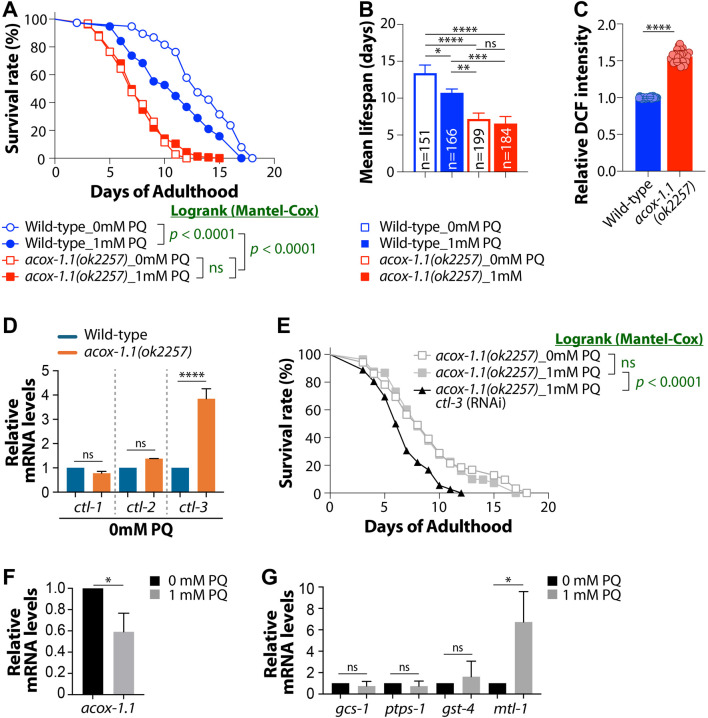
{"title":"Enhanced oxidative stress resilience in <i>C. elegans acox-1.1</i> mutants through CTL-3 and proteasomal regulation.","authors":"Woori Bae, Mina Norman, Myon Hee Lee","doi":"10.3389/ebm.2026.10796","DOIUrl":null,"url":null,"abstract":"<p><p>Oxidative stress is a primary driver of aging, necessitating robust cellular adaptation mechanisms. While peroxisomal β-oxidation and proteasomal degradation are known to influence stress responses, their functional crosstalk remains elusive. In this study, we show that <i>C. elegans acox-1.1</i> mutants, despite having a shortened lifespan under normal conditions, exhibit a paradoxical resistance to mild chronic oxidative stress (1 mM paraquat, PQ) compared to wild-type worms. This PQ-induced resistance in <i>acox-1.1</i> mutants was independent of the canonical SKN-1 pathway but required the peroxisomal catalase CTL-3. RNA-mediated knockdown of <i>ctl-3</i> largely abolished the stress resistance of <i>acox-1.1</i> mutants, leading to rapid mortality. Proteomic and biochemical analyses revealed that <i>acox-1.1</i> mutants possess reduced levels of PAS-5, a core 20S proteasome subunit, resulting in impaired proteasomal assembly and accumulation of ubiquitinated (Ub) substrates under basal conditions. Intriguingly, exposure to 1 mM PQ significantly reduced the Ub-smear in <i>acox-1.1</i> mutants, suggesting a metabolic shift where the cell prioritizes ROS scavenging over ATP-dependent protein degradation. Under oxidative stress, <i>acox-1.1</i> mutants bypass defective proteasomal machinery and redirect energy toward CTL-3-mediated antioxidant defense. This study identified a peroxisomal adaptation mechanism whereby reduced proteasome complexity, coupled with enhanced ROS-regulatory machinery, confers survival advantages under specific oxidative challenges.</p>","PeriodicalId":12163,"journal":{"name":"Experimental Biology and Medicine","volume":"251 ","pages":"10796"},"PeriodicalIF":2.7000,"publicationDate":"2026-03-13","publicationTypes":"Journal Article","fieldsOfStudy":null,"isOpenAccess":false,"openAccessPdf":"https://www.ncbi.nlm.nih.gov/pmc/articles/PMC13021563/pdf/","citationCount":"0","resultStr":null,"platform":"Semanticscholar","paperid":null,"PeriodicalName":"Experimental Biology and Medicine","FirstCategoryId":"3","ListUrlMain":"https://doi.org/10.3389/ebm.2026.10796","RegionNum":4,"RegionCategory":"医学","ArticlePicture":[],"TitleCN":null,"AbstractTextCN":null,"PMCID":null,"EPubDate":"2026/1/1 0:00:00","PubModel":"eCollection","JCR":"Q2","JCRName":"MEDICINE, RESEARCH & EXPERIMENTAL","Score":null,"Total":0}
引用次数: 0
Abstract
Oxidative stress is a primary driver of aging, necessitating robust cellular adaptation mechanisms. While peroxisomal β-oxidation and proteasomal degradation are known to influence stress responses, their functional crosstalk remains elusive. In this study, we show that C. elegans acox-1.1 mutants, despite having a shortened lifespan under normal conditions, exhibit a paradoxical resistance to mild chronic oxidative stress (1 mM paraquat, PQ) compared to wild-type worms. This PQ-induced resistance in acox-1.1 mutants was independent of the canonical SKN-1 pathway but required the peroxisomal catalase CTL-3. RNA-mediated knockdown of ctl-3 largely abolished the stress resistance of acox-1.1 mutants, leading to rapid mortality. Proteomic and biochemical analyses revealed that acox-1.1 mutants possess reduced levels of PAS-5, a core 20S proteasome subunit, resulting in impaired proteasomal assembly and accumulation of ubiquitinated (Ub) substrates under basal conditions. Intriguingly, exposure to 1 mM PQ significantly reduced the Ub-smear in acox-1.1 mutants, suggesting a metabolic shift where the cell prioritizes ROS scavenging over ATP-dependent protein degradation. Under oxidative stress, acox-1.1 mutants bypass defective proteasomal machinery and redirect energy toward CTL-3-mediated antioxidant defense. This study identified a peroxisomal adaptation mechanism whereby reduced proteasome complexity, coupled with enhanced ROS-regulatory machinery, confers survival advantages under specific oxidative challenges.
期刊介绍:
Experimental Biology and Medicine (EBM) is a global, peer-reviewed journal dedicated to the publication of multidisciplinary and interdisciplinary research in the biomedical sciences. EBM provides both research and review articles as well as meeting symposia and brief communications. Articles in EBM represent cutting edge research at the overlapping junctions of the biological, physical and engineering sciences that impact upon the health and welfare of the world''s population.
Topics covered in EBM include: Anatomy/Pathology; Biochemistry and Molecular Biology; Bioimaging; Biomedical Engineering; Bionanoscience; Cell and Developmental Biology; Endocrinology and Nutrition; Environmental Health/Biomarkers/Precision Medicine; Genomics, Proteomics, and Bioinformatics; Immunology/Microbiology/Virology; Mechanisms of Aging; Neuroscience; Pharmacology and Toxicology; Physiology; Stem Cell Biology; Structural Biology; Systems Biology and Microphysiological Systems; and Translational Research.


 求助内容:
求助内容: 应助结果提醒方式:

 京公网安备 11010802042870号


