Site-Specific Calibration of Low-Cost Particulate Matter (PM) 2.5 Monitors in the United States: A Comparison of Industrial and Non-Industrial Communities.
Jung Hyun Lee, Subin Han, Chang Geun Lee, Tim DaSilva, Carolina Gonzalez-Canas, Jon-Paul McCool, Kenneth L Brown, Jodi Allen, Graham F Peaslee, Jae Hong Park, Julie Peller, Christopher R Iceman, Ellen M Wells
{"title":"Site-Specific Calibration of Low-Cost Particulate Matter (PM) 2.5 Monitors in the United States: A Comparison of Industrial and Non-Industrial Communities.","authors":"Jung Hyun Lee, Subin Han, Chang Geun Lee, Tim DaSilva, Carolina Gonzalez-Canas, Jon-Paul McCool, Kenneth L Brown, Jodi Allen, Graham F Peaslee, Jae Hong Park, Julie Peller, Christopher R Iceman, Ellen M Wells","doi":"10.1007/s44408-026-00112-7","DOIUrl":null,"url":null,"abstract":"<p><p>Particulate matter (PM) poses a significant public health concern, particularly in industrialized communities. While modern sophisticated air monitors like those deployed by the United States Environmental Protection Agency (US EPA) provide accurate 24-h PM2.5 (PM ≤ 2.5 µm) data, limited spatial and temporal coverage may create monitoring gaps. Low-cost monitors, such as a PurpleAir monitor (PA-II), offer an accessible alternative; however, their accuracy can be influenced by local environmental conditions and PM characteristics. This study evaluated the site-specific performance of PA-II in an industrial region within northern Lake County (N = 6) and a suburban region of Tippecanoe County (N = 4), both in Indiana, United States. As a reference measurement, a deployable particulate sampler (DPS) was co-located with each PA-II. For microscopic analysis, PM was collected on a glass substrate. PA-II data were assessed in raw form and following calibration using two methods, with performance assessed by root mean square error (RMSE) and the coefficient of determination (R<sup>2</sup>). Microscopic analysis revealed the presence of dark, irregular particles near industrial sites in northern Lake County, which may affect sensor readings by altering light-scattering efficiency. Raw PA-II data showed weak absolute agreement with DPS measurements in northern Lake County (RMSE: 2.04 µg/m<sup>3</sup>, R<sup>2</sup>: 0.25), while the US-wide calibration exhibited the best performance (RMSE: 1.40 µg/m<sup>3</sup>; R<sup>2</sup>: 0.67). In contrast, raw data showed the best performance in Tippecanoe County (RMSE: 0.62 µg/m<sup>3</sup>; R<sup>2</sup>: 0.94). These findings highlight the relevance of site-specific calibration approaches to enhance the accuracy of low-cost PM2.5 monitors, especially in environmentally impacted communities.</p><p><strong>Graphical abstract: </strong></p><p><strong>Supplementary information: </strong>The online version contains supplementary material available at 10.1007/s44408-026-00112-7.</p>","PeriodicalId":7402,"journal":{"name":"Aerosol and Air Quality Research","volume":"26 4","pages":"35"},"PeriodicalIF":2.9000,"publicationDate":"2026-01-01","publicationTypes":"Journal Article","fieldsOfStudy":null,"isOpenAccess":false,"openAccessPdf":"https://www.ncbi.nlm.nih.gov/pmc/articles/PMC13021805/pdf/","citationCount":"0","resultStr":null,"platform":"Semanticscholar","paperid":null,"PeriodicalName":"Aerosol and Air Quality Research","FirstCategoryId":"93","ListUrlMain":"https://doi.org/10.1007/s44408-026-00112-7","RegionNum":4,"RegionCategory":"环境科学与生态学","ArticlePicture":[],"TitleCN":null,"AbstractTextCN":null,"PMCID":null,"EPubDate":"2026/3/25 0:00:00","PubModel":"Epub","JCR":"Q3","JCRName":"ENVIRONMENTAL SCIENCES","Score":null,"Total":0}
引用次数: 0
Abstract
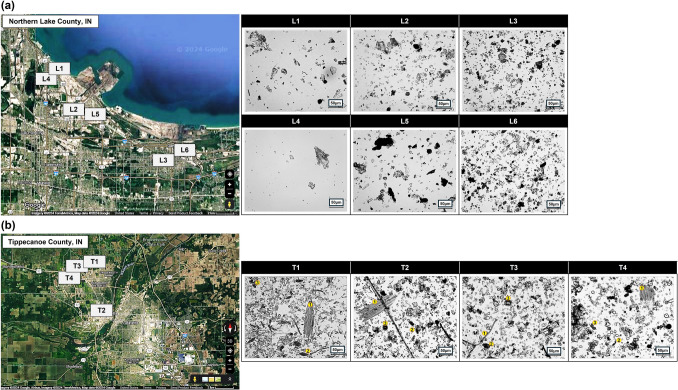
Particulate matter (PM) poses a significant public health concern, particularly in industrialized communities. While modern sophisticated air monitors like those deployed by the United States Environmental Protection Agency (US EPA) provide accurate 24-h PM2.5 (PM ≤ 2.5 µm) data, limited spatial and temporal coverage may create monitoring gaps. Low-cost monitors, such as a PurpleAir monitor (PA-II), offer an accessible alternative; however, their accuracy can be influenced by local environmental conditions and PM characteristics. This study evaluated the site-specific performance of PA-II in an industrial region within northern Lake County (N = 6) and a suburban region of Tippecanoe County (N = 4), both in Indiana, United States. As a reference measurement, a deployable particulate sampler (DPS) was co-located with each PA-II. For microscopic analysis, PM was collected on a glass substrate. PA-II data were assessed in raw form and following calibration using two methods, with performance assessed by root mean square error (RMSE) and the coefficient of determination (R2). Microscopic analysis revealed the presence of dark, irregular particles near industrial sites in northern Lake County, which may affect sensor readings by altering light-scattering efficiency. Raw PA-II data showed weak absolute agreement with DPS measurements in northern Lake County (RMSE: 2.04 µg/m3, R2: 0.25), while the US-wide calibration exhibited the best performance (RMSE: 1.40 µg/m3; R2: 0.67). In contrast, raw data showed the best performance in Tippecanoe County (RMSE: 0.62 µg/m3; R2: 0.94). These findings highlight the relevance of site-specific calibration approaches to enhance the accuracy of low-cost PM2.5 monitors, especially in environmentally impacted communities.
Graphical abstract:
Supplementary information: The online version contains supplementary material available at 10.1007/s44408-026-00112-7.
期刊介绍:
The international journal of Aerosol and Air Quality Research (AAQR) covers all aspects of aerosol science and technology, atmospheric science and air quality related issues. It encompasses a multi-disciplinary field, including:
- Aerosol, air quality, atmospheric chemistry and global change;
- Air toxics (hazardous air pollutants (HAPs), persistent organic pollutants (POPs)) - Sources, control, transport and fate, human exposure;
- Nanoparticle and nanotechnology;
- Sources, combustion, thermal decomposition, emission, properties, behavior, formation, transport, deposition, measurement and analysis;
- Effects on the environments;
- Air quality and human health;
- Bioaerosols;
- Indoor air quality;
- Energy and air pollution;
- Pollution control technologies;
- Invention and improvement of sampling instruments and technologies;
- Optical/radiative properties and remote sensing;
- Carbon dioxide emission, capture, storage and utilization; novel methods for the reduction of carbon dioxide emission;
- Other topics related to aerosol and air quality.



 求助内容:
求助内容: 应助结果提醒方式:

 京公网安备 11010802042870号


