Yuchen Wang, Kun Liu, Henghui Xiao, Zhaorun Zhu, Chenqun Hong, Hongzhen Lin, Jian Wang, Decai Guo, Meinan Liu
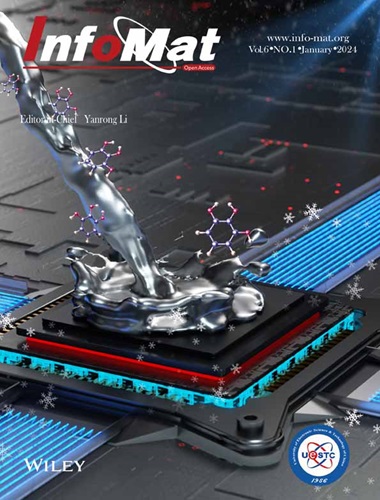
{"title":"Delicate design of lithium-ion bridges in hybrid solid electrolyte for wide-temperature adaptive solid-state lithium metal batteries","authors":"Yuchen Wang, Kun Liu, Henghui Xiao, Zhaorun Zhu, Chenqun Hong, Hongzhen Lin, Jian Wang, Decai Guo, Meinan Liu","doi":"10.1002/inf2.70095","DOIUrl":null,"url":null,"abstract":"<p>Hybrid solid electrolytes have emerged as promising candidates for next-generation high-energy-density solid-state lithium metal batteries owing to the enhanced safety and processability. Nevertheless, the practical implementation remains hindered by severe interfacial Li<sup>+</sup> transport barriers at ceramic-polymer junctions, particularly under ambient low-temperature or high-power-density surroundings. Herein, the lithium-ion bridge concept has been proposed to accelerate Li<sup>+</sup> transport kinetics across the ceramic-polymer interphase through the delicate design of a chemical bonding strategy. As demonstrated, the poly(vinylidene fluoride-co-hexafluoropropylene) (PH) chain with Li<sub>6.4</sub>La<sub>3</sub>Zr<sub>1.4</sub>Ta<sub>0.6</sub>O<sub>12</sub> (LLZTO) particles can be connected by lithium benzene sulfonate as Li<sup>+</sup> conductive bridges. With these Li<sup>+</sup> bridges, this unique hybrid PH-LLZTO solid-state electrolyte exhibits an exceptional ionic conductivity of 0.71 mS cm<sup>−1</sup> at 25°C with a superior Li<sup>+</sup> transference number of 0.67. Impressively, this advanced solid-state electrolyte empowers high-voltage LiNi<sub>0.8</sub>Co<sub>0.1</sub>Mn<sub>0.1</sub>O<sub>2</sub>/Li cells under fast charge/discharge capability as high as 4C and a wide temperature range from −20°C to 60°C. Consequently, the optimal solid-state Li metal battery could stabilize at −20°C with a high discharge specific capacity of 130 mAh g<sup>−1</sup>. Moreover, a bipolar pouch cell by stacking 4 units can be successfully assembled using this advanced solid-state electrolyte with fast Li<sup>+</sup> transport kinetics and delivers an ultra-high voltage of 15.12 V, showcasing the great potential of integrated module application in the future.</p><p>\n <figure>\n <div><picture>\n <source></source></picture><p></p>\n </div>\n </figure></p>","PeriodicalId":48538,"journal":{"name":"Infomat","volume":"8 3","pages":""},"PeriodicalIF":19.6000,"publicationDate":"2026-02-24","publicationTypes":"Journal Article","fieldsOfStudy":null,"isOpenAccess":false,"openAccessPdf":"https://onlinelibrary.wiley.com/doi/epdf/10.1002/inf2.70095","citationCount":"0","resultStr":null,"platform":"Semanticscholar","paperid":null,"PeriodicalName":"Infomat","FirstCategoryId":"88","ListUrlMain":"https://onlinelibrary.wiley.com/doi/10.1002/inf2.70095","RegionNum":1,"RegionCategory":"材料科学","ArticlePicture":[],"TitleCN":null,"AbstractTextCN":null,"PMCID":null,"EPubDate":"2025/10/28 0:00:00","PubModel":"Epub","JCR":"Q1","JCRName":"MATERIALS SCIENCE, MULTIDISCIPLINARY","Score":null,"Total":0}
引用次数: 0
Abstract
Hybrid solid electrolytes have emerged as promising candidates for next-generation high-energy-density solid-state lithium metal batteries owing to the enhanced safety and processability. Nevertheless, the practical implementation remains hindered by severe interfacial Li+ transport barriers at ceramic-polymer junctions, particularly under ambient low-temperature or high-power-density surroundings. Herein, the lithium-ion bridge concept has been proposed to accelerate Li+ transport kinetics across the ceramic-polymer interphase through the delicate design of a chemical bonding strategy. As demonstrated, the poly(vinylidene fluoride-co-hexafluoropropylene) (PH) chain with Li6.4La3Zr1.4Ta0.6O12 (LLZTO) particles can be connected by lithium benzene sulfonate as Li+ conductive bridges. With these Li+ bridges, this unique hybrid PH-LLZTO solid-state electrolyte exhibits an exceptional ionic conductivity of 0.71 mS cm−1 at 25°C with a superior Li+ transference number of 0.67. Impressively, this advanced solid-state electrolyte empowers high-voltage LiNi0.8Co0.1Mn0.1O2/Li cells under fast charge/discharge capability as high as 4C and a wide temperature range from −20°C to 60°C. Consequently, the optimal solid-state Li metal battery could stabilize at −20°C with a high discharge specific capacity of 130 mAh g−1. Moreover, a bipolar pouch cell by stacking 4 units can be successfully assembled using this advanced solid-state electrolyte with fast Li+ transport kinetics and delivers an ultra-high voltage of 15.12 V, showcasing the great potential of integrated module application in the future.
混合固体电解质已成为下一代高能量密度固态锂金属电池的有希望的候选者,因为它具有更高的安全性和可加工性。然而,实际应用仍然受到陶瓷-聚合物连接处严重的界面Li+输运障碍的阻碍,特别是在环境低温或高功率密度环境下。本文提出了锂离子桥的概念,通过精心设计化学键策略来加速Li+在陶瓷-聚合物界面的传递动力学。结果表明,具有Li6.4La3Zr1.4Ta0.6O12 (LLZTO)颗粒的聚偏氟乙烯-共六氟丙烯(PH)链可以通过苯磺酸锂作为Li+导电桥接。有了这些Li+桥,这种独特的混合PH-LLZTO固态电解质在25°C时表现出0.71 mS cm - 1的优异离子电导率,Li+转移数为0.67。令人印象深刻的是,这种先进的固态电解质使高压LiNi0.8Co0.1Mn0.1O2/Li电池在高达4℃的快速充放电能力和−20°C至60°C的宽温度范围下能够工作。因此,最佳固态锂金属电池可以稳定在- 20°C,放电比容量高达130 mAh g - 1。此外,使用这种先进的固态电解质,可以成功地组装一个堆叠4个单元的双极袋状电池,具有快速的Li+传输动力学,并提供15.12 V的超高电压,展示了未来集成模块应用的巨大潜力。
期刊介绍:
InfoMat, an interdisciplinary and open-access journal, caters to the growing scientific interest in novel materials with unique electrical, optical, and magnetic properties, focusing on their applications in the rapid advancement of information technology. The journal serves as a high-quality platform for researchers across diverse scientific areas to share their findings, critical opinions, and foster collaboration between the materials science and information technology communities.



 求助内容:
 应助结果提醒方式:


 京公网安备 11010802042870号


