{"title":"A multi-parametric comparative study of Solar Cycles 23, 24, and 25 using solar and interplanetary disturbance indices","authors":"Munendra Singh, Y. P. Singh","doi":"10.1007/s10509-026-04561-9","DOIUrl":null,"url":null,"abstract":"<div><p>This study presents a comprehensive multi-parametric comparison of solar and interplanetary disturbances during Solar Cycles 23, 24, and 25. Using key indices including sunspot number (SSN), solar radio flux (F10.7), Coronal Mass Ejections (CMEs), High-Speed Streams (HSSs), Co-rotating Interaction Regions (CIRs), interplanetary (IP) shocks, Sudden Storm Commencements (SSCs), and Forbush Decreases (FDs), the temporal evolution and relative strengths of the three cycles are examined. The results show that Solar Cycle 23 was the strongest, exhibiting pronounced magnetic activity and frequent eruptive events. Solar Cycle 24 was significantly weaker across all parameters, reflecting reduced solar dynamo efficiency and diminished levels of heliospheric disturbances. Preliminary observations of the rising phase of Solar Cycle 25 indicate a moderate recovery, with activity levels exceeding those of Cycle 24 but remaining below those of Cycle 23. The combined comparison highlights a progression from strong to weak to moderate in solar behaviour, providing critical insights into long-term solar variability, heliospheric modulation, and space weather forecasting for upcoming solar activity phases.</p></div>","PeriodicalId":8644,"journal":{"name":"Astrophysics and Space Science","volume":"371 3","pages":""},"PeriodicalIF":2.1000,"publicationDate":"2026-03-26","publicationTypes":"Journal Article","fieldsOfStudy":null,"isOpenAccess":false,"openAccessPdf":"","citationCount":"0","resultStr":null,"platform":"Semanticscholar","paperid":null,"PeriodicalName":"Astrophysics and Space Science","FirstCategoryId":"101","ListUrlMain":"https://link.springer.com/article/10.1007/s10509-026-04561-9","RegionNum":4,"RegionCategory":"物理与天体物理","ArticlePicture":[],"TitleCN":null,"AbstractTextCN":null,"PMCID":null,"EPubDate":"","PubModel":"","JCR":"Q3","JCRName":"ASTRONOMY & ASTROPHYSICS","Score":null,"Total":0}
引用次数: 0
Abstract
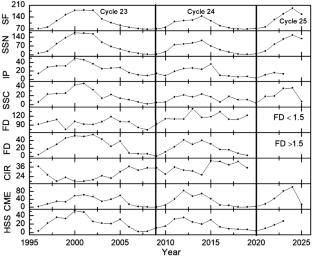
This study presents a comprehensive multi-parametric comparison of solar and interplanetary disturbances during Solar Cycles 23, 24, and 25. Using key indices including sunspot number (SSN), solar radio flux (F10.7), Coronal Mass Ejections (CMEs), High-Speed Streams (HSSs), Co-rotating Interaction Regions (CIRs), interplanetary (IP) shocks, Sudden Storm Commencements (SSCs), and Forbush Decreases (FDs), the temporal evolution and relative strengths of the three cycles are examined. The results show that Solar Cycle 23 was the strongest, exhibiting pronounced magnetic activity and frequent eruptive events. Solar Cycle 24 was significantly weaker across all parameters, reflecting reduced solar dynamo efficiency and diminished levels of heliospheric disturbances. Preliminary observations of the rising phase of Solar Cycle 25 indicate a moderate recovery, with activity levels exceeding those of Cycle 24 but remaining below those of Cycle 23. The combined comparison highlights a progression from strong to weak to moderate in solar behaviour, providing critical insights into long-term solar variability, heliospheric modulation, and space weather forecasting for upcoming solar activity phases.
期刊介绍:
Astrophysics and Space Science publishes original contributions and invited reviews covering the entire range of astronomy, astrophysics, astrophysical cosmology, planetary and space science and the astrophysical aspects of astrobiology. This includes both observational and theoretical research, the techniques of astronomical instrumentation and data analysis and astronomical space instrumentation. We particularly welcome papers in the general fields of high-energy astrophysics, astrophysical and astrochemical studies of the interstellar medium including star formation, planetary astrophysics, the formation and evolution of galaxies and the evolution of large scale structure in the Universe. Papers in mathematical physics or in general relativity which do not establish clear astrophysical applications will no longer be considered.
The journal also publishes topically selected special issues in research fields of particular scientific interest. These consist of both invited reviews and original research papers. Conference proceedings will not be considered. All papers published in the journal are subject to thorough and strict peer-reviewing.
Astrophysics and Space Science features short publication times after acceptance and colour printing free of charge.

 求助内容:
求助内容: 应助结果提醒方式:

 京公网安备 11010802042870号


