{"title":"Studying the Complexation of Mercury(II) with 1-Phenyl-2,3-dimethylpyrazoline-5-thione in 1.0 mol/L HNO3","authors":"N. S. Beknazarova, J. O. Shoalifov","doi":"10.1134/S0036024425703339","DOIUrl":null,"url":null,"abstract":"<p>The complexation of mercury(II) contained in Hg(NO<sub>3</sub>)<sub>2</sub>⋅2H<sub>2</sub>O with 1-phenyl-2,3-dimethylpyrazoline-5-thione (PDPT) in 1.0 mol/L HNO<sub>3</sub> at 273–338 K is studied by potentiometric titration using a redox electrode based on PDPT and the oxidized form of it. It is found that four complex species are formed in the studied system; they have the following compositions: [HgL(H<sub>2</sub>O)<sub>3</sub>]<sup>2+</sup>, [HgL<sub>2</sub>(H<sub>2</sub>O)<sub>2</sub>]<sup>2+</sup>, [HgL<sub>3</sub>(H<sub>2</sub>O)]<sup>2+</sup>, and [HgL<sub>4</sub>]<sup>2+</sup>. For each complex species, stability constants are found and refined using the Bjerrum method. It is shown that the stepwise stability constants of mercury(II)–PDPT complexes decrease with an increase in temperature and the number of coordinated ligand molecules in the inner sphere of the complex. Using the stability constants, the thermodynamic functions of the complexation process are calculated. Distribution curves for all complex species formed in the Hg(II)–PDPT–1.0 mol/L HNO<sub>3</sub> system at temperatures of 273–338 K are calculated. The distribution diagrams of mercury(II)–PDPT complexes as a function of organic ligand concentration are analyzed to identify the region of dominance of all complex species formed in the studied system and develop optimum procedures for synthesizing novel mercury(II) coordination compounds.</p>","PeriodicalId":767,"journal":{"name":"Russian Journal of Physical Chemistry A","volume":"100 2","pages":"159 - 164"},"PeriodicalIF":0.8000,"publicationDate":"2026-03-23","publicationTypes":"Journal Article","fieldsOfStudy":null,"isOpenAccess":false,"openAccessPdf":"","citationCount":"0","resultStr":null,"platform":"Semanticscholar","paperid":null,"PeriodicalName":"Russian Journal of Physical Chemistry A","FirstCategoryId":"92","ListUrlMain":"https://link.springer.com/article/10.1134/S0036024425703339","RegionNum":4,"RegionCategory":"化学","ArticlePicture":[],"TitleCN":null,"AbstractTextCN":null,"PMCID":null,"EPubDate":"","PubModel":"","JCR":"Q4","JCRName":"CHEMISTRY, PHYSICAL","Score":null,"Total":0}
引用次数: 0
Abstract
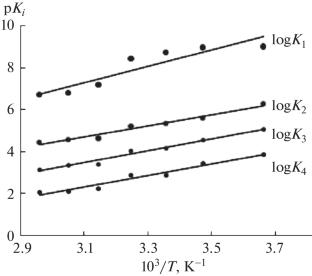
The complexation of mercury(II) contained in Hg(NO3)2⋅2H2O with 1-phenyl-2,3-dimethylpyrazoline-5-thione (PDPT) in 1.0 mol/L HNO3 at 273–338 K is studied by potentiometric titration using a redox electrode based on PDPT and the oxidized form of it. It is found that four complex species are formed in the studied system; they have the following compositions: [HgL(H2O)3]2+, [HgL2(H2O)2]2+, [HgL3(H2O)]2+, and [HgL4]2+. For each complex species, stability constants are found and refined using the Bjerrum method. It is shown that the stepwise stability constants of mercury(II)–PDPT complexes decrease with an increase in temperature and the number of coordinated ligand molecules in the inner sphere of the complex. Using the stability constants, the thermodynamic functions of the complexation process are calculated. Distribution curves for all complex species formed in the Hg(II)–PDPT–1.0 mol/L HNO3 system at temperatures of 273–338 K are calculated. The distribution diagrams of mercury(II)–PDPT complexes as a function of organic ligand concentration are analyzed to identify the region of dominance of all complex species formed in the studied system and develop optimum procedures for synthesizing novel mercury(II) coordination compounds.
期刊介绍:
Russian Journal of Physical Chemistry A. Focus on Chemistry (Zhurnal Fizicheskoi Khimii), founded in 1930, offers a comprehensive review of theoretical and experimental research from the Russian Academy of Sciences, leading research and academic centers from Russia and from all over the world.
Articles are devoted to chemical thermodynamics and thermochemistry, biophysical chemistry, photochemistry and magnetochemistry, materials structure, quantum chemistry, physical chemistry of nanomaterials and solutions, surface phenomena and adsorption, and methods and techniques of physicochemical studies.

 求助内容:
求助内容: 应助结果提醒方式:

 京公网安备 11010802042870号


