Comparison of the Adsorption Properties of the Mesoporous Sorbents Modified with Chelate Complexes of Rare-Earth Benzoyl Acetonates Studied by Gas Chromatography
{"title":"Comparison of the Adsorption Properties of the Mesoporous Sorbents Modified with Chelate Complexes of Rare-Earth Benzoyl Acetonates Studied by Gas Chromatography","authors":"Zh. V. Faustova, Yu. G. Slizhov, V. V. Kamotskii","doi":"10.1134/S0036024425703510","DOIUrl":null,"url":null,"abstract":"<p>New sorption materials have been synthesized from mesoporous silicon dioxide modified with cerium, europium, and ytterbium benzoyl acetonates. The temperature at which the resulting sorbents are stable (260–320°C) was determined by thermal analysis. It was shown by low-temperature nitrogen adsorption/desorption that modification of the surface of the mesoporous SiO<sub>2</sub> layer leads to a decrease in the specific surface area from 133 to 100 m<sup>2</sup> g<sup>–1</sup>. A gas chromatographic analysis revealed that the polarity of the samples with deposited cerium, europium, and ytterbium benzoyl acetonate complexes increases, the highest values being characteristic of organic compounds prone to donor-acceptor and proton-acceptor interactions. The effects of cerium, europium, and ytterbium benzoyl acetonates on the thermodynamic characteristics of adsorption of various classes of organic substances on the mesoporous SiO<sub>2</sub> surface were studied by gas chromatography. The differential molar heats of adsorption <span>\\({{\\bar {q}}_{{{\\text{dif,1}}}}}\\)</span>, the change in the standard differential molar entropy of adsorption <span>\\(\\Delta \\bar {S}_{{1,{\\text{C}}}}^{0}\\)</span>, and the contributions of specific interactions to the total adsorption energy Δ<span>\\({{\\bar {q}}_{{{\\text{dif}},1({\\text{sp}})}}}\\)</span> were calculated from the experimental data on the retention of the test adsorbate molecules.</p>","PeriodicalId":767,"journal":{"name":"Russian Journal of Physical Chemistry A","volume":"100 2","pages":"281 - 288"},"PeriodicalIF":0.8000,"publicationDate":"2026-03-23","publicationTypes":"Journal Article","fieldsOfStudy":null,"isOpenAccess":false,"openAccessPdf":"","citationCount":"0","resultStr":null,"platform":"Semanticscholar","paperid":null,"PeriodicalName":"Russian Journal of Physical Chemistry A","FirstCategoryId":"92","ListUrlMain":"https://link.springer.com/article/10.1134/S0036024425703510","RegionNum":4,"RegionCategory":"化学","ArticlePicture":[],"TitleCN":null,"AbstractTextCN":null,"PMCID":null,"EPubDate":"","PubModel":"","JCR":"Q4","JCRName":"CHEMISTRY, PHYSICAL","Score":null,"Total":0}
引用次数: 0
Abstract
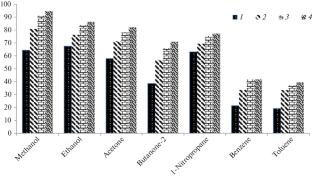
New sorption materials have been synthesized from mesoporous silicon dioxide modified with cerium, europium, and ytterbium benzoyl acetonates. The temperature at which the resulting sorbents are stable (260–320°C) was determined by thermal analysis. It was shown by low-temperature nitrogen adsorption/desorption that modification of the surface of the mesoporous SiO2 layer leads to a decrease in the specific surface area from 133 to 100 m2 g–1. A gas chromatographic analysis revealed that the polarity of the samples with deposited cerium, europium, and ytterbium benzoyl acetonate complexes increases, the highest values being characteristic of organic compounds prone to donor-acceptor and proton-acceptor interactions. The effects of cerium, europium, and ytterbium benzoyl acetonates on the thermodynamic characteristics of adsorption of various classes of organic substances on the mesoporous SiO2 surface were studied by gas chromatography. The differential molar heats of adsorption \({{\bar {q}}_{{{\text{dif,1}}}}}\), the change in the standard differential molar entropy of adsorption \(\Delta \bar {S}_{{1,{\text{C}}}}^{0}\), and the contributions of specific interactions to the total adsorption energy Δ\({{\bar {q}}_{{{\text{dif}},1({\text{sp}})}}}\) were calculated from the experimental data on the retention of the test adsorbate molecules.
期刊介绍:
Russian Journal of Physical Chemistry A. Focus on Chemistry (Zhurnal Fizicheskoi Khimii), founded in 1930, offers a comprehensive review of theoretical and experimental research from the Russian Academy of Sciences, leading research and academic centers from Russia and from all over the world.
Articles are devoted to chemical thermodynamics and thermochemistry, biophysical chemistry, photochemistry and magnetochemistry, materials structure, quantum chemistry, physical chemistry of nanomaterials and solutions, surface phenomena and adsorption, and methods and techniques of physicochemical studies.

 求助内容:
求助内容: 应助结果提醒方式:

 京公网安备 11010802042870号


