L. O. Romanova, M. I. Ivanov, V. G. Kudin, N. V. Podoprigora, V. S. Sudavtsova
{"title":"Mixing Enthalpies of Melts in the Cu–La–Sc System","authors":"L. O. Romanova, M. I. Ivanov, V. G. Kudin, N. V. Podoprigora, V. S. Sudavtsova","doi":"10.1007/s11106-026-00530-7","DOIUrl":null,"url":null,"abstract":"<p>The mixing enthalpies of melts in the La–Sc and Cu–La–Sc systems were determined by high-temperature calorimetry. The mixing enthalpies of La–Sc melts measured in the composition range 0 < <i>x</i><sub>La</sub> < 0.5 at 1830 ± 2 K showed small endothermic effects. Our thermochemical properties and those reported in the literature for La–Sc melts at 0 < <i>x</i><sub>Sc</sub> < 0.5 were used to calculate the mixing enthalpies over the entire composition range. The extrema of the integral mixing enthalpy were ∆<i>H</i><sub>min</sub> = –0.4 ± 0.1 kJ/mol at <i>x</i><sub>Sc</sub> = 0.14 and ∆<i>H</i><sub>max</sub> = 0.8 ± 0.2 kJ/mol at <i>x</i><sub>Sc</sub> = 0.58. The partial mixing enthalpies of lanthanum and copper were determined for melts along four radial sections of the ternary Cu–La–Sc system. The partial mixing enthalpies of lanthanum in the Cu<sub>0.4</sub>Sc<sub>0.6</sub> and Cu<sub>0.7</sub>Sc<sub>0.3</sub> melts were measured at 1450 ± 1 K for lanthanum concentrations from 0 to <i>x</i><sub>La</sub> = 0.2. The partial mixing enthalpies of copper were measured in the La<sub>0.4</sub>Sc<sub>0.6</sub> and La<sub>0.78</sub>Sc<sub>0.22</sub> melts at 1450 ± 1 K for copper concentrations 0 < <i>x</i><sub>Cu</sub> < 0.22. The mixing enthalpies of these melts indicate predominantly exothermic effects, attributed to interactions in the binary Cu–Sc system. Reliable thermochemical properties of melts in the bounding binary Cu–La(Sc) and La–Sc subsystems were represented by Redlich–Kister polynomials. On this basis, mixing enthalpies for the ternary melts were calculated employing the analytical Redlich–Kister–Muggianu model. Comparison of the experimental and calculated mixing enthalpies of these melts indicated that our data and those found with the Redlich–Kister–Muggianu model agreed without ternary contribution within the experimental error. The extremum of the integral molar mixing enthalpy in the ternary Cu–La–Sc system was –24 ± 1 kJ/mol, located near the equiatomic composition of the Cu–Sc melts. Thus, the principal contribution to the interaction energy between unlike atoms in the studied melts arises from this bounding subsystem. The research results were analyzed within the modern electronic theory of metals.</p>","PeriodicalId":742,"journal":{"name":"Powder Metallurgy and Metal Ceramics","volume":"64 5-6","pages":"369 - 377"},"PeriodicalIF":0.6000,"publicationDate":"2026-03-17","publicationTypes":"Journal Article","fieldsOfStudy":null,"isOpenAccess":false,"openAccessPdf":"","citationCount":"0","resultStr":null,"platform":"Semanticscholar","paperid":null,"PeriodicalName":"Powder Metallurgy and Metal Ceramics","FirstCategoryId":"88","ListUrlMain":"https://link.springer.com/article/10.1007/s11106-026-00530-7","RegionNum":4,"RegionCategory":"材料科学","ArticlePicture":[],"TitleCN":null,"AbstractTextCN":null,"PMCID":null,"EPubDate":"","PubModel":"","JCR":"Q3","JCRName":"MATERIALS SCIENCE, CERAMICS","Score":null,"Total":0}
引用次数: 0
Abstract
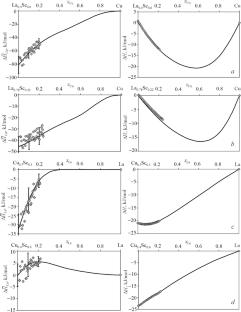
The mixing enthalpies of melts in the La–Sc and Cu–La–Sc systems were determined by high-temperature calorimetry. The mixing enthalpies of La–Sc melts measured in the composition range 0 < xLa < 0.5 at 1830 ± 2 K showed small endothermic effects. Our thermochemical properties and those reported in the literature for La–Sc melts at 0 < xSc < 0.5 were used to calculate the mixing enthalpies over the entire composition range. The extrema of the integral mixing enthalpy were ∆Hmin = –0.4 ± 0.1 kJ/mol at xSc = 0.14 and ∆Hmax = 0.8 ± 0.2 kJ/mol at xSc = 0.58. The partial mixing enthalpies of lanthanum and copper were determined for melts along four radial sections of the ternary Cu–La–Sc system. The partial mixing enthalpies of lanthanum in the Cu0.4Sc0.6 and Cu0.7Sc0.3 melts were measured at 1450 ± 1 K for lanthanum concentrations from 0 to xLa = 0.2. The partial mixing enthalpies of copper were measured in the La0.4Sc0.6 and La0.78Sc0.22 melts at 1450 ± 1 K for copper concentrations 0 < xCu < 0.22. The mixing enthalpies of these melts indicate predominantly exothermic effects, attributed to interactions in the binary Cu–Sc system. Reliable thermochemical properties of melts in the bounding binary Cu–La(Sc) and La–Sc subsystems were represented by Redlich–Kister polynomials. On this basis, mixing enthalpies for the ternary melts were calculated employing the analytical Redlich–Kister–Muggianu model. Comparison of the experimental and calculated mixing enthalpies of these melts indicated that our data and those found with the Redlich–Kister–Muggianu model agreed without ternary contribution within the experimental error. The extremum of the integral molar mixing enthalpy in the ternary Cu–La–Sc system was –24 ± 1 kJ/mol, located near the equiatomic composition of the Cu–Sc melts. Thus, the principal contribution to the interaction energy between unlike atoms in the studied melts arises from this bounding subsystem. The research results were analyzed within the modern electronic theory of metals.
期刊介绍:
Powder Metallurgy and Metal Ceramics covers topics of the theory, manufacturing technology, and properties of powder; technology of forming processes; the technology of sintering, heat treatment, and thermo-chemical treatment; properties of sintered materials; and testing methods.

 求助内容:
求助内容: 应助结果提醒方式:

 京公网安备 11010802042870号


