{"title":"Examination of the Real and Imaginary Parts of the Dielectric Permittivity of Aluminum Nitride Composites Before and After the Percolation Threshold","authors":"V. I. Chasnyk, D. V. Chasnyk, O. M. Kaidash","doi":"10.1007/s11106-026-00531-6","DOIUrl":null,"url":null,"abstract":"<p>Aluminum nitride composites with high resistivity are used in vacuum microwave devices as bulk microwave absorbers. Their application requires comprehensive characterization of electrophysical parameters over the desired frequency range. This primarily concerns their dielectric characteristics (real ε′ and imaginary ε″ parts of the complex dielectric permittivity and dielectric loss tangent tanδ) and electrical resistivity. For AlN–Mo composites produced by pressureless sintering, the dependences of the real and imaginary parts of complex dielectric permittivity were analyzed for a volume molybdenum content of 14–30%, i.e., both before and after the percolation threshold was exceeded. It was shown that ε′ and ε″ of the composites increased with the content of molybdenum particles both before and after the percolation threshold. Experimental values of the dielectric loss tangent tanδ are presented. They rise from 0.005 to 18 when the content of molybdenum particles increases from 20 to 28%. Starting from 25–30 % Mo, the dependences of the imaginary part ε″ of dielectric permittivity and the dielectric loss tangent tanδ are straight lines on a logarithmic scale. This behavior of tanδ and ε″ makes it possible to determine their values at 30% Mo. In this case, ε′ = 96–106, ε″ = (2.88–3.24) ∙ 10<sup>4</sup>, and tanδ = 300. The calculated imaginary part of complex dielectric permittivity for bulk molybdenum at a frequency of 10 GHz is ε″ = 3.5 · 10<sup>7</sup>, which is more than three orders of magnitude higher than ε″ of the AlN–30% Mo composite. The percolation threshold width for AlN–Mo composites with an average molybdenum particle size of 4–6 μm is about 3% at 25–28% Mo. In this range, the bulk electrical resistivity of the composite decreases from 9 · 10<sup>13</sup> to 0.6 Ω ∙ cm. After the percolation threshold, over the range of 28–30% Mo, the electrical resistivity further decreases threefold, from 0.6 to 0.2 Ω ∙ cm.</p>","PeriodicalId":742,"journal":{"name":"Powder Metallurgy and Metal Ceramics","volume":"64 5-6","pages":"378 - 384"},"PeriodicalIF":0.6000,"publicationDate":"2026-03-18","publicationTypes":"Journal Article","fieldsOfStudy":null,"isOpenAccess":false,"openAccessPdf":"","citationCount":"0","resultStr":null,"platform":"Semanticscholar","paperid":null,"PeriodicalName":"Powder Metallurgy and Metal Ceramics","FirstCategoryId":"88","ListUrlMain":"https://link.springer.com/article/10.1007/s11106-026-00531-6","RegionNum":4,"RegionCategory":"材料科学","ArticlePicture":[],"TitleCN":null,"AbstractTextCN":null,"PMCID":null,"EPubDate":"","PubModel":"","JCR":"Q3","JCRName":"MATERIALS SCIENCE, CERAMICS","Score":null,"Total":0}
引用次数: 0
Abstract
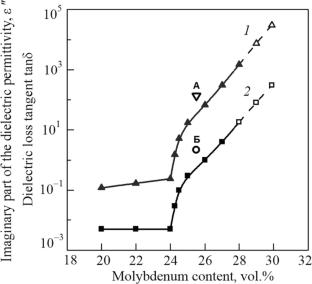
Aluminum nitride composites with high resistivity are used in vacuum microwave devices as bulk microwave absorbers. Their application requires comprehensive characterization of electrophysical parameters over the desired frequency range. This primarily concerns their dielectric characteristics (real ε′ and imaginary ε″ parts of the complex dielectric permittivity and dielectric loss tangent tanδ) and electrical resistivity. For AlN–Mo composites produced by pressureless sintering, the dependences of the real and imaginary parts of complex dielectric permittivity were analyzed for a volume molybdenum content of 14–30%, i.e., both before and after the percolation threshold was exceeded. It was shown that ε′ and ε″ of the composites increased with the content of molybdenum particles both before and after the percolation threshold. Experimental values of the dielectric loss tangent tanδ are presented. They rise from 0.005 to 18 when the content of molybdenum particles increases from 20 to 28%. Starting from 25–30 % Mo, the dependences of the imaginary part ε″ of dielectric permittivity and the dielectric loss tangent tanδ are straight lines on a logarithmic scale. This behavior of tanδ and ε″ makes it possible to determine their values at 30% Mo. In this case, ε′ = 96–106, ε″ = (2.88–3.24) ∙ 104, and tanδ = 300. The calculated imaginary part of complex dielectric permittivity for bulk molybdenum at a frequency of 10 GHz is ε″ = 3.5 · 107, which is more than three orders of magnitude higher than ε″ of the AlN–30% Mo composite. The percolation threshold width for AlN–Mo composites with an average molybdenum particle size of 4–6 μm is about 3% at 25–28% Mo. In this range, the bulk electrical resistivity of the composite decreases from 9 · 1013 to 0.6 Ω ∙ cm. After the percolation threshold, over the range of 28–30% Mo, the electrical resistivity further decreases threefold, from 0.6 to 0.2 Ω ∙ cm.
期刊介绍:
Powder Metallurgy and Metal Ceramics covers topics of the theory, manufacturing technology, and properties of powder; technology of forming processes; the technology of sintering, heat treatment, and thermo-chemical treatment; properties of sintered materials; and testing methods.

 求助内容:
求助内容: 应助结果提醒方式:

 京公网安备 11010802042870号


