{"title":"Investigation of Microhardness Behaviors of Ceramic Reinforced Bronze Matrix Composite Materials Using Theoretical Models","authors":"H. Ada, E. Asikuzun Tokeser, E. Turkmen","doi":"10.1007/s11106-026-00527-2","DOIUrl":null,"url":null,"abstract":"<p>In this study, Cu–10Sn powders with a size of <44 μm were used as the main matrix material, and SiC (<45 μm) and B<sub>4</sub>C (<45 μm) powders of approximately the exact dimensions were used for the reinforcement material. The composite materials were produced by powder metallurgy. In this study, we focused on the analysis of their mechanical properties using a Shimadzu HMV-2 digital microhardness tester and summarized optical microscope and scanning electron microscope (SEM) images of Cu–10Sn/B<sub>4</sub>C and Cu–10Sn/SiC composite materials. The images show that the reinforcement particles are homogeneously distributed in the Cu–10Sn matrix. The mechanical properties of the reinforcement materials were determined using the Vickers microhardness test. The decrease in the microhardness values of all samples with increasing applied load indicates their indentation size effect (ISE) behavior. Also, parameters such as the elastic modulus (E), the conditional yield strength of the material when deformed under the indenter (Y), and the critical stress intensity factor (K<sub>Ic</sub>), which are as crucial as hardness in mechanical characterizations of materials, were calculated. The load-dependent values of E, Y, and K<sub>Ic</sub> decrease with both increases in the B<sub>4</sub>C and SiC content and with the applied test load. Different models are presented in the literature to explain ‘indentation size effect/reverse indentation size effect’ (ISE/RISE) behavior. Microhardness comparisons are performed using Meyer's law, the proportional sample resistance (PSR) model, the elastic/plastic deformation (EPD) model, and the Hayes–Kendall approach. According to these analyses, the samples exhibited ISE behavior. The applied load to these samples caused both elastic and plastic deformation. Among these models, the Hays–Kendall approach was more suitable for determining the micromechanical properties and ISE behavior of the samples.</p>","PeriodicalId":742,"journal":{"name":"Powder Metallurgy and Metal Ceramics","volume":"64 5-6","pages":"323 - 334"},"PeriodicalIF":0.6000,"publicationDate":"2026-03-18","publicationTypes":"Journal Article","fieldsOfStudy":null,"isOpenAccess":false,"openAccessPdf":"","citationCount":"0","resultStr":null,"platform":"Semanticscholar","paperid":null,"PeriodicalName":"Powder Metallurgy and Metal Ceramics","FirstCategoryId":"88","ListUrlMain":"https://link.springer.com/article/10.1007/s11106-026-00527-2","RegionNum":4,"RegionCategory":"材料科学","ArticlePicture":[],"TitleCN":null,"AbstractTextCN":null,"PMCID":null,"EPubDate":"","PubModel":"","JCR":"Q3","JCRName":"MATERIALS SCIENCE, CERAMICS","Score":null,"Total":0}
引用次数: 0
Abstract
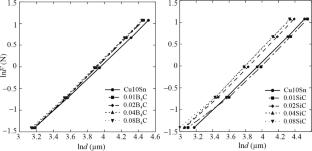
In this study, Cu–10Sn powders with a size of <44 μm were used as the main matrix material, and SiC (<45 μm) and B4C (<45 μm) powders of approximately the exact dimensions were used for the reinforcement material. The composite materials were produced by powder metallurgy. In this study, we focused on the analysis of their mechanical properties using a Shimadzu HMV-2 digital microhardness tester and summarized optical microscope and scanning electron microscope (SEM) images of Cu–10Sn/B4C and Cu–10Sn/SiC composite materials. The images show that the reinforcement particles are homogeneously distributed in the Cu–10Sn matrix. The mechanical properties of the reinforcement materials were determined using the Vickers microhardness test. The decrease in the microhardness values of all samples with increasing applied load indicates their indentation size effect (ISE) behavior. Also, parameters such as the elastic modulus (E), the conditional yield strength of the material when deformed under the indenter (Y), and the critical stress intensity factor (KIc), which are as crucial as hardness in mechanical characterizations of materials, were calculated. The load-dependent values of E, Y, and KIc decrease with both increases in the B4C and SiC content and with the applied test load. Different models are presented in the literature to explain ‘indentation size effect/reverse indentation size effect’ (ISE/RISE) behavior. Microhardness comparisons are performed using Meyer's law, the proportional sample resistance (PSR) model, the elastic/plastic deformation (EPD) model, and the Hayes–Kendall approach. According to these analyses, the samples exhibited ISE behavior. The applied load to these samples caused both elastic and plastic deformation. Among these models, the Hays–Kendall approach was more suitable for determining the micromechanical properties and ISE behavior of the samples.
期刊介绍:
Powder Metallurgy and Metal Ceramics covers topics of the theory, manufacturing technology, and properties of powder; technology of forming processes; the technology of sintering, heat treatment, and thermo-chemical treatment; properties of sintered materials; and testing methods.

 求助内容:
求助内容: 应助结果提醒方式:

 京公网安备 11010802042870号


