
Hydrogen sulfide generated by cystathionine gamma lyase inhibits lysyl oxidase and protects against calcific tendinopathy
IF 5.9
1区 医学
Q1 ORTHOPEDICS
Journal of Orthopaedic Translation
Pub Date : 2026-03-01
Epub Date: 2026-03-25
DOI:10.1016/j.jot.2026.101082
引用次数: 0
Abstract
Background/objective
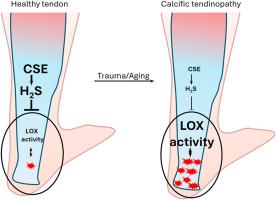
Increased lysyl oxidase (LOX) activity favors pathologic cartilage and vessel calcification. LOX promotes disease through enhanced collagen cross-linking, inflammation, reactive oxygen species (ROS) production, cell trans-differentiation, and fibrosis. This study investigates the therapeutic potential of cystathionine gamma lyase (CSE)-generated hydrogen sulfide (H2S) to inhibit tendon calcification by targeting LOX in human samples and murine models of calcific tendinopathy (CT).
Methods
Human shoulder supraspinatus tendons with varying degrees of CT were analyzed using Alizarin Red staining and LOX and CSE immunohistochemistry to evaluate the correlation between CSE and LOX/calcification. Mechanistic studies were performed using wild-type (WT) and CSE knockout murine tenocytes cultured in calcification-inducing medium with or without H2S donors or the LOX inhibitor β-aminopropionitrile (BAPN). Achilles tendon CT was induced in WT and CSE knockout mice via surgical intervention or aging. Tendon calcification, LOX expression, biomechanical integrity, and transcriptomic changes were assessed. Persulfidation of total proteins and recombinant human LOX (rhLOX) was measured using the dimedone-switch method.
Results
An inverse correlation between CSE levels and LOX/calcification was observed in human tendons and in the surgery-induced CT murine model. In murine tenocytes and in the aging murine model, CSE deficiency led to increased LOX expression, enhanced calcification, and reduced tendon biomechanical integrity.Transcriptomic analysis confirmed the negative association between CSE and LOX in murine CT. Mechanistically, H2S increased total cellular protein persulfidation, including rhLOX, resulting in inhibition of its enzymatic activity.
Conclusion
Dysregulated LOX activity is a key driver of calcific tendinopathy. CSE-generated H2S effectively suppresses LOX activity, highlighting its potential as a therapeutic strategy for CT and other calcification-related disorders.
The translational potential of this article
This study identifies LOX as a therapeutic target in CT and supports H2S as a promising treatment strategy for this condition.
由半胱硫氨酸γ裂解酶产生的硫化氢抑制赖氨酸氧化酶和防止钙化肌腱病
背景/目的赖氨酸氧化酶(LOX)活性增加有利于病理软骨和血管钙化。LOX通过增强胶原交联、炎症、活性氧(ROS)产生、细胞反式分化和纤维化来促进疾病。本研究探讨了半胱硫氨酸γ裂解酶(CSE)产生的硫化氢(H2S)在人类样本和小鼠钙化肌腱病(CT)模型中通过靶向LOX抑制肌腱钙化的治疗潜力。方法采用茜素红染色、LOX和CSE免疫组化方法分析不同程度CT示的人肩冈上肌腱,评价CSE与LOX/钙化的相关性。机制研究使用野生型(WT)和CSE敲除小鼠在钙化诱导培养基中培养,有或没有H2S供体或LOX抑制剂β-氨基丙腈(BAPN)。对WT和CSE基因敲除小鼠进行手术干预或老化诱导跟腱CT。评估肌腱钙化、LOX表达、生物力学完整性和转录组学变化。用二美酮开关法测定总蛋白和重组人LOX (rhLOX)的过硫化。结果在人肌腱和手术诱导的小鼠CT模型中,CSE水平与LOX/钙化呈负相关。在小鼠肌腱细胞和衰老小鼠模型中,CSE缺乏导致LOX表达增加,钙化增强,肌腱生物力学完整性降低。转录组学分析证实CSE与小鼠CT中LOX呈负相关。从机制上讲,H2S增加了包括rhLOX在内的总细胞蛋白过硫化,从而抑制了其酶活性。结论LOX活性异常是钙化性肌腱病变的关键驱动因素。cse产生的H2S有效抑制LOX活性,突出了其作为CT和其他钙化相关疾病的治疗策略的潜力。本研究确定了LOX作为CT的治疗靶点,并支持H2S作为一种有前景的治疗策略。
本文章由计算机程序翻译,如有差异,请以英文原文为准。
求助全文
约1分钟内获得全文
求助全文
来源期刊
Journal of Orthopaedic Translation
Medicine-Orthopedics and Sports Medicine
CiteScore
11.80
自引率
13.60%
发文量
91
审稿时长
29 days
期刊介绍:
The Journal of Orthopaedic Translation (JOT) is the official peer-reviewed, open access journal of the Chinese Speaking Orthopaedic Society (CSOS) and the International Chinese Musculoskeletal Research Society (ICMRS). It is published quarterly, in January, April, July and October, by Elsevier.
 求助内容:
求助内容: 应助结果提醒方式:

 京公网安备 11010802042870号


