{"title":"Proteomic Insights into the Immune and Sex-Specific Proteins in the Skin Mucus of Barramundi (<i>Lates calcarifer</i>).","authors":"Varsha V Balu, Dean R Jerry, Andreas L Lopata","doi":"10.3390/proteomes14010015","DOIUrl":null,"url":null,"abstract":"<p><strong>Background: </strong>Fish skin mucus contains proteins involved in diverse biological pathways, representing a valuable non-invasive diagnostic of fish health.</p><p><strong>Methods: </strong>Skin mucus from three male and three female barramundi was analysed using liquid chromatography-tandem mass spectrometry (LC-MS/MS) following protein extraction and S-Trap digestion.</p><p><strong>Results and discussion: </strong>A total of 1801 protein groups were matched to the <i>L. calcarifer</i> reference proteome and functionally annotated using Gene Ontology (GO) terms via UniProt ID mapping, with representation across Biological Process, Cellular Component, and Molecular Function categories. Functional classification using eggNOG-mapper further associated leading protein group sequences with Clusters of Orthologous Groups (COGs) and Kyoto Encyclopaedia of Genes and Genomes (KEGG) pathways. GO-based screening prioritised 352 putatively immune-relevant protein groups and 24 protein groups associated with sex- and reproduction-related processes, highlighting the functional complexity of the skin mucus proteome. Comparative analysis revealed sex-associated patterns in protein group detection and relative abundance, with differential abundance analysis identifying 244 protein groups exhibiting statistically significant differences between male and female samples.</p><p><strong>Conclusions: </strong>This study provides the first comprehensive discovery-based characterisation of the barramundi skin mucus proteome and establishes a baseline reference dataset for this aquaculture-relevant species. The findings support the utility of skin mucus proteomics for exploring immune and sex-associated molecular patterns and provide a baseline dataset for future validation studies investigating non-invasive health and reproductive monitoring.</p>","PeriodicalId":20877,"journal":{"name":"Proteomes","volume":"14 1","pages":""},"PeriodicalIF":3.6000,"publicationDate":"2026-03-20","publicationTypes":"Journal Article","fieldsOfStudy":null,"isOpenAccess":false,"openAccessPdf":"https://www.ncbi.nlm.nih.gov/pmc/articles/PMC13030388/pdf/","citationCount":"0","resultStr":null,"platform":"Semanticscholar","paperid":null,"PeriodicalName":"Proteomes","FirstCategoryId":"1085","ListUrlMain":"https://doi.org/10.3390/proteomes14010015","RegionNum":0,"RegionCategory":null,"ArticlePicture":[],"TitleCN":null,"AbstractTextCN":null,"PMCID":null,"EPubDate":"","PubModel":"","JCR":"Q2","JCRName":"BIOCHEMISTRY & MOLECULAR BIOLOGY","Score":null,"Total":0}
引用次数: 0
Abstract
Background: Fish skin mucus contains proteins involved in diverse biological pathways, representing a valuable non-invasive diagnostic of fish health.
Methods: Skin mucus from three male and three female barramundi was analysed using liquid chromatography-tandem mass spectrometry (LC-MS/MS) following protein extraction and S-Trap digestion.
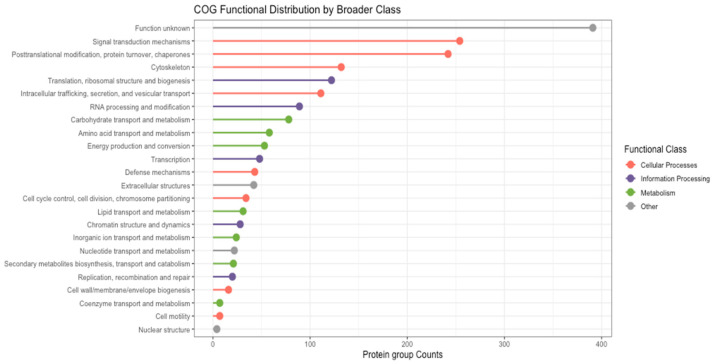
Results and discussion: A total of 1801 protein groups were matched to the L. calcarifer reference proteome and functionally annotated using Gene Ontology (GO) terms via UniProt ID mapping, with representation across Biological Process, Cellular Component, and Molecular Function categories. Functional classification using eggNOG-mapper further associated leading protein group sequences with Clusters of Orthologous Groups (COGs) and Kyoto Encyclopaedia of Genes and Genomes (KEGG) pathways. GO-based screening prioritised 352 putatively immune-relevant protein groups and 24 protein groups associated with sex- and reproduction-related processes, highlighting the functional complexity of the skin mucus proteome. Comparative analysis revealed sex-associated patterns in protein group detection and relative abundance, with differential abundance analysis identifying 244 protein groups exhibiting statistically significant differences between male and female samples.
Conclusions: This study provides the first comprehensive discovery-based characterisation of the barramundi skin mucus proteome and establishes a baseline reference dataset for this aquaculture-relevant species. The findings support the utility of skin mucus proteomics for exploring immune and sex-associated molecular patterns and provide a baseline dataset for future validation studies investigating non-invasive health and reproductive monitoring.
背景:鱼皮粘液中含有参与多种生物途径的蛋白质,代表了鱼类健康的有价值的非侵入性诊断。方法:采用液相色谱-串联质谱法(LC-MS/MS)对3只雄性和3只雌性barramundi的皮肤黏液进行蛋白质提取和S-Trap消化分析。结果和讨论:共有1801个蛋白质组与L. calcarifer参考蛋白质组匹配,并通过UniProt ID图谱使用基因本体(GO)术语进行功能注释,包括生物过程、细胞成分和分子功能类别。利用eggNOG-mapper进行功能分类,进一步将先导蛋白组序列与COGs (Clusters of Orthologous Groups)和KEGG (Kyoto encyclopedia of Genes and Genomes)途径联系起来。基于go的筛选优先考虑了352个推定免疫相关蛋白组和24个与性和生殖相关过程相关的蛋白组,突出了皮肤粘液蛋白组的功能复杂性。对比分析揭示了蛋白质组检测和相对丰度的性别相关模式,差异丰度分析确定了244个蛋白质组在男性和女性样本之间存在统计学差异。结论:本研究提供了第一个全面的基于发现的barramundi皮肤粘液蛋白质组特征,并为该水产养殖相关物种建立了基线参考数据集。这些发现支持了皮肤黏液蛋白质组学在探索免疫和性别相关分子模式方面的应用,并为未来研究非侵入性健康和生殖监测的验证研究提供了基线数据集。
ProteomesBiochemistry, Genetics and Molecular Biology-Clinical Biochemistry
CiteScore
6.50
自引率
3.00%
发文量
37
审稿时长
11 weeks
期刊介绍:
Proteomes (ISSN 2227-7382) is an open access, peer reviewed journal on all aspects of proteome science. Proteomes covers the multi-disciplinary topics of structural and functional biology, protein chemistry, cell biology, methodology used for protein analysis, including mass spectrometry, protein arrays, bioinformatics, HTS assays, etc. Our aim is to encourage scientists to publish their experimental and theoretical results in as much detail as possible. Therefore, there is no restriction on the length of papers. Scope: -whole proteome analysis of any organism -disease/pharmaceutical studies -comparative proteomics -protein-ligand/protein interactions -structure/functional proteomics -gene expression -methodology -bioinformatics -applications of proteomics




 求助内容:
求助内容: 应助结果提醒方式:

 京公网安备 11010802042870号


