Tatiana Gabrusskaya, Natalia Ulanova, Elena Shilova, Natalia Volkova, Sofia Kilina, Elena Kornienko, Mikhail Kostik
{"title":"Efficacy and safety of dual-targeted therapy in children with inflammatory bowel disease: Retrospective cohort study.","authors":"Tatiana Gabrusskaya, Natalia Ulanova, Elena Shilova, Natalia Volkova, Sofia Kilina, Elena Kornienko, Mikhail Kostik","doi":"10.5409/wjcp.v15.i1.111093","DOIUrl":null,"url":null,"abstract":"<p><strong>Background: </strong>There is a limited number of studies on the efficacy and safety of dual-targeted therapy (DTT) in children with inflammatory bowel diseases (IBD); the latest reports focus on the combination of biological drugs with Janus kinase inhibitors (JAKI).</p><p><strong>Aim: </strong>To evaluate the efficacy and safety of DTT in children with IBD.</p><p><strong>Methods: </strong>This retrospective cohort study included 18 IBD patients, aged 2-17 years, with 13 (72%) having Crohn's disease (CD) and 5 (28%) having ulcerative colitis, who were treated with DTT. In two children, two different combinations of DTT were used sequentially. The data on clinical and laboratory changes were assessed at the beginning of DTT and at three months (M3) and six months (M6). Fecal calprotectin and endoscopy were evaluated at baseline and M6.</p><p><strong>Results: </strong>A total of 20 courses of DTT in 18 patients were included in the analysis: (1) 12 (60%) were treated with JAKI and vedolizumab; (2) 6 (30%) with JAKI and ustekinumab; and (3) 2 (10%) with JAKI and adalimumab. Clinical remission was achieved in 9/20 (45%) and 13/20 (68%) DTT courses in patients within M3 and M6, respectively. In contrast, laboratory and endoscopic remission (ER) were achieved in 8/20 (40%) and 9/17 (53%) patients, respectively, within M6. Perianal lesions and upper gastrointestinal tract involvement were negatively associated with the efficacy of the DTT in CD patients. Children with early onset of the disease are more likely to achieve ER compared with those with later onset: 8/11 (73%) <i>vs</i> 1/6 (17%), respectively. Side effects were reported in 6/20 (30%) of cases, and 5/6 (83.3%) were considered non-serious.</p><p><strong>Conclusion: </strong>A DTT may be considered for children with refractory IBD. This strategy was shown to be most effective among children with a very early onset of the disease.</p>","PeriodicalId":75338,"journal":{"name":"World journal of clinical pediatrics","volume":"15 1","pages":"111093"},"PeriodicalIF":0.0000,"publicationDate":"2026-03-09","publicationTypes":"Journal Article","fieldsOfStudy":null,"isOpenAccess":false,"openAccessPdf":"https://www.ncbi.nlm.nih.gov/pmc/articles/PMC13010580/pdf/","citationCount":"0","resultStr":null,"platform":"Semanticscholar","paperid":null,"PeriodicalName":"World journal of clinical pediatrics","FirstCategoryId":"1085","ListUrlMain":"https://doi.org/10.5409/wjcp.v15.i1.111093","RegionNum":0,"RegionCategory":null,"ArticlePicture":[],"TitleCN":null,"AbstractTextCN":null,"PMCID":null,"EPubDate":"","PubModel":"","JCR":"","JCRName":"","Score":null,"Total":0}
引用次数: 0
Abstract
Background: There is a limited number of studies on the efficacy and safety of dual-targeted therapy (DTT) in children with inflammatory bowel diseases (IBD); the latest reports focus on the combination of biological drugs with Janus kinase inhibitors (JAKI).
Aim: To evaluate the efficacy and safety of DTT in children with IBD.
Methods: This retrospective cohort study included 18 IBD patients, aged 2-17 years, with 13 (72%) having Crohn's disease (CD) and 5 (28%) having ulcerative colitis, who were treated with DTT. In two children, two different combinations of DTT were used sequentially. The data on clinical and laboratory changes were assessed at the beginning of DTT and at three months (M3) and six months (M6). Fecal calprotectin and endoscopy were evaluated at baseline and M6.
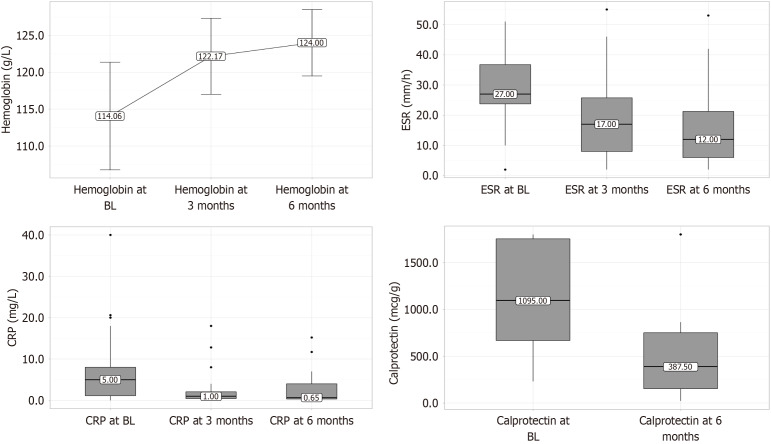
Results: A total of 20 courses of DTT in 18 patients were included in the analysis: (1) 12 (60%) were treated with JAKI and vedolizumab; (2) 6 (30%) with JAKI and ustekinumab; and (3) 2 (10%) with JAKI and adalimumab. Clinical remission was achieved in 9/20 (45%) and 13/20 (68%) DTT courses in patients within M3 and M6, respectively. In contrast, laboratory and endoscopic remission (ER) were achieved in 8/20 (40%) and 9/17 (53%) patients, respectively, within M6. Perianal lesions and upper gastrointestinal tract involvement were negatively associated with the efficacy of the DTT in CD patients. Children with early onset of the disease are more likely to achieve ER compared with those with later onset: 8/11 (73%) vs 1/6 (17%), respectively. Side effects were reported in 6/20 (30%) of cases, and 5/6 (83.3%) were considered non-serious.
Conclusion: A DTT may be considered for children with refractory IBD. This strategy was shown to be most effective among children with a very early onset of the disease.


 求助内容:
求助内容: 应助结果提醒方式:

 京公网安备 11010802042870号


