Nabeel Ahmad, Uzair Ahmed, Ghulam Mohy Ud Din, Mavia Habib, Muhammad Shaheer Luqman, Muhammad Talha, Muneeb Saifullah, Ikra Rana
{"title":"Comparison of bilirubin albumin ratio and total serum bilirubin for predicting neurological dysfunction in newborns: A meta-analysis.","authors":"Nabeel Ahmad, Uzair Ahmed, Ghulam Mohy Ud Din, Mavia Habib, Muhammad Shaheer Luqman, Muhammad Talha, Muneeb Saifullah, Ikra Rana","doi":"10.5409/wjcp.v15.i1.112088","DOIUrl":null,"url":null,"abstract":"<p><strong>Background: </strong>Bilirubin-induced neurologic dysfunction (BIND) remains a serious complication of severe neonatal hyperbilirubinemia, especially in resource-limited settings. While total serum bilirubin (TSB) is widely used for risk stratification, the bilirubin/albumin (B/A) ratio has been proposed as a surrogate for free bilirubin, the neurotoxic fraction.</p><p><strong>Aim: </strong>To compare the diagnostic accuracy of the B/A ratio <i>vs</i> TSB for predicting acute BIND in neonates.</p><p><strong>Methods: </strong>We conducted a systematic review and meta-analysis of observational studies evaluating the B/A ratio and TSB for predicting BIND in neonates (≥ 35 weeks' gestational age). Data sources included PubMed, EMBASE, Cochrane Central, and Google Scholar. Pooled standardized mean difference (SMD), sensitivity, specificity, and heterogeneity (<i>I</i> <sup>2</sup>) were calculated using a bivariate random-effects model. Meta-regression was used to assess whether biomarker type (B/A <i>vs</i> TSB) explained performance differences. The risk of bias was evaluated using the Quality Assessment of Diagnostic Accuracy Studies-2 tool.</p><p><strong>Results: </strong>Five studies involving a total of 1022 neonates were included, with a male-to-female ratio of approximately 57:40. The SMD for B/A ratio was 1.71 (95%CI: 1.00-2.41, <i>P</i> < 0.0001), and for TSB it was 1.68, both showing strong associations with BIND. Meta-regression revealed no significant difference in predictive value between the two biomarkers (<i>P</i> = 0.96).</p><p><strong>Conclusion: </strong>Both TSB and the B/A ratio are comparably effective in predicting BIND. While the B/A ratio may provide incremental value in specific clinical contexts, current evidence supports continued reliance on TSB for routine risk stratification.</p>","PeriodicalId":75338,"journal":{"name":"World journal of clinical pediatrics","volume":"15 1","pages":"112088"},"PeriodicalIF":0.0000,"publicationDate":"2026-03-09","publicationTypes":"Journal Article","fieldsOfStudy":null,"isOpenAccess":false,"openAccessPdf":"https://www.ncbi.nlm.nih.gov/pmc/articles/PMC13010676/pdf/","citationCount":"0","resultStr":null,"platform":"Semanticscholar","paperid":null,"PeriodicalName":"World journal of clinical pediatrics","FirstCategoryId":"1085","ListUrlMain":"https://doi.org/10.5409/wjcp.v15.i1.112088","RegionNum":0,"RegionCategory":null,"ArticlePicture":[],"TitleCN":null,"AbstractTextCN":null,"PMCID":null,"EPubDate":"","PubModel":"","JCR":"","JCRName":"","Score":null,"Total":0}
引用次数: 0
Abstract
Background: Bilirubin-induced neurologic dysfunction (BIND) remains a serious complication of severe neonatal hyperbilirubinemia, especially in resource-limited settings. While total serum bilirubin (TSB) is widely used for risk stratification, the bilirubin/albumin (B/A) ratio has been proposed as a surrogate for free bilirubin, the neurotoxic fraction.
Aim: To compare the diagnostic accuracy of the B/A ratio vs TSB for predicting acute BIND in neonates.
Methods: We conducted a systematic review and meta-analysis of observational studies evaluating the B/A ratio and TSB for predicting BIND in neonates (≥ 35 weeks' gestational age). Data sources included PubMed, EMBASE, Cochrane Central, and Google Scholar. Pooled standardized mean difference (SMD), sensitivity, specificity, and heterogeneity (I2) were calculated using a bivariate random-effects model. Meta-regression was used to assess whether biomarker type (B/A vs TSB) explained performance differences. The risk of bias was evaluated using the Quality Assessment of Diagnostic Accuracy Studies-2 tool.
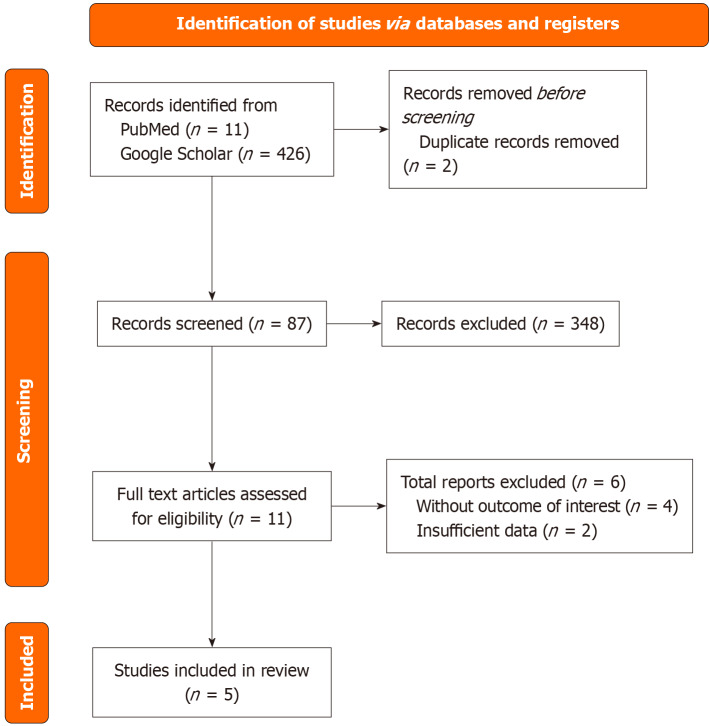
Results: Five studies involving a total of 1022 neonates were included, with a male-to-female ratio of approximately 57:40. The SMD for B/A ratio was 1.71 (95%CI: 1.00-2.41, P < 0.0001), and for TSB it was 1.68, both showing strong associations with BIND. Meta-regression revealed no significant difference in predictive value between the two biomarkers (P = 0.96).
Conclusion: Both TSB and the B/A ratio are comparably effective in predicting BIND. While the B/A ratio may provide incremental value in specific clinical contexts, current evidence supports continued reliance on TSB for routine risk stratification.



 求助内容:
求助内容: 应助结果提醒方式:

 京公网安备 11010802042870号


