Ivánia Furtado, Nuno Gião, Martim Urbano, João Boavida Ferreira
{"title":"Managing Advanced Fibrolamellar Carcinoma at Stage IV: A Case Report.","authors":"Ivánia Furtado, Nuno Gião, Martim Urbano, João Boavida Ferreira","doi":"10.1159/000550704","DOIUrl":null,"url":null,"abstract":"<p><strong>Introduction: </strong>Fibrolamellar carcinoma (FLC) is a rare primary liver malignancy that predominantly affects young individuals without underlying liver disease, distinguishing it from typical hepatocellular carcinoma. It is characterized by the <i>DNAJB1-PRKACA</i> fusion gene, which is believed to drive tumorigenesis. The diagnosis is often delayed due to nonspecific symptoms. Disease stage and resectability are the most significant prognostic factors. Surgery remains the only potentially curative option, but many patients present with unresectable or metastatic disease, for which there is no established standard treatment. For unresectable and metastatic disease, treatment decisions are largely empirical and based on case series.</p><p><strong>Case presentation: </strong>We report a case of a 29-year-old woman diagnosed with metastatic FLC who was treated with 6 cycles of gemcitabine + oxaliplatin, achieving stable disease for nearly 1 year. However, she subsequently experienced disease progression and rapidly declined, preventing the initiation of further systemic therapy.</p><p><strong>Discussion/conclusion: </strong>This case highlights the limitations of current systemic therapies and the urgent need for novel targeted treatments. Further research is essential to improve outcomes for patients with metastatic FLC.</p>","PeriodicalId":51838,"journal":{"name":"GE Portuguese Journal of Gastroenterology","volume":"33 1","pages":"377-383"},"PeriodicalIF":0.6000,"publicationDate":"2026-02-02","publicationTypes":"Journal Article","fieldsOfStudy":null,"isOpenAccess":false,"openAccessPdf":"https://www.ncbi.nlm.nih.gov/pmc/articles/PMC13008403/pdf/","citationCount":"0","resultStr":null,"platform":"Semanticscholar","paperid":null,"PeriodicalName":"GE Portuguese Journal of Gastroenterology","FirstCategoryId":"1085","ListUrlMain":"https://doi.org/10.1159/000550704","RegionNum":0,"RegionCategory":null,"ArticlePicture":[],"TitleCN":null,"AbstractTextCN":null,"PMCID":null,"EPubDate":"2026/1/1 0:00:00","PubModel":"eCollection","JCR":"Q4","JCRName":"GASTROENTEROLOGY & HEPATOLOGY","Score":null,"Total":0}
引用次数: 0
Abstract
Introduction: Fibrolamellar carcinoma (FLC) is a rare primary liver malignancy that predominantly affects young individuals without underlying liver disease, distinguishing it from typical hepatocellular carcinoma. It is characterized by the DNAJB1-PRKACA fusion gene, which is believed to drive tumorigenesis. The diagnosis is often delayed due to nonspecific symptoms. Disease stage and resectability are the most significant prognostic factors. Surgery remains the only potentially curative option, but many patients present with unresectable or metastatic disease, for which there is no established standard treatment. For unresectable and metastatic disease, treatment decisions are largely empirical and based on case series.
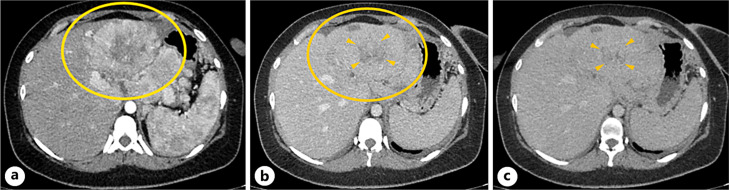
Case presentation: We report a case of a 29-year-old woman diagnosed with metastatic FLC who was treated with 6 cycles of gemcitabine + oxaliplatin, achieving stable disease for nearly 1 year. However, she subsequently experienced disease progression and rapidly declined, preventing the initiation of further systemic therapy.
Discussion/conclusion: This case highlights the limitations of current systemic therapies and the urgent need for novel targeted treatments. Further research is essential to improve outcomes for patients with metastatic FLC.
期刊介绍:
The ''GE Portuguese Journal of Gastroenterology'' (formerly Jornal Português de Gastrenterologia), founded in 1994, is the official publication of Sociedade Portuguesa de Gastrenterologia (Portuguese Society of Gastroenterology), Sociedade Portuguesa de Endoscopia Digestiva (Portuguese Society of Digestive Endoscopy) and Associação Portuguesa para o Estudo do Fígado (Portuguese Association for the Study of the Liver). The journal publishes clinical and basic research articles on Gastroenterology, Digestive Endoscopy, Hepatology and related topics. Review articles, clinical case studies, images, letters to the editor and other articles such as recommendations or papers on gastroenterology clinical practice are also considered. Only articles written in English are accepted.




 求助内容:
求助内容: 应助结果提醒方式:

 京公网安备 11010802042870号


