Federica Mosti, Jing Liu, Katie Lam, Noah R Dillon, Samantha Skavicus, Victoria A Kapps, Ketrin Gjoni, Chia-Fang Lee, Emily N Glidewell, Nicholas S Heaton, Katherine S Pollard, Debra L Silver
{"title":"Species-specific chromatin architecture and neurogenesis mediated by a human enhancer.","authors":"Federica Mosti, Jing Liu, Katie Lam, Noah R Dillon, Samantha Skavicus, Victoria A Kapps, Ketrin Gjoni, Chia-Fang Lee, Emily N Glidewell, Nicholas S Heaton, Katherine S Pollard, Debra L Silver","doi":"10.1016/j.stem.2026.02.009","DOIUrl":null,"url":null,"abstract":"<p><p>Genomic modifications underlie the evolution of human brain features, including a larger neocortex. Human accelerated regions (HARs) are highly conserved loci containing human-specific variants, with ∼50% identified as neurodevelopmental enhancers. However, the neurodevelopmental functions of HARs and their mechanisms of gene regulation are largely unknown. We show that human (Homo sapiens [Hs]) HAR1984 promotes neurogenesis by influencing species-specific transcription and chromatin interactions. Hs-HAR1984 knockin chimpanzee (Pan troglodytes [Pt]) cortical organoids contain more progenitors and neurons, whereas Pt-HAR1984 knockin human cortical organoids exhibit the opposite phenotype. Hs-HAR1984 knockin mice have increased neurogenesis and a thicker cortex with focal folds. HAR1984 exhibits chromatin looping with its target genes, ETV5 and TRA2B, in human fetal brains, which is notably reduced in chimpanzee, macaque, and mouse neural cells. We show that human-specific HAR1984 promotes these interactions and that human-specific ETS variant transcription factor 5 (ETV5) binding auto-regulates enhancer activity. Our study demonstrates molecular mechanisms underlying human-specific neurodevelopment, linking HARs to chromatin architecture, cortical fate, and expansion.</p>","PeriodicalId":93928,"journal":{"name":"Cell stem cell","volume":" ","pages":"695-714.e10"},"PeriodicalIF":20.4000,"publicationDate":"2026-04-02","publicationTypes":"Journal Article","fieldsOfStudy":null,"isOpenAccess":false,"openAccessPdf":"https://www.ncbi.nlm.nih.gov/pmc/articles/PMC13142994/pdf/","citationCount":"0","resultStr":null,"platform":"Semanticscholar","paperid":null,"PeriodicalName":"Cell stem cell","FirstCategoryId":"1085","ListUrlMain":"https://doi.org/10.1016/j.stem.2026.02.009","RegionNum":0,"RegionCategory":null,"ArticlePicture":[],"TitleCN":null,"AbstractTextCN":null,"PMCID":null,"EPubDate":"2026/3/19 0:00:00","PubModel":"Epub","JCR":"","JCRName":"","Score":null,"Total":0}
引用次数: 0
Abstract
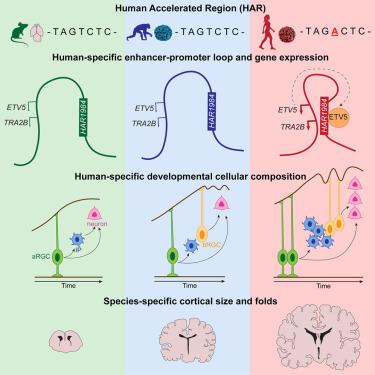
Genomic modifications underlie the evolution of human brain features, including a larger neocortex. Human accelerated regions (HARs) are highly conserved loci containing human-specific variants, with ∼50% identified as neurodevelopmental enhancers. However, the neurodevelopmental functions of HARs and their mechanisms of gene regulation are largely unknown. We show that human (Homo sapiens [Hs]) HAR1984 promotes neurogenesis by influencing species-specific transcription and chromatin interactions. Hs-HAR1984 knockin chimpanzee (Pan troglodytes [Pt]) cortical organoids contain more progenitors and neurons, whereas Pt-HAR1984 knockin human cortical organoids exhibit the opposite phenotype. Hs-HAR1984 knockin mice have increased neurogenesis and a thicker cortex with focal folds. HAR1984 exhibits chromatin looping with its target genes, ETV5 and TRA2B, in human fetal brains, which is notably reduced in chimpanzee, macaque, and mouse neural cells. We show that human-specific HAR1984 promotes these interactions and that human-specific ETS variant transcription factor 5 (ETV5) binding auto-regulates enhancer activity. Our study demonstrates molecular mechanisms underlying human-specific neurodevelopment, linking HARs to chromatin architecture, cortical fate, and expansion.


 求助内容:
求助内容: 应助结果提醒方式:

 京公网安备 11010802042870号


