Liah McElligott, Caitriona Cahir, Diane M Gillan, Norman Delanty, Susan Byrne, Noel Gerry McElvaney, Eavan McGovern
{"title":"Education Research: Validity and Reliability of the Neurophobia-Combined Measure (NCM) in Irish Medical Students.","authors":"Liah McElligott, Caitriona Cahir, Diane M Gillan, Norman Delanty, Susan Byrne, Noel Gerry McElvaney, Eavan McGovern","doi":"10.1212/NE9.0000000000200291","DOIUrl":null,"url":null,"abstract":"<p><strong>Background and objectives: </strong>Neurophobia, defined as a fear of neurology and the neurosciences, is a recognized barrier in medical education and clinical practice. It affects one-third of medical students internationally, yet measurement approaches remain inconsistent. This study aimed to validate the Neurophobia-Combined Measure (NCM), a psychometric tool for assessing neurophobia in medical students.</p><p><strong>Methods: </strong>NCM items were developed from literature, expert input, and existing measures of interest, confidence, and anxiety. Final-year medical students at the Royal College of Surgeons in Ireland completed the NCM alongside the Test Anxiety Inventory (TAI-5), State-Trait Anxiety Inventory (STAIT-5), and a summative Multiple Choice Questionnaire Examination (MCQE). Exploratory and confirmatory factor analyses were conducted to evaluate dimensionality. Model fit was assessed using structural equation modeling indices. Internal consistency was estimated with Cronbach alpha and McDonald omega. Criterion, convergent and discriminant validity were assessed via correlations with MCQE, TAI-5, and STAIT-5. Receiver operating characteristic (ROC) analysis tested diagnostic accuracy, and invariance was explored across sex and academic entry status.</p><p><strong>Results: </strong>A total of 311 students (mean age = 24 years, SD = 3; 64% female; 70% undergraduate-entry) completed all measures. Exploratory factor analysis supported a 2-factor structure reflecting (1) perceived neurology difficulty/complexity and (2) confidence/interest. The 2-factor model demonstrated good fit, χ<sup>2</sup> (26) = 75.77, <i>p</i> < 0.001, Root Mean Square Error of Approximation = 0.079, 90% CI [0.058, 0.099], CFI = 0.93, Tucker-Lewis Index = 0.90, and Standardized Root Mean Square Residual = 0.053. Internal consistency was acceptable (Cronbach α = 0.80; McDonald ω = 0.81). Item Response Theory model comparisons further supported the 2-factor structure, with separate NeuroQ and Schön models showing better fit than a combined unidimensional model. Receiver operating characteristic analysis indicated strong accuracy (area under the ROC curve = 0.96). Overall, 60% of students were classified as neurophobic, with higher prevalence among female (69%) and undergraduate-entry (65%) students. Neurophobia correlated positively with trait anxiety (ρ = 0.16, <i>p</i> = 0.004, 95% CI [0.06-0.27]) and test anxiety (ρ = 0.11, <i>p</i> = 0.047, 95% CI [0.00-0.23]). Both neurophobia (ρ = -0.12, <i>p</i> = 0.041, 95% CI [-0.23 to 0.00]) and test anxiety (ρ = -0.19, <i>p</i> = 0.001, 95% CI [-0.30 to -0.08]) were negatively associated with MCQE performance.</p><p><strong>Discussion: </strong>The NCM demonstrates good reliability and validity and reflects 2 related but distinct dimensions of neurophobia. Future research should examine its applicability across institutions and educational levels.</p>","PeriodicalId":520085,"journal":{"name":"Neurology. Education","volume":"5 1","pages":"e200291"},"PeriodicalIF":0.0000,"publicationDate":"2026-03-17","publicationTypes":"Journal Article","fieldsOfStudy":null,"isOpenAccess":false,"openAccessPdf":"https://www.ncbi.nlm.nih.gov/pmc/articles/PMC12999273/pdf/","citationCount":"0","resultStr":null,"platform":"Semanticscholar","paperid":null,"PeriodicalName":"Neurology. Education","FirstCategoryId":"1085","ListUrlMain":"https://doi.org/10.1212/NE9.0000000000200291","RegionNum":0,"RegionCategory":null,"ArticlePicture":[],"TitleCN":null,"AbstractTextCN":null,"PMCID":null,"EPubDate":"2026/3/1 0:00:00","PubModel":"eCollection","JCR":"","JCRName":"","Score":null,"Total":0}
引用次数: 0
Abstract
Background and objectives: Neurophobia, defined as a fear of neurology and the neurosciences, is a recognized barrier in medical education and clinical practice. It affects one-third of medical students internationally, yet measurement approaches remain inconsistent. This study aimed to validate the Neurophobia-Combined Measure (NCM), a psychometric tool for assessing neurophobia in medical students.
Methods: NCM items were developed from literature, expert input, and existing measures of interest, confidence, and anxiety. Final-year medical students at the Royal College of Surgeons in Ireland completed the NCM alongside the Test Anxiety Inventory (TAI-5), State-Trait Anxiety Inventory (STAIT-5), and a summative Multiple Choice Questionnaire Examination (MCQE). Exploratory and confirmatory factor analyses were conducted to evaluate dimensionality. Model fit was assessed using structural equation modeling indices. Internal consistency was estimated with Cronbach alpha and McDonald omega. Criterion, convergent and discriminant validity were assessed via correlations with MCQE, TAI-5, and STAIT-5. Receiver operating characteristic (ROC) analysis tested diagnostic accuracy, and invariance was explored across sex and academic entry status.
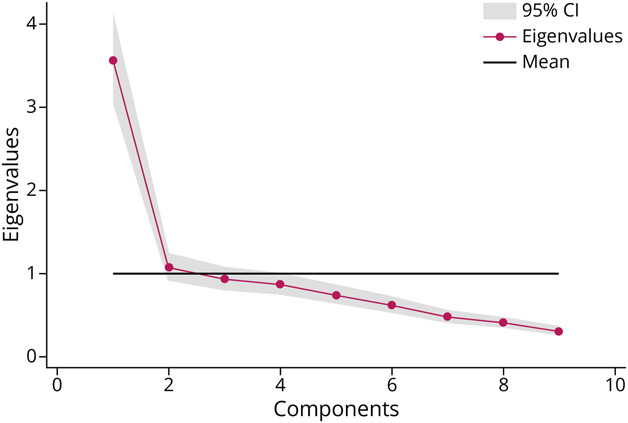
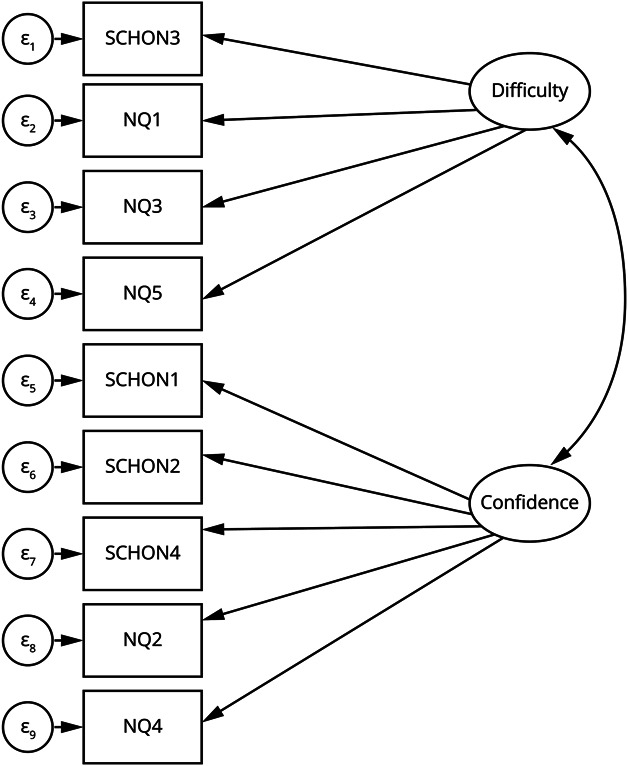
Results: A total of 311 students (mean age = 24 years, SD = 3; 64% female; 70% undergraduate-entry) completed all measures. Exploratory factor analysis supported a 2-factor structure reflecting (1) perceived neurology difficulty/complexity and (2) confidence/interest. The 2-factor model demonstrated good fit, χ2 (26) = 75.77, p < 0.001, Root Mean Square Error of Approximation = 0.079, 90% CI [0.058, 0.099], CFI = 0.93, Tucker-Lewis Index = 0.90, and Standardized Root Mean Square Residual = 0.053. Internal consistency was acceptable (Cronbach α = 0.80; McDonald ω = 0.81). Item Response Theory model comparisons further supported the 2-factor structure, with separate NeuroQ and Schön models showing better fit than a combined unidimensional model. Receiver operating characteristic analysis indicated strong accuracy (area under the ROC curve = 0.96). Overall, 60% of students were classified as neurophobic, with higher prevalence among female (69%) and undergraduate-entry (65%) students. Neurophobia correlated positively with trait anxiety (ρ = 0.16, p = 0.004, 95% CI [0.06-0.27]) and test anxiety (ρ = 0.11, p = 0.047, 95% CI [0.00-0.23]). Both neurophobia (ρ = -0.12, p = 0.041, 95% CI [-0.23 to 0.00]) and test anxiety (ρ = -0.19, p = 0.001, 95% CI [-0.30 to -0.08]) were negatively associated with MCQE performance.
Discussion: The NCM demonstrates good reliability and validity and reflects 2 related but distinct dimensions of neurophobia. Future research should examine its applicability across institutions and educational levels.



 求助内容:
求助内容: 应助结果提醒方式:

 京公网安备 11010802042870号


