{"title":"Association Between Bleeding Severity and Quality of Life in Adults with Immune Thrombocytopenia.","authors":"Marvelous Popoola, Sharmeen Malik, Kaushalendra Mani Tripathi, Ashok Kumar, Irem Karatas, Muhammad Muneeb Khan, Basil Khalil, Shough Alharata, Farah Saleh, Sidra Hariss, Majd Aldin Oudeh, Hiba Manaf, Khuzami Moaied Rashad Odeh","doi":"10.14789/ejmj.JMJ25-0055-OA","DOIUrl":null,"url":null,"abstract":"<p><strong>Objectives: </strong>Immune thrombocytopenia (ITP) is a disorder that is characterised by a low count of platelets and an increased risk of bleeding. It can cause symptoms which affect normal functioning and well-being. The study has discussed how bleeding severity is linked to the quality of life (QOL) of ITP patients in adulthood.</p><p><strong>Materials and methods: </strong>A cross-sectional study was done to examine 300 patients with primary ITP admitted to tertiary care hospitals. Bleeding severity was measured with the help of the International Society on Thrombosis and Haemostasis Bleeding Assessment Tool (ISTH-BAT), and HRQoL was measured with the help of the WHOQOL-BREF. The data were analysed using Pearson's correlation, t-tests, ANOVA, and multiple linear regression.</p><p><strong>Results: </strong>Most participants (92.7%) were female, with a mean age of 49.8. Overall, HRQoL showed a significant negative correlation with bleeding severity (r = -0.42, p < 0.001). Women had higher bleeding scores (p < 0.001) and lower HRQoL scores (p = 0.017) than men. Worse bleeding and lower HRQoL were linked to older age (p < 0.001). Regression analysis revealed bleeding severity (β = -0.32, p = 0.001), female gender, old age, prolonged disease duration, frequent bleeding episodes, hospitalisation, and comorbidity as significant predictors of worse HRQoL.</p><p><strong>Conclusion: </strong>Adults with ITP have a worse quality of life in relation to greater bleeding severity. The holistic treatment that is concerned not only with the physical condition, but also with the emotional needs can contribute to the general welfare.</p>","PeriodicalId":520470,"journal":{"name":"Juntendo medical journal","volume":"72 1","pages":"127-133"},"PeriodicalIF":0.0000,"publicationDate":"2026-02-10","publicationTypes":"Journal Article","fieldsOfStudy":null,"isOpenAccess":false,"openAccessPdf":"https://www.ncbi.nlm.nih.gov/pmc/articles/PMC12997340/pdf/","citationCount":"0","resultStr":null,"platform":"Semanticscholar","paperid":null,"PeriodicalName":"Juntendo medical journal","FirstCategoryId":"1085","ListUrlMain":"https://doi.org/10.14789/ejmj.JMJ25-0055-OA","RegionNum":0,"RegionCategory":null,"ArticlePicture":[],"TitleCN":null,"AbstractTextCN":null,"PMCID":null,"EPubDate":"2026/1/1 0:00:00","PubModel":"eCollection","JCR":"","JCRName":"","Score":null,"Total":0}
引用次数: 0
Abstract
Objectives: Immune thrombocytopenia (ITP) is a disorder that is characterised by a low count of platelets and an increased risk of bleeding. It can cause symptoms which affect normal functioning and well-being. The study has discussed how bleeding severity is linked to the quality of life (QOL) of ITP patients in adulthood.
Materials and methods: A cross-sectional study was done to examine 300 patients with primary ITP admitted to tertiary care hospitals. Bleeding severity was measured with the help of the International Society on Thrombosis and Haemostasis Bleeding Assessment Tool (ISTH-BAT), and HRQoL was measured with the help of the WHOQOL-BREF. The data were analysed using Pearson's correlation, t-tests, ANOVA, and multiple linear regression.
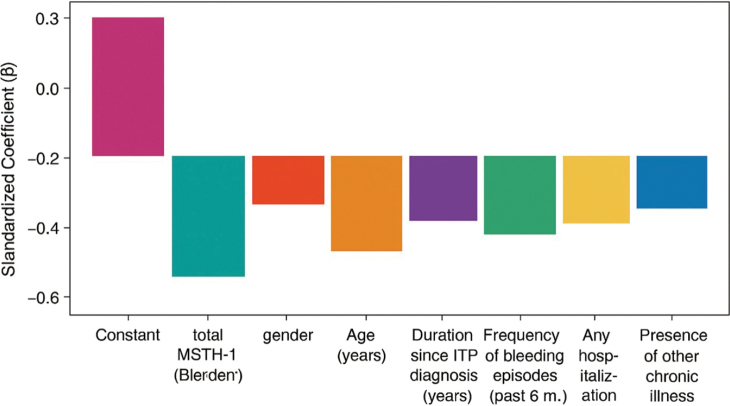
Results: Most participants (92.7%) were female, with a mean age of 49.8. Overall, HRQoL showed a significant negative correlation with bleeding severity (r = -0.42, p < 0.001). Women had higher bleeding scores (p < 0.001) and lower HRQoL scores (p = 0.017) than men. Worse bleeding and lower HRQoL were linked to older age (p < 0.001). Regression analysis revealed bleeding severity (β = -0.32, p = 0.001), female gender, old age, prolonged disease duration, frequent bleeding episodes, hospitalisation, and comorbidity as significant predictors of worse HRQoL.
Conclusion: Adults with ITP have a worse quality of life in relation to greater bleeding severity. The holistic treatment that is concerned not only with the physical condition, but also with the emotional needs can contribute to the general welfare.


 求助内容:
求助内容: 应助结果提醒方式:

 京公网安备 11010802042870号


