Lea A Tamberg, Vivien Fisch-Romito, Julia K Steinberger
{"title":"Determinants of Well-Being: A Causal Framework.","authors":"Lea A Tamberg, Vivien Fisch-Romito, Julia K Steinberger","doi":"10.1007/s11205-026-03816-w","DOIUrl":null,"url":null,"abstract":"<p><p>Different philosophical strands have developed distinct well-being conceptions, which are nevertheless strongly linked. For instance, many typical well-being components in eudaimonic philosophies correlate with subjective life assessment measures. Existing empirical research also provides many insights into which factors determine human well-being, such as health and the quality of relationships. However, the causal ordering of these factors is often not explicitly considered, although doing so would be crucial for the identification of intervention points and a correct estimation of effect sizes in empirical studies. In response to these two observations, we propose a unified causal framework of the main pathways determining human well-being in its different conceptions, with a focus on those prominent in sustainability research and the subjective well-being community. The framework considers environmental, economic, societal, political, social, and psychological factors and shows how they interact. It combines insights from theories of human needs, the capabilities approach, and research on subjective indicators. We illustrate the use of the framework with examples of societal interventions on well-being, environmental impacts, and sustainable well-being policies.</p>","PeriodicalId":21943,"journal":{"name":"Social Indicators Research","volume":"182 2","pages":"23"},"PeriodicalIF":3.2000,"publicationDate":"2026-01-01","publicationTypes":"Journal Article","fieldsOfStudy":null,"isOpenAccess":false,"openAccessPdf":"https://www.ncbi.nlm.nih.gov/pmc/articles/PMC12995919/pdf/","citationCount":"0","resultStr":null,"platform":"Semanticscholar","paperid":null,"PeriodicalName":"Social Indicators Research","FirstCategoryId":"90","ListUrlMain":"https://doi.org/10.1007/s11205-026-03816-w","RegionNum":2,"RegionCategory":"社会学","ArticlePicture":[],"TitleCN":null,"AbstractTextCN":null,"PMCID":null,"EPubDate":"2026/3/17 0:00:00","PubModel":"Epub","JCR":"Q1","JCRName":"SOCIAL SCIENCES, INTERDISCIPLINARY","Score":null,"Total":0}
引用次数: 0
Abstract
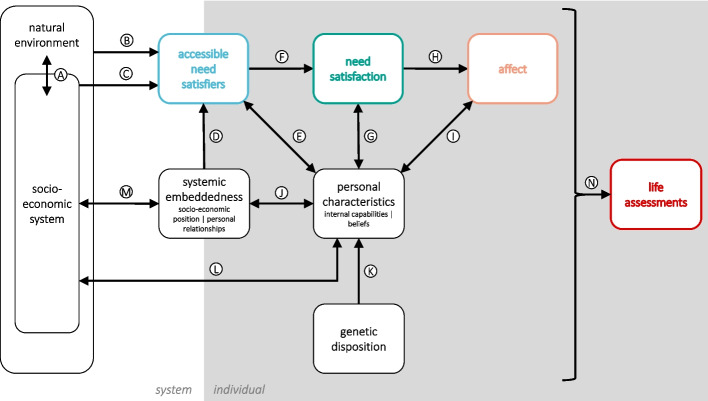
Different philosophical strands have developed distinct well-being conceptions, which are nevertheless strongly linked. For instance, many typical well-being components in eudaimonic philosophies correlate with subjective life assessment measures. Existing empirical research also provides many insights into which factors determine human well-being, such as health and the quality of relationships. However, the causal ordering of these factors is often not explicitly considered, although doing so would be crucial for the identification of intervention points and a correct estimation of effect sizes in empirical studies. In response to these two observations, we propose a unified causal framework of the main pathways determining human well-being in its different conceptions, with a focus on those prominent in sustainability research and the subjective well-being community. The framework considers environmental, economic, societal, political, social, and psychological factors and shows how they interact. It combines insights from theories of human needs, the capabilities approach, and research on subjective indicators. We illustrate the use of the framework with examples of societal interventions on well-being, environmental impacts, and sustainable well-being policies.
期刊介绍:
Since its foundation in 1974, Social Indicators Research has become the leading journal on problems related to the measurement of all aspects of the quality of life. The journal continues to publish results of research on all aspects of the quality of life and includes studies that reflect developments in the field. It devotes special attention to studies on such topics as sustainability of quality of life, sustainable development, and the relationship between quality of life and sustainability. The topics represented in the journal cover and involve a variety of segmentations, such as social groups, spatial and temporal coordinates, population composition, and life domains. The journal presents empirical, philosophical and methodological studies that cover the entire spectrum of society and are devoted to giving evidences through indicators. It considers indicators in their different typologies, and gives special attention to indicators that are able to meet the need of understanding social realities and phenomena that are increasingly more complex, interrelated, interacted and dynamical. In addition, it presents studies aimed at defining new approaches in constructing indicators.

 求助内容:
求助内容: 应助结果提醒方式:

 京公网安备 11010802042870号


