{"title":"Pathological risk stratification after endoscopic resection of T1 colorectal cancer: a comparative analysis of international guidelines.","authors":"Hyun Tae Lim, Dae Kyung Sohn","doi":"10.7602/jmis.2026.29.1.31","DOIUrl":null,"url":null,"abstract":"<p><strong>Purpose: </strong>Incidence of T1 colorectal cancer (CRC) has steadily increased. Although endoscopic resection is curative for many patients, lymph node metastasis (LNM) remains problematic, often prompting additional colectomy after endoscopic therapy. This study aimed to comparatively analyze major international guidelines for post-resection management of T1 CRC, summarize evidence supporting the key pathological risk factors for LNM, and examine the effect of divergent definitions and thresholds on variations in clinical decision-making.</p><p><strong>Methods: </strong>Within North America, Europe, and East Asia, current and comprehensive guidelines issued by internationally recognized professional societies for CRC management were included in the analysis. Each guideline was reviewed for its issuing organization, target population, scope, evidence methodology, consensus process, and update frequency. Our evaluation assessed how each guideline addressed individual pathological risk factors associated with LNM, specifically focusing on five key shared features.</p><p><strong>Results: </strong>Five pathological features were consistently recognized as increasing LNM risk: lymphovascular invasion, poor histological differentiation, deep submucosal invasion, tumor budding, and positive or indeterminate resection margins. Overall, although the guidelines shared the core pathological risk factors, their relative weights differed. Eastern guidelines were found to favor surgery based on a single adverse feature, whereas Western approaches prioritize cumulative risk and patient-specific factors.</p><p><strong>Conclusion: </strong>By highlighting areas of consensus and controversy, this comparative analysis underscores the limitations of binary risk stratification and the resulting burden of overtreatment; it also discusses emerging strategies to support more precise, individualized management of T1 CRC.</p>","PeriodicalId":73832,"journal":{"name":"Journal of minimally invasive surgery","volume":"29 1","pages":"31-39"},"PeriodicalIF":0.0000,"publicationDate":"2026-03-15","publicationTypes":"Journal Article","fieldsOfStudy":null,"isOpenAccess":false,"openAccessPdf":"https://www.ncbi.nlm.nih.gov/pmc/articles/PMC13006761/pdf/","citationCount":"0","resultStr":null,"platform":"Semanticscholar","paperid":null,"PeriodicalName":"Journal of minimally invasive surgery","FirstCategoryId":"1085","ListUrlMain":"https://doi.org/10.7602/jmis.2026.29.1.31","RegionNum":0,"RegionCategory":null,"ArticlePicture":[],"TitleCN":null,"AbstractTextCN":null,"PMCID":null,"EPubDate":"","PubModel":"","JCR":"","JCRName":"","Score":null,"Total":0}
引用次数: 0
Abstract
Purpose: Incidence of T1 colorectal cancer (CRC) has steadily increased. Although endoscopic resection is curative for many patients, lymph node metastasis (LNM) remains problematic, often prompting additional colectomy after endoscopic therapy. This study aimed to comparatively analyze major international guidelines for post-resection management of T1 CRC, summarize evidence supporting the key pathological risk factors for LNM, and examine the effect of divergent definitions and thresholds on variations in clinical decision-making.
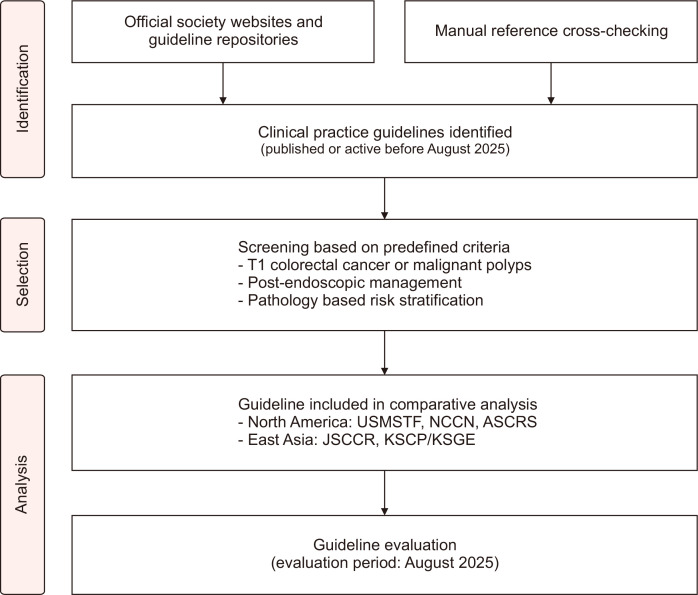
Methods: Within North America, Europe, and East Asia, current and comprehensive guidelines issued by internationally recognized professional societies for CRC management were included in the analysis. Each guideline was reviewed for its issuing organization, target population, scope, evidence methodology, consensus process, and update frequency. Our evaluation assessed how each guideline addressed individual pathological risk factors associated with LNM, specifically focusing on five key shared features.
Results: Five pathological features were consistently recognized as increasing LNM risk: lymphovascular invasion, poor histological differentiation, deep submucosal invasion, tumor budding, and positive or indeterminate resection margins. Overall, although the guidelines shared the core pathological risk factors, their relative weights differed. Eastern guidelines were found to favor surgery based on a single adverse feature, whereas Western approaches prioritize cumulative risk and patient-specific factors.
Conclusion: By highlighting areas of consensus and controversy, this comparative analysis underscores the limitations of binary risk stratification and the resulting burden of overtreatment; it also discusses emerging strategies to support more precise, individualized management of T1 CRC.


 求助内容:
求助内容: 应助结果提醒方式:

 京公网安备 11010802042870号


